
Does Insurance Cover Water Damage? Phoenix Answers, Peril by Peril
Published August 7, 2026 · Last reviewed August 21, 2026 · Water Fighters Restoration
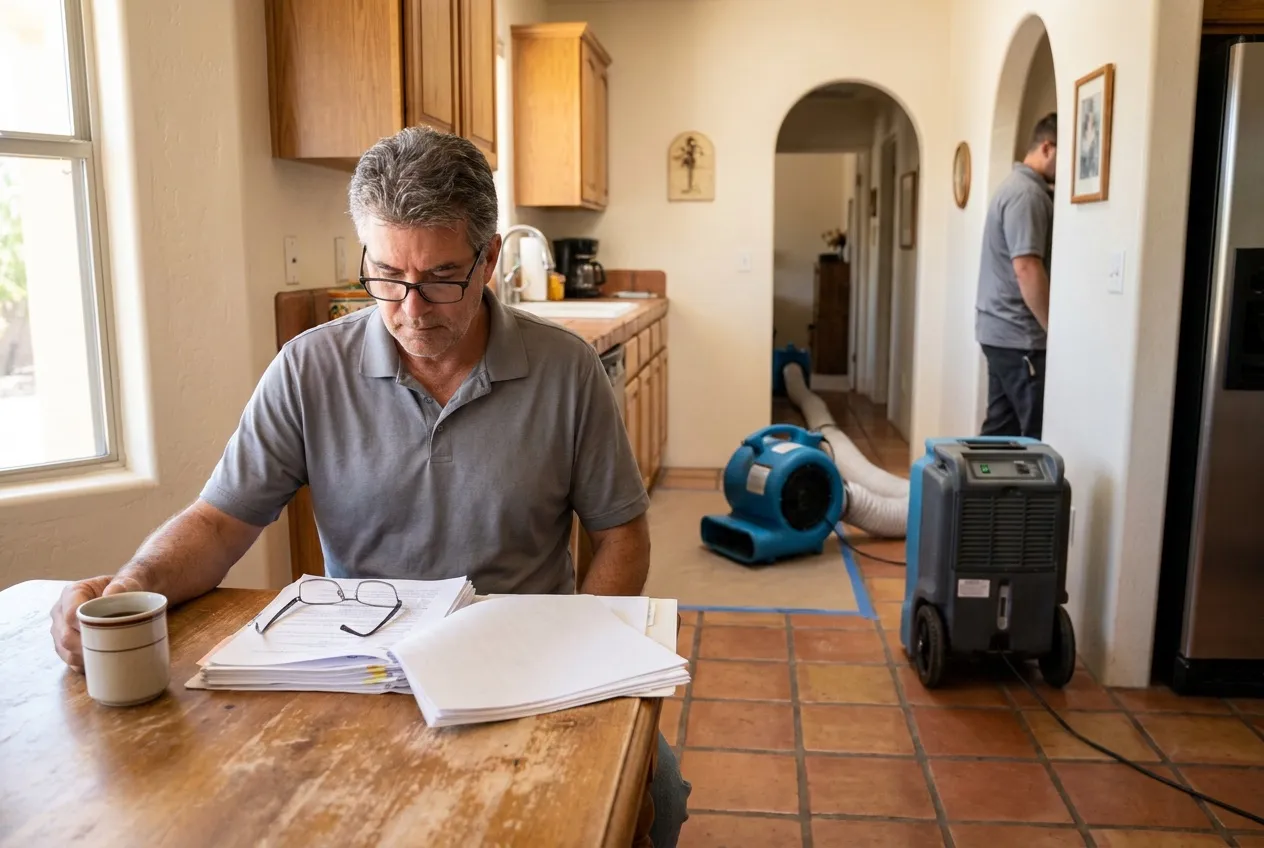
The honest answer to the headline is "usually, if it was sudden — and the details decide everything." This page walks the perils one at a time: the pipe versus the damage, AC leaks, mold caps, the tub you forgot, condo walls, and the flood-zone question. Ground rules first: policies differ, your declarations page and your agent outrank anything written here, and we're restoration contractors, not insurance professionals. What we bring is pattern knowledge from documenting hundreds of Valley claims a year — which perils pay routinely, which get argued, and what evidence settles the arguments.
Does insurance cover the broken pipe itself, or only the water damage it caused?
Usually only the damage. The pipe, valve, or supply line that failed is treated as wear and tear — your cost. Everything the escaping water ruined — drywall, flooring, cabinets — is the covered loss. And the cost of tearing out and repairing what's in the way of reaching the pipe is commonly covered too.
That three-part split surprises people, so it's worth holding onto: failed component yours, resulting damage theirs, access to the failure commonly theirs. In a Phoenix slab home the access piece matters most — reaching a line under tile over slab can mean demolition that dwarfs the plumber's bill, and "reasonable cost to access" language is what picks that up. Where this axis gets argued is not the pipe-versus-damage line; it's suddenness, which is a different question with its own answer on this site. What settles the access and damage lines is the usual currency: the plumber's cause-of-loss note, our moisture map showing what the water reached, and photos before anything came out.
So don't fight for the fitting — it's a hardware-store number. Spend the documentation where the money is: the resulting damage and the access scope.
Will insurance cover water damage from an AC leak?
Often yes, when the failure was sudden — a condensate line that backed up and overflowed, a drain pan that cracked and let go. What's routinely excluded: the AC repair itself, and damage from a slow drip that ran long enough to read as deferred maintenance. Suddenness and duration decide it.
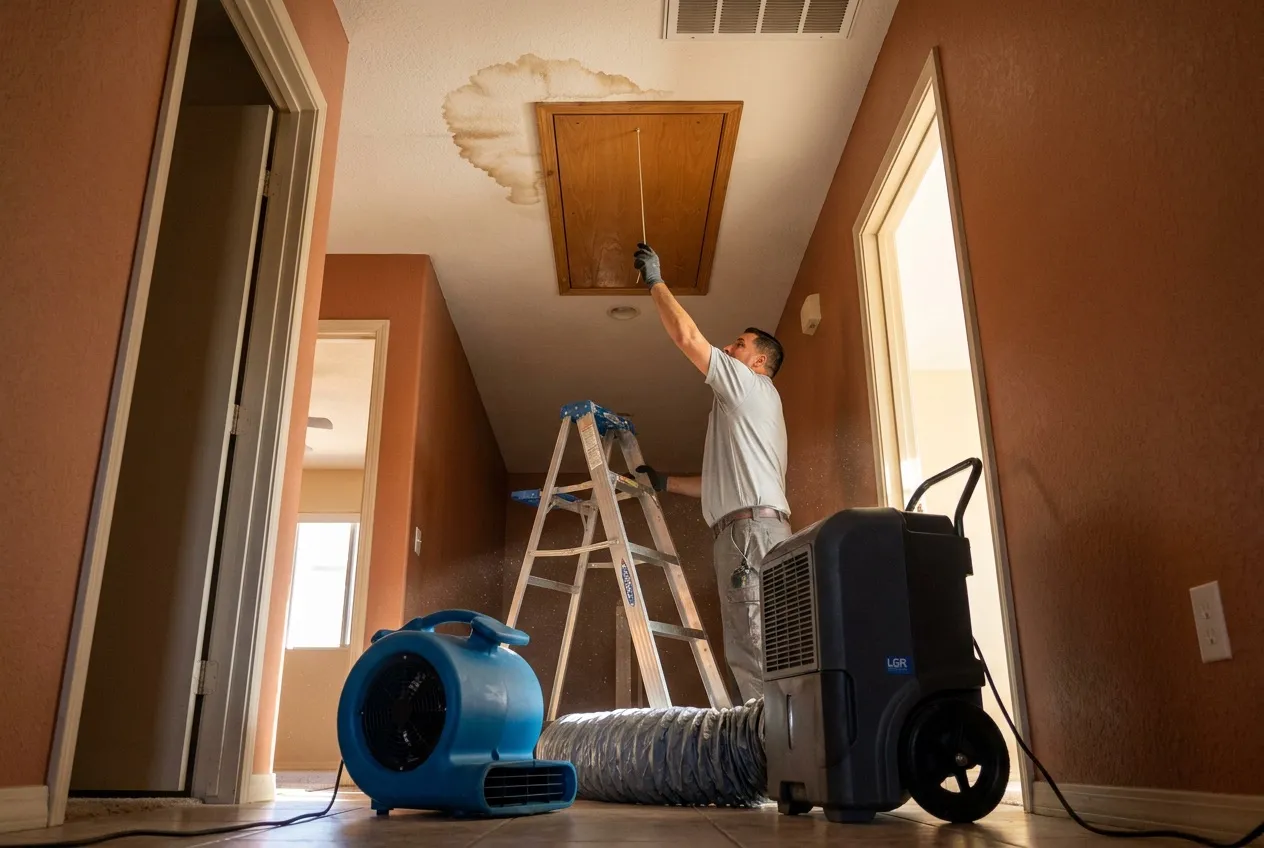
This is Phoenix's signature summer claim. Condensate systems move gallons a day in cooling season, the lines scale up and clog, and the overflow arrives through a hallway ceiling in June with no storm in sight. The coverage conversation runs on two questions: what failed (the sudden overflow reads as accidental discharge; the fitting that seeped all spring reads as neglect) and how fast you acted once water showed. Two habits protect both answers — the annual condensate flush your HVAC company sells cheap, and a same-week response to any ceiling stain, because a stain photographed and metered early is evidence of promptness, while one painted over is evidence of the opposite.
If the ceiling is stained right now, the claim question is second. Wet blown-in attic insulation doesn't dry in place, and the 24-to-48-hour clock doesn't wait for an adjuster's callback.
Does home insurance cover mold caused by water damage?
Sometimes — and less than people expect. The common shape: mold that resulted from a covered, promptly handled water loss is covered, but capped at a sublimit well below what remediation can run. Mold from long-term moisture, humidity, or a leak nobody addressed is typically excluded outright.
The sublimit is the detail to find tonight: it lives on your declarations page or in a mold endorsement, and it caps everything mold-related — testing, containment, removal, sometimes the associated tear-out — regardless of what the remediation actually requires. Arizona policies carry these caps as standard practice, and some offer higher limits by endorsement for a small premium, which is the rare insurance upgrade we'd call obviously worth asking about. The coverage logic underneath is consistent with everything else on this page: carriers pay for what a sudden event caused, not for what time and inattention grew. Which makes speed the whole game twice over — fast drying prevents the mold, and a documented fast response is what keeps any mold that started anyway inside the covered story.
Eleven mold questions elsewhere on this site cover the substance itself. The coverage version compresses to one line: dry fast, document the dates, and know your cap before you need it.
Does insurance cover water damage if it was my fault, like leaving the tub running?
Generally yes. Homeowner policies cover sudden, accidental discharge of water, and "accidental" includes your own ordinary carelessness — the overflowing tub, the washing machine started before a weekend away. What's excluded is intent and gross neglect: damage done on purpose, or a known leak ignored for months.
The legal spine here is that insurance exists for negligence — your own mistakes are precisely the risk you're paying to transfer. So don't pre-deny your own claim out of embarrassment; adjusters process forgotten-tub losses every week, and honesty about the sequence reads far better in a file than a vague story. Where self-caused claims actually go wrong: the duration question (the tub that ran an hour is sudden; the toilet supply line you knew wept since spring is not) and the mitigation duty (leaving the water in place over a long weekend converts a covered accident into an argued one). Report it straight, act fast, and let the timestamps carry it.
The one version worth a phone call before filing: small losses near your deductible, where the claims-history cost can outweigh the payout — the FAQ below on non-renewal covers that math.
Is the HOA responsible for water damage to my condo?
It depends on where the water landed and what your CC&Rs say. The association's master policy typically covers the building's structure and common elements; your own HO-6 policy covers your unit's interior — and where the line sits ("walls-in," "studs-out," or original-specification) is defined in your association's documents, not by intuition.
Reading your CC&Rs' insurance section is the whole assignment, because the three regimes produce very different claims. Under a studs-out master policy, your HO-6 carries the drywall inward — flooring, cabinets, paint, your betterments. Under all-in arrangements, the master policy reaches further into the unit and your HO-6 covers belongings and improvements. Two coverages condo owners routinely discover they needed: loss assessment coverage, which pays your share when the association levies unit owners after a big master-policy claim, and adequate HO-6 dwelling coverage matched to the actual CC&R line. When a loss crosses units or touches common elements, expect two or three carriers in one conversation — which is exactly why our documentation names origin and water path precisely, so the policies can sort payment from evidence.
Before any of that: report to both the association's management and your own carrier the same day. Dueling notifications beat dueling denials.
Do I need flood insurance in Phoenix if I'm not in a flood zone?
It's worth pricing, because the coverage gap is absolute: homeowner policies exclude rising surface water, period — and that exclusion doesn't check FEMA's maps. Outside high-risk zones, flood coverage through the federal program or private carriers is typically inexpensive. A monsoon cell parked over your neighborhood doesn't read zone designations.
The distinction to keep clean: rain driven through a storm-damaged roof or window is a homeowner-policy conversation covered elsewhere on this site. Water rising from the ground — the street that became a river, the wash that jumped its banks, sheet flow off the desert crossing your threshold — is flood, and only flood insurance touches it. Much of the Valley sits in low-risk mapped zones where lenders don't require the coverage, which is exactly where a large share of flood claims nationally come from, because "low risk" priced the policy cheap and convinced everyone to skip it. Two practical notes: federal flood policies carry a roughly 30-day waiting period, so June is late to start thinking about August, and coverage for contents is a separate election from the structure.
Price it in the spring with your agent. It's one of the few insurance decisions where the Phoenix-specific answer is genuinely different from the national default.
Common Questions
Can my insurance drop me or refuse to renew after a water damage claim?
Mid-term cancellation is tightly restricted — absent fraud or nonpayment, carriers generally can't drop you because you used the policy. Non-renewal at term is the real mechanism: a carrier can decline to continue the policy, and claims history is a lawful reason in most circumstances.
The practical shape: one well-documented sudden loss rarely ends a relationship; frequency is what carriers price and prune, and two or three water claims inside a few years puts a file under review. That's the honest math behind the near-deductible question — a claim that nets little after your deductible still lands on your history. What helps if non-renewal comes: Arizona's market has plenty of carriers, an independent agent can re-shop the risk, and documentation showing the cause was fixed (the repipe, the new water heater) is underwriting gold. Ask your agent, not the internet, how your specific carrier treats first claims — agencies know their carriers' appetites.
What is a CLUE report and how long does a water claim stay on it?
CLUE is the industry's shared claims database — the Comprehensive Loss Underwriting Exchange, run by LexisNexis. When you file, the claim is reported there, and carriers pull the report when pricing new policies. Claims typically remain visible for five to seven years.
Three facts worth having: you're entitled to a free copy of your own report annually from LexisNexis, and it's worth pulling before you shop coverage — errors happen and can be disputed. The report follows the property as well as the person, which is why buyers' agents sometimes request a seller's CLUE history on a home. And inquiries that never became paid claims are handled differently than paid losses, which is one more reason the call-the-agent-first conversation on near-deductible damage has real value. None of this should scare anyone off legitimate claims — it's simply the memory the pricing system keeps, and knowing it exists beats discovering it at renewal.
Do home warranties cover water damage?
No — they cover the thing that failed, not what the failure did to your house. A home warranty is a service contract: it repairs or replaces the water heater, the AC, the dishwasher. The soaked drywall, flooring, and cabinets around the failure are your homeowner policy's territory.
The two products are complements, not competitors, and a Phoenix water loss often invokes both in one afternoon: the warranty dispatches a plumber for the failed heater while the homeowner policy covers the garage and hallway the fifty gallons reached. Where people get burned is the gap assumption in either direction — expecting the warranty to rebuild a kitchen, or expecting homeowners insurance to buy a new appliance. One caution from the claims we document: a warranty company's repair timeline doesn't pause your policy's mitigation duty, so never wait for a warranty technician's appointment before drying starts. The fixture can wait three days. The drywall can't.
If I'm renting, who pays for the water damage cleanup — me, my landlord, or the HOA?
Split it by what got damaged. The building — walls, flooring, fixtures — is the landlord's responsibility and their insurance's problem, with an association's master policy sometimes involved in condo rentals. Your belongings are yours, which is precisely what renter's insurance exists for, along with your hotel if the unit's unlivable.
From the tenant's seat, the sequence is: report the water to your landlord or manager in writing the day you find it, photograph your unit and your affected belongings, and call your own renter's carrier about contents and loss-of-use. Don't pay for structural drying out of pocket — that's the owner's side of the line — but don't obstruct access for it either, since fast mitigation protects your living situation as much as their building. If cleanup stalls and the unit's genuinely uninhabitable, Arizona's landlord-tenant framework gives you options, and that conversation belongs in writing. The one universally good move: renter's insurance before you need it — it's the cheapest policy in the entire insurance world and the difference between a bad week and a bad season.