
Burst Pipe Water Damage in Phoenix
Published August 4, 2026 · Last reviewed October 8, 2026 · Water Fighters Restoration
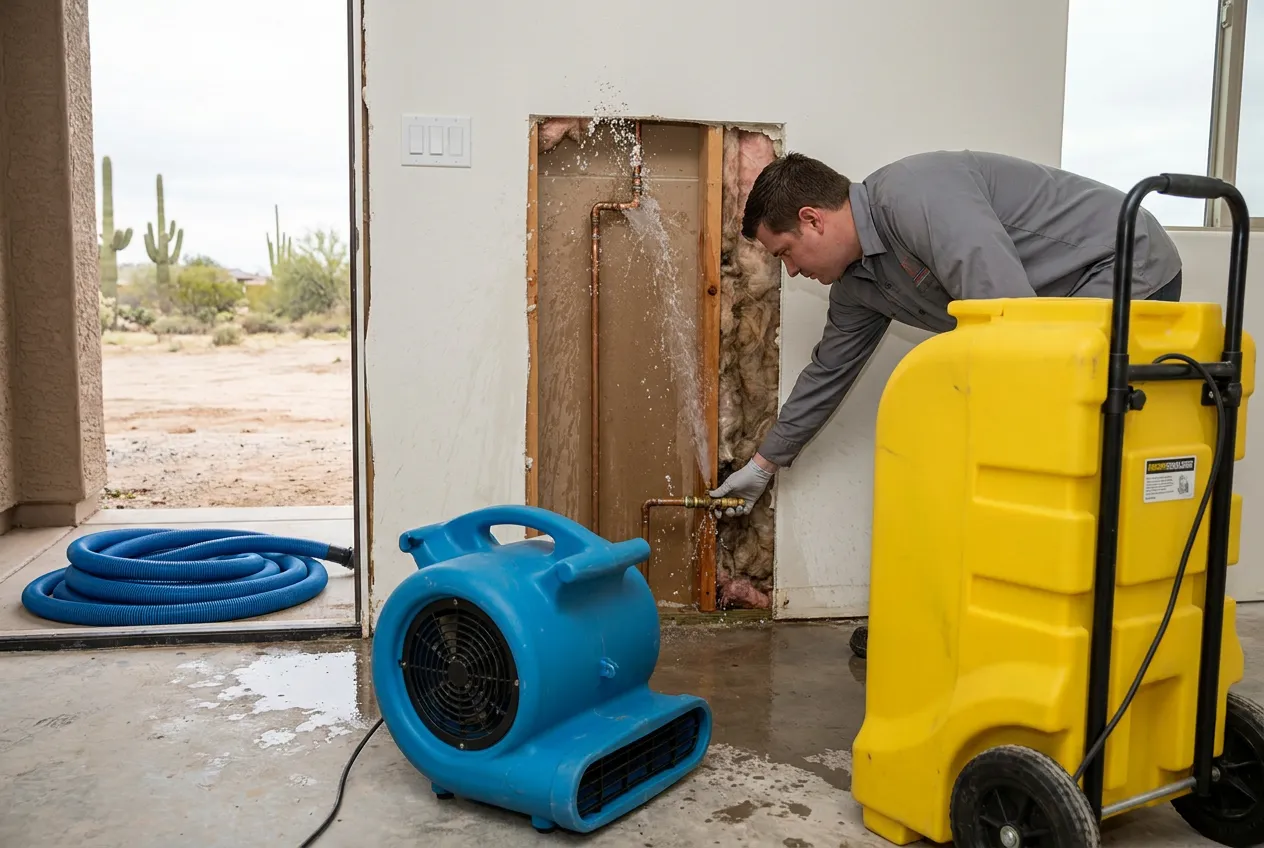
A half-inch supply line under pressure moves water faster than most people can bail with buckets — a burst that runs unattended for an hour can put several hundred gallons into the house. The response is a race with two legs: yours to the valve, ours to your door.
The Math of a Burst
What makes a burst different from a leak is rate. A pinhole weeps; a burst delivers. In the first minutes, water crosses the room and starts under the walls. Within the hour it's in the pad, the baseboards, and the bottom plates, and drywall has begun its inch-an-hour climb. A burst discovered at breakfast is a serious dry-out; a burst that ran overnight is usually flooring and lower-cabinet replacement in every room it reached. The entire outcome swings on how fast the water stops and how fast extraction starts — which is the whole reason the damage clock chapter leads our handbook.
The Shutoff Field Guide
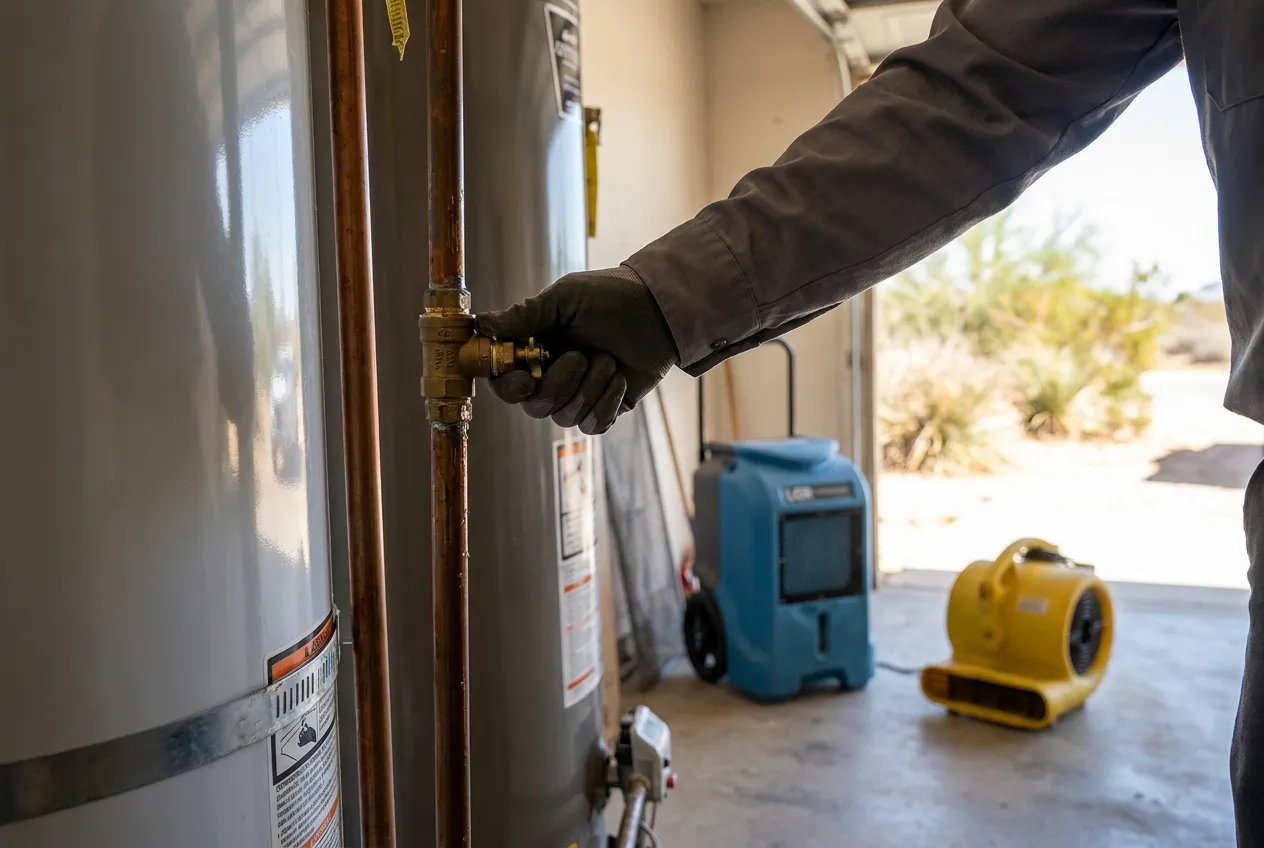
Two places to look, in order. The fixture valve — under the sink, behind the toilet, at the appliance — if the failure is visible and the valve turns. Then the main house shutoff, near where the line enters the home: usually the water heater area or a garage wall. Clockwise closes both. Leave the meter box at the curb alone. The meter belongs to the water provider, and the City of Phoenix tells customers not to turn water off at the meter themselves. If the house valve is stuck or crumbles in your hand — common on original hardware — call your water provider to shut it off at the meter (Phoenix Water's 24/7 line is 602-261-8000), and tell us when you call.
Do this once on a calm Saturday: find all three, turn the main off and on, and show everyone in the house. It's the cheapest insurance in this entire industry.
Why Phoenix Pipes Burst
Freezing gets the folklore, and it isn't zero here — a few hard nights a winter can split exposed hose bibs, attic runs, and uninsulated lines, and when a Valley-wide freeze hits, our phones prove it. But the everyday causes are quieter. Polybutylene supply pipe from the late-seventies-through-mid-nineties construction window turns brittle and lets go at fittings without warning. Original copper in older slab homes pinholes from the inside, and a pinhole under pressure becomes a rupture. Galvanized lines in the oldest neighborhoods corrode shut and then through. High municipal water pressure without a working regulator stresses everything equally, and the flexible connectors under sinks and behind washing machines — the humble braided lines — fail more often than any pipe in the house.
The pattern worth acting on: if your home's era matches one of those materials and you've had one failure, the system is introducing itself. We dry the damage and coordinate with your plumber on the pipe; the cost guide explains why the second failure usually costs less than the first — because now everyone moves fast.
What We Do When We Arrive
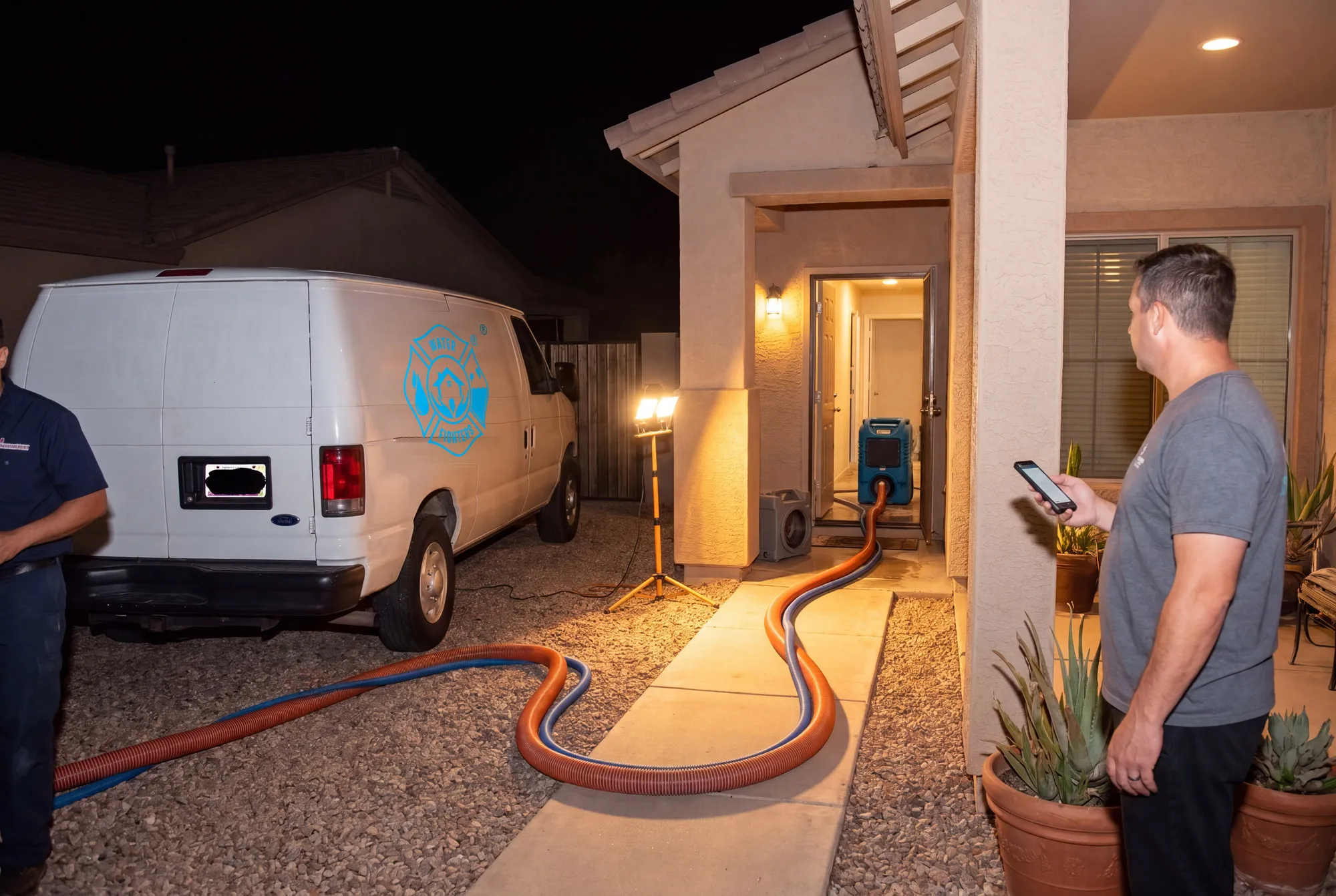
Confirm the water is fully stopped, then extract — truck-mounted units pulling standing water and everything the pad is holding. Then map: moisture readings on every wall and floor the water could have reached, because burst-pipe water always travels farther than the visible line. Drying equipment goes in against the map, contents get blocked and protected, and the documentation that becomes your insurance file — photos, readings, cause-of-loss notes — gets built the same night. Sudden pipe failures are the textbook covered loss on most policies, and from there the job runs the standard road: verified drying, then the one-team rebuild that puts drywall, trim, and flooring back without a contractor handoff.
Common Questions
How much water actually comes out of a burst pipe?
A pressurized half-inch line can release on the order of hundreds of gallons per hour — more than enough to involve multiple rooms before anyone notices. Rate is why bursts outrank almost every other household loss for speed of spread.
The pipe burst inside a wall. How do you find it without demolition?
Moisture meters and thermal imaging trace the water path from outside the wall; the plumber's access opening gets cut where the evidence points, not where guesswork does. Small, deliberate openings beat exploratory demolition every time.
My shutoff valve won't turn. What now?
Don't force a crumbling valve into a second failure. Call your water provider to shut the service off at the meter — Phoenix Water's 24/7 line is 602-261-8000 — and tell us on the call so the crew brings what's needed. Stuck original valves are common in older Phoenix homes and worth replacing the same week.
Does insurance treat a burst pipe differently than a slow leak?
Usually yes. Sudden bursts are the classic covered loss; long-running slow leaks drift into maintenance territory. Our documentation establishes cause and duration precisely, because that's the line the coverage decision walks — the slab leak page covers the slow-leak side of that story.
Where is the main water shut-off valve on a Phoenix house?
Check two places, in order: the garage wall near the water heater, then an exterior wall on the side facing the street, near where the line enters the house. Phoenix houses sit on slabs — there is no basement valve, which is where most transplants look first.
The house-side valve is usually a gate wheel or a lever-style ball valve on a vertical pipe; clockwise closes it, and a quarter-turn lever closes when it sits crosswise to the pipe. The concrete meter box at the curb is the water provider's side, not yours: the City of Phoenix owns the meter and tells customers not to shut water off there themselves. If the house valve won't close, the provider's emergency line handles the meter. Mid-century Valley homes — much of Sun City, older Peoria and Glendale — sometimes hide the house valve at a hose-bib manifold instead, painted over decades ago. The shutoff field guide on this page walks both locations with more detail, and the stuck-valve answer below covers what to do when original hardware won't turn.
Find yours on a calm Saturday, turn it once to prove it moves, and label it. Locating it dry is a ten-minute chore. Locating it mid-burst is done barefoot, in the dark, while the hallway fills — close it, then call while you walk back inside.
How do I know if there's water behind my wall?
Usually the wall tells on itself: paint bubbling or peeling, drywall tape seams lifting, baseboards darkening or pulling away, a musty smell parked in one spot, or a section that feels cool to your palm when the rest of the wall is warm. Any two of those together means water, not humidity.
The cool spot is evaporation working through the drywall — it's the earliest touchable sign, and it usually sits below and beside the actual leak, because water follows framing before it shows. The late signs are the loud ones: texture cracking along a line, a soft spot that gives under a thumb, and skirting swelling off the floor. If the wall carries a supply line, put the water bill in evidence too — a quiet climb over two cycles is a leak voting from inside. What you shouldn't do is cut an exploratory hole tonight: an undocumented wall opening muddies the cause-of-loss story your claim depends on.
A pin meter and a thermal camera settle the question in ten minutes without opening anything — the finding-it answer above covers how that works. Ask for that visit before the wall makes the decision for you.