Commercial Sewage Cleanup in Phoenix
Published August 21, 2026 · Last reviewed August 21, 2026 · Water Fighters Restoration
A sewage backup in a business is not a bigger version of a sewage backup in a house. There is a health authority involved, there are employees who cannot be in the building, and there is a closed sign on the door costing money every hour it stays up. The work has to be done correctly and it has to be done on a schedule.
What Makes It Category Three
Water is classified by what is in it, and that classification decides what can be saved. Category 3 water contains grossly contaminated material — sewage, waste line backups, and anything that has been through a floor drain or a grease interceptor. It carries bacteria and other pathogens, and it does not become safe because it looks like water by the time you see it.
The rule that follows is the one people push back on: porous materials that absorbed Category 3 water come out. Carpet and pad, drywall to a measured height above the water line, insulation, ceiling tile, and particleboard casework come out rather than get dried. There is no way to sanitize the inside of a material you cannot reach. Semi-porous and non-porous surfaces — concrete, sealed floors, metal, solid wood framing — get cleaned, treated, and verified.
That distinction is not a preference. It is the standard the industry works to. It is what an adjuster expects to see in a scope, and what a health inspector asks about.
The First Hours
The sequence in a commercial building runs in a specific order, and most of it happens before anyone starts cleaning.
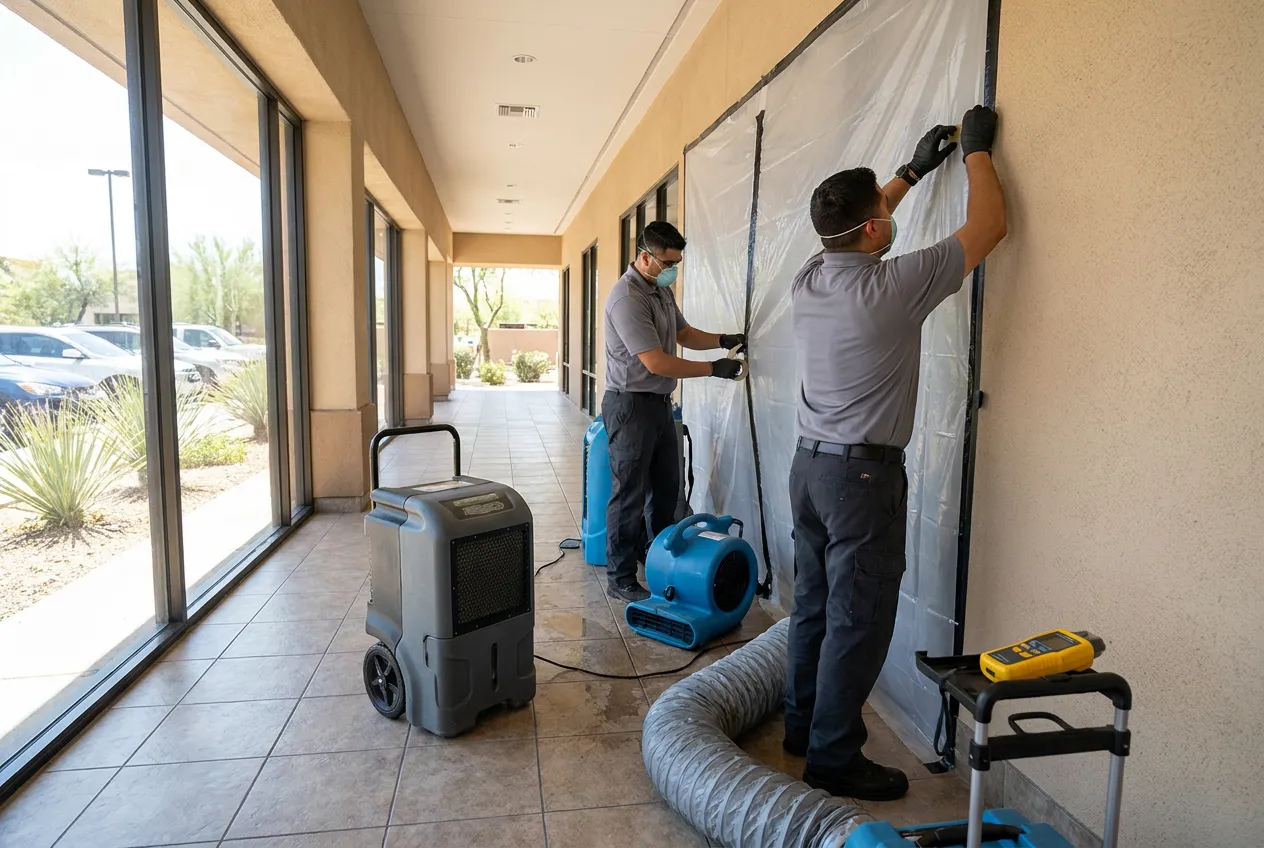
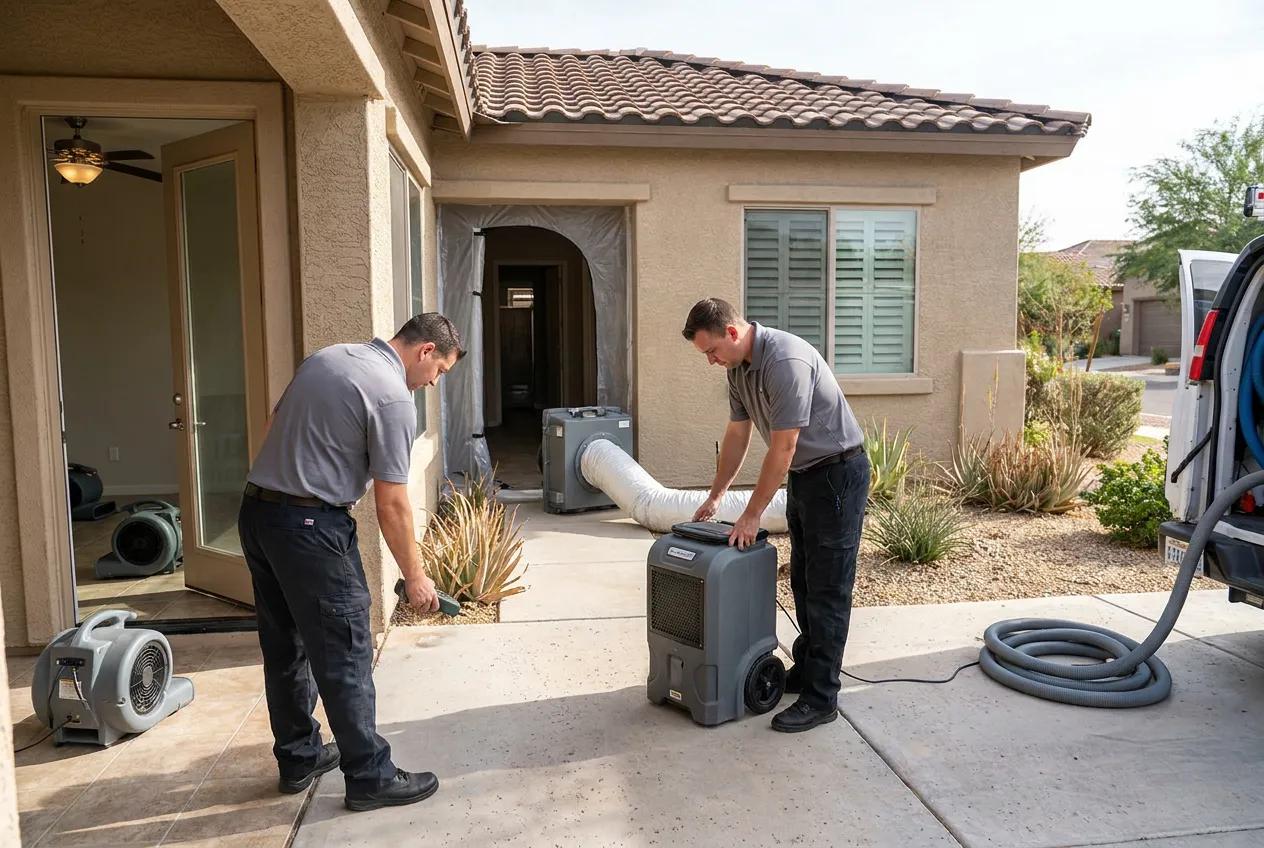
Stop the source and isolate the area. A backup that is still producing has to be stopped at the line before anything else is worth doing. Then the affected area gets sealed — physical containment with a zippered entry, and negative air pressure so the air inside the containment moves in rather than out. In an occupied building this step is what protects every part of the property you are not working in.
Establish the boundary. Where the contamination stopped is a measurement, not an estimate. Category 3 water travels under cove base, beneath sealed flooring, into the seam between a slab and a wall, and along the underside of casework. The line drawn on the first night determines the scope of the whole job.
Extract, remove, and clean. Waste water out with dedicated equipment. Contaminated porous materials bagged and removed through the containment. Surfaces cleaned and treated. Then structural drying to verified readings, on the same clock as any other water loss — because whatever the source, wet material still colonizes in a day or two.
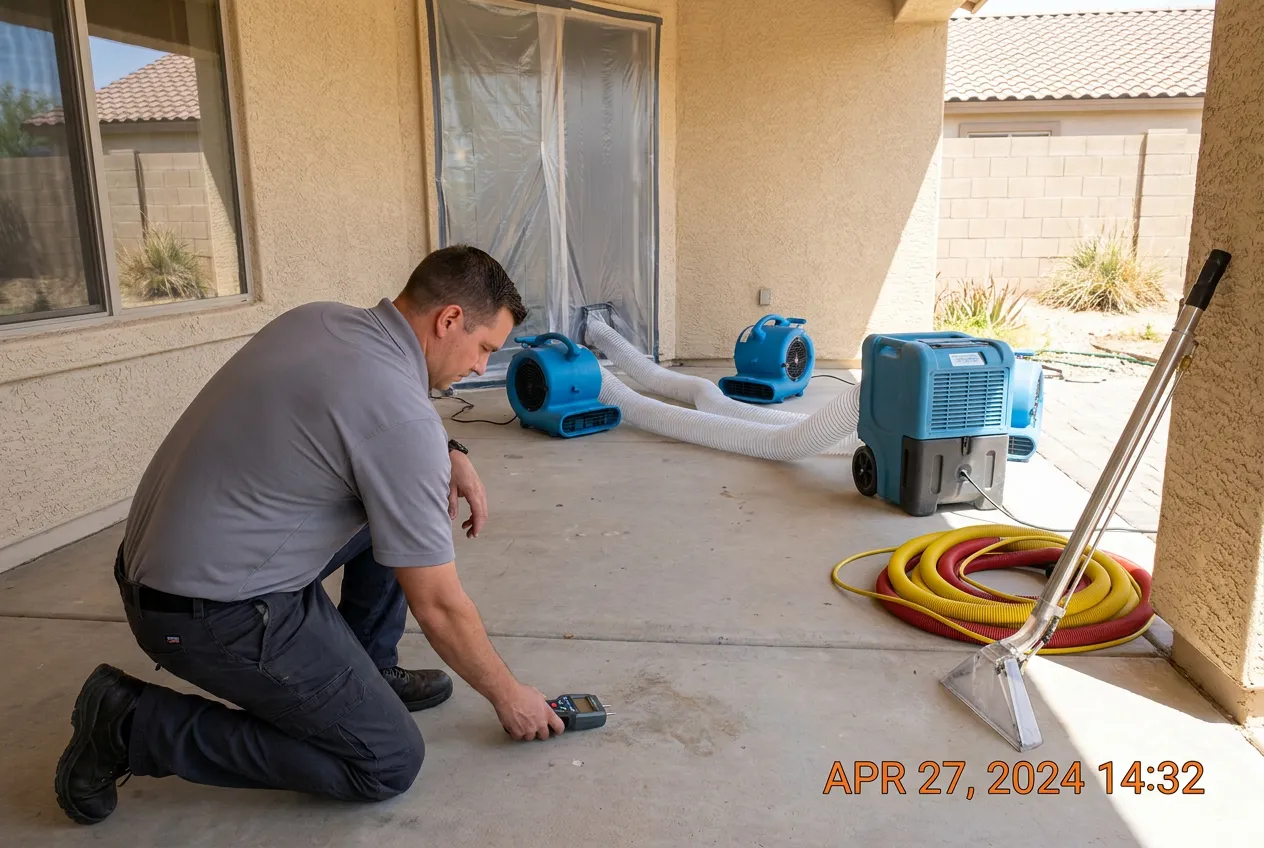
Document all of it. Photographs before anything moves, moisture readings by location, and a written scope. That file is what lets a claim proceed and a health authority sign off. It is far easier to build as you go than to reconstruct afterward.
Who This Happens To
Restaurants are the most common call, and grease is usually the reason — an interceptor that stopped doing its job, or a line that narrowed over years until one busy Friday closed it. The health department dimension is immediate and non-negotiable, and everything in a food-service space has a surface classification that determines how it gets treated.
Multi-tenant office and retail buildings produce the second pattern: a shared line backs up into the lowest fixture in the building, which belongs to a tenant who did nothing wrong. That becomes a documentation problem as much as a cleanup problem, since the origin determines who pays.
Medical and dental suites, schools, and childcare facilities carry the strictest occupancy requirements. Apartment and HOA properties bring the multi-unit version — the loss crosses a demising wall, two carriers get involved, and residents need somewhere to be. Warehouses and industrial buildings usually have the simplest surfaces and the largest square footage.
Clearance and Reopening
Reopening is the whole point, and the standard we hold to is that the building is verified, not merely visibly clean.
Structural drying continues until the materials read dry against a documented target, not until the fans have been running a certain number of days. Where the situation calls for it, third-party verification gets arranged so the clearance is not simply our own word. That covers food service, healthcare, childcare, and any insurer or ownership group that asks for it. Post-remediation verification is standard practice in mold work and it applies here for the same reason: the person signing off should not be the person who did the work.
Then the space goes back together. Cove base, drywall, ceiling grid, flooring, casework — put back to the condition it was in, by the same company, under one estimate. A tenant space that has been dried and left in demolition is not a finished job.
Documentation and Billing
Commercial losses have more people reading the file than residential ones do — a property manager, an ownership group, one or two carriers, sometimes a tenant's carrier and a health authority as well. The file has to survive all of that.
What that means in practice: a line-item scope written in the format adjusters process, photographs tied to locations, daily moisture logs, and a clear record of what was removed and why. We bill carriers directly and provide certificates of insurance, W-9s, and lien waivers as a matter of course rather than as a special request. Property management groups running multiple buildings can set up preferred-vendor arrangements and after-hours contact protocols in advance. Then the first call on a bad night is not also the first conversation.
Common Questions
Can we stay open in another part of the building while you work?
Often yes, and that is what containment and negative air are for. Whether a section stays occupied depends on the layout, the shared air handling, and what the health authority says for your type of facility.
Do you really have to remove the drywall? It looks fine.
Where Category 3 water was absorbed, yes. The material cannot be sanitized on the inside, and a scope that dries contaminated porous material in place is one an adjuster or an inspector can reasonably reject.
Our line has backed up twice this year. Is that going to keep happening?
Repeat backups point at a cause, not an accident. Usually it is a grease interceptor past service, roots in an old lateral, or a line narrowed enough that ordinary use closes it. Cleanup is our lane and the line itself is a plumber's, but the pattern is worth chasing down, because the third one costs more than the fix.
The backup came from a shared line. Whose problem is it?
That depends on where the failure occurred and what the lease and the CC&Rs say, which is exactly why the origin gets documented before demolition starts. Our job is to establish the facts precisely enough that the parties can sort out responsibility from evidence.
Will the health department accept your cleanup?
They evaluate the facility, not the contractor, so what we provide is the documentation and, where appropriate, third-party verification that supports it. Requirements vary by facility type, and building the file with that in mind from hour one is the difference between a smooth sign-off and a second visit.