
Water Damage Repair in Phoenix
Published October 8, 2026 · Last reviewed October 8, 2026 · Water Fighters Restoration
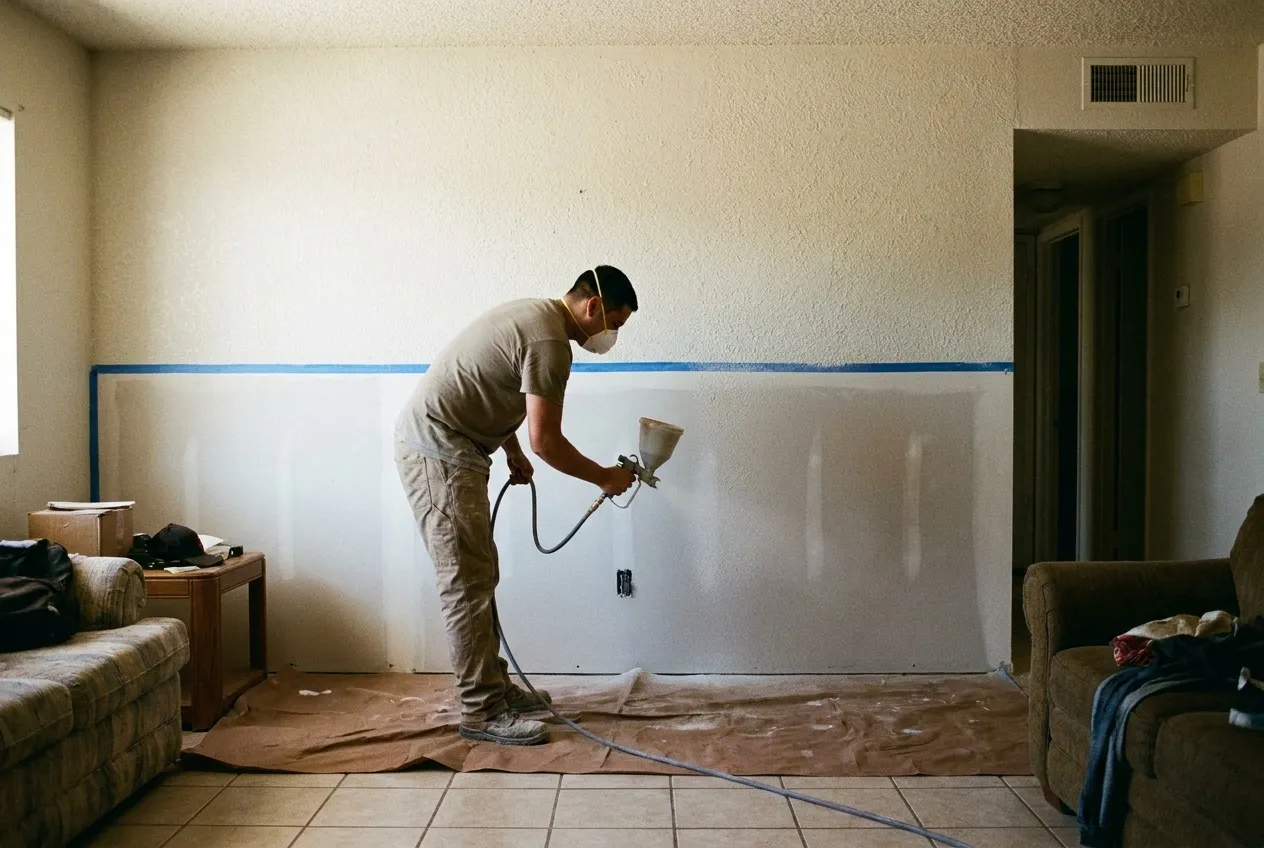
The equipment is gone, and the house is quiet for the first time in days. The readings say dry. What's left is a strip of bare studs along the bottom of the hallway wall, a kitchen with no sink base, and a doorway where the tile stops at nothing.
From here the job stops being drying and becomes construction, and Arizona law treats it that way. This page covers what gets replaced, how new work matches old, who may legally do it, and what the paperwork should say.
Replaced or dried: where the line falls
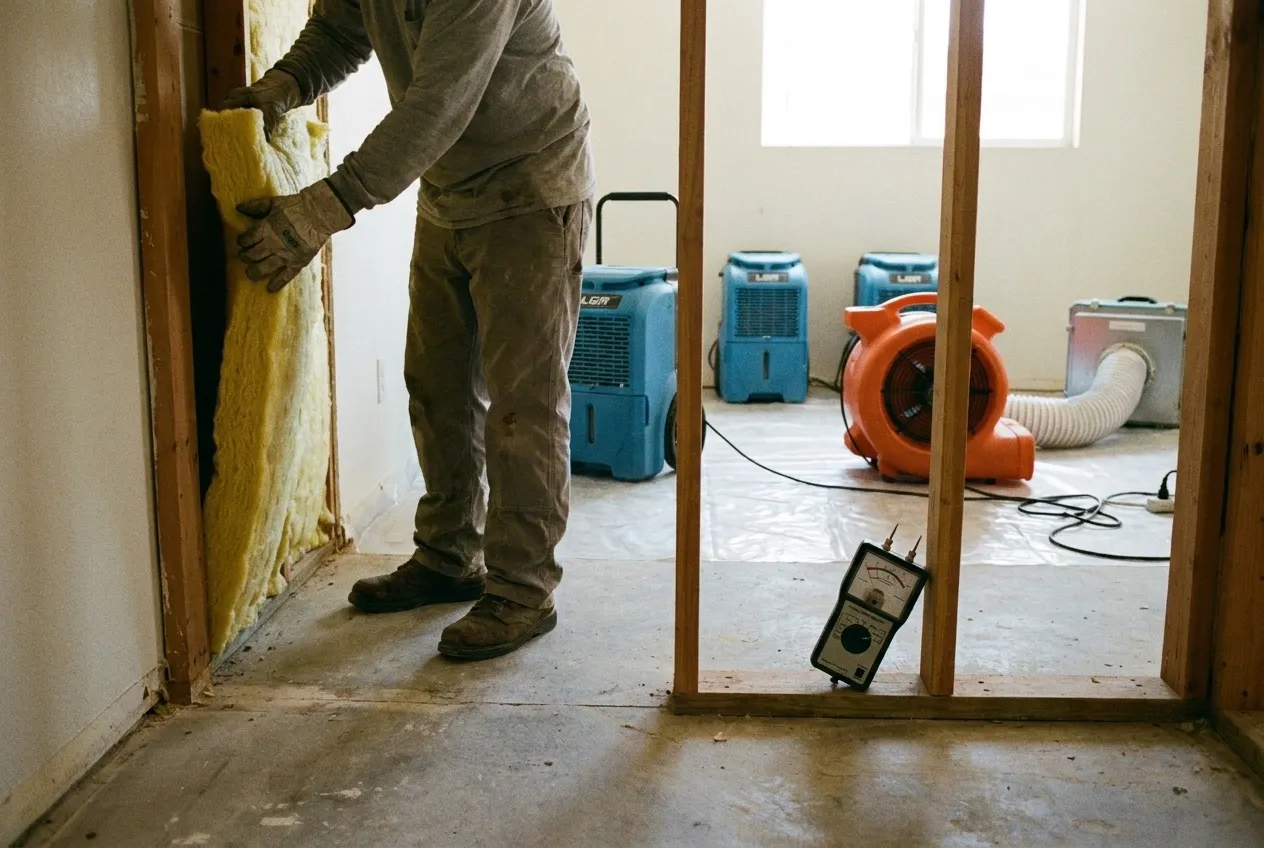
For clean water, EPA's guidelines draw the lines. Wallboard "may be dried in place if there is no obvious swelling and the seams are intact. If not, remove, discard, and replace." Ceiling tiles, cellulose insulation, and fiberglass insulation all get "Discard and replace." Under ceramic tile, vinyl, and linoleum, the underflooring gets checked and dried if necessary. The subfloor under carpet or other flooring "must also be cleaned and dried."
That guidance covers clean water only. Category 2 and 3 water, such as washer discharge or sewage, takes out more, and so does outside water that touched the ground, which is handled as Category 3. The ceiling guide covers ceiling board and attic insulation, and the flooring guide covers tile, laminate, plank, and wood.
Matching is where a repair shows
A repair shows in the texture, the paint sheen, and the seam where new drywall meets old. Texture gets matched to the existing wall, whether orange peel, knockdown, or smooth. Paint commonly runs to a corner or other natural break so the new section doesn't read as a patch. Doorway transitions, like tile meeting carpet or new plank meeting old, get planned for height and continuity.
Cabinets and countertops
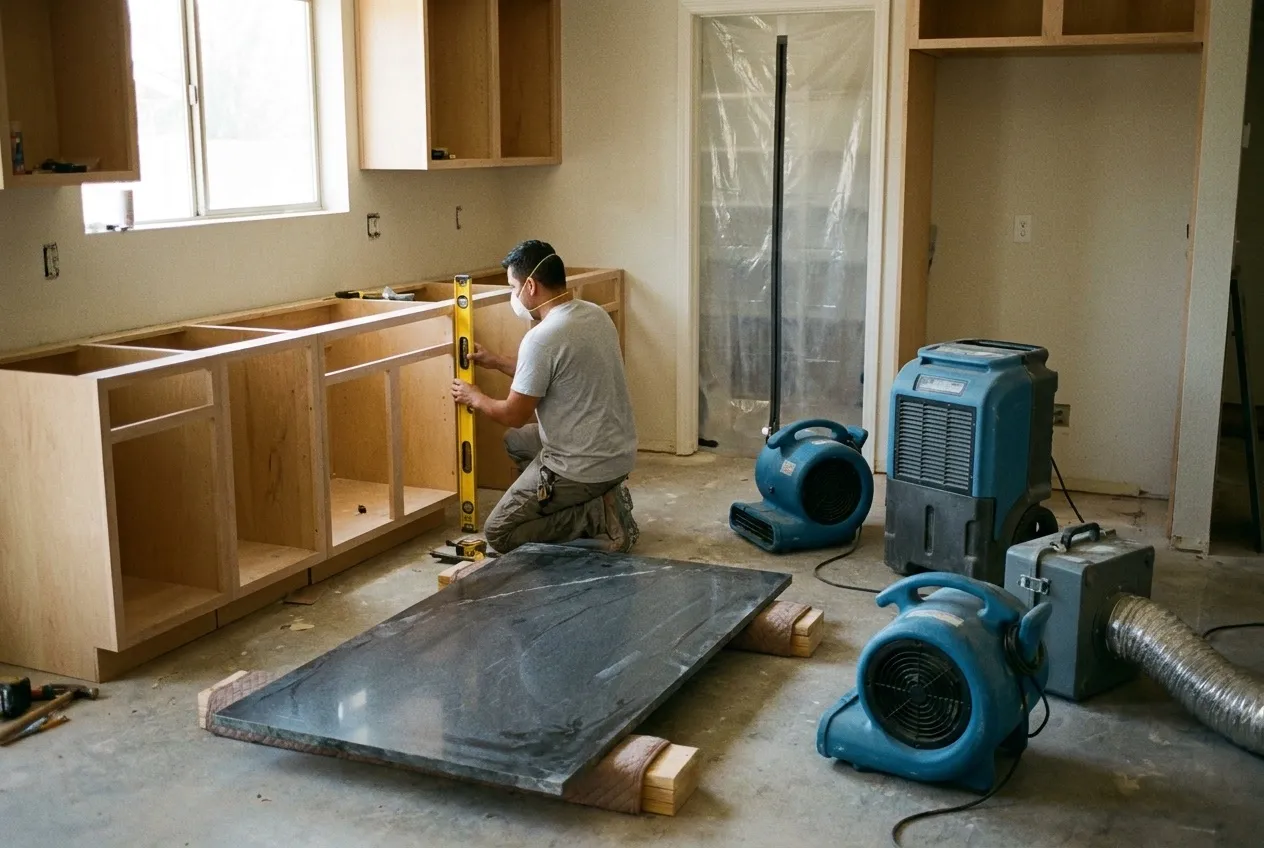
A particleboard cabinet box that swelled usually gets replaced. Doors and face frames sometimes survive. When the base cabinets under a stone countertop come out, the top usually has to come off and be reset or replaced. That's careful work, best planned early.
Repair is contracting under Arizona law
Arizona's definition of a residential contractor, in A.R.S. 32-1101, covers anyone who for pay undertakes to "construct, alter, repair" or otherwise work on a residential structure. It names "houses, townhouses, condominiums or cooperative units," and the same statute separates residential, commercial, and dual licenses. Contracting without a license is unlawful unless an exemption applies. Under A.R.S. 32-1151, securing a permit is accepted in court as prima facie evidence that a contract existed.
The small-job exemption is narrow. It covers work "of a casual or minor nature" under a dollar threshold set in statute. It doesn't apply when the work needs a local building permit or is "only a part of a larger or major operation." It never covers fire-safety work, meaning hardwired or interconnected smoke alarms and fire sprinklers, or work that connects to natural gas, propane, or another fuel gas.
Electrical, plumbing, and gas work belong to those trades. Water Fighters' credentials: IICRC Certified 70192944 · AZ ROC 324471 · ROC 324468 · EPA Lead-Safe Certified Firm · Licensed, Bonded & Insured. The about page explains how to check an ROC number.
Permits in Phoenix
The City of Phoenix's residential projects page says painting, flooring, and replacing existing plumbing fixtures don't need a permit. Neither do minor non-structural repairs like trim and hardware, or replacing kitchen cabinets in their existing locations with no new electrical or structural changes. Electrical updates, moving or adding sinks, toilets, and tubs, wall removals, and gas line changes do. A City remodeling handout adds that replacing a water softener or relocating walls may require one.
Drywall depends on size. The City's published permit-exemption guidance (Rev. 07/14) separates the two. "Patching a hole in a drywall sheet would not require a permit, but removing and replacing an entire drywall sheet would require a permit." The scope decides which side of that line a rebuild falls on, and other Valley cities set their own rules.
Pre-1978 homes
EPA's Renovation, Repair and Painting rule covers work that disturbs painted surfaces in homes built before 1978. Contractors must be certified and follow lead-safe work practices. During the emergency itself, some steps can be skipped only as far as the emergency requires. Cleaning, cleaning verification, and records still apply. Once the emergency part is done, the repair work falls under the full rule. Water Fighters is an EPA Lead-Safe Certified Firm, and the asbestos and lead guide covers testing before demolition.
Insurance and the repair scope
Carriers generally want to see damage, or documentation of it, before permanent repairs or disposal. A repair scope tied to the mitigation file's photos, readings, and removals covers that. The estimate is free, the estimate you receive is the same one the insurer receives, and Water Fighters bills the insurance company directly. The cost guide covers how the rebuild shapes cost, and the claim guide covers supplements.
One team, start to finish
Water Fighters does mitigation and rebuild with one team, so the drying record and the repair scope stay in the same hands. If water is still on the floor, start with emergency flood cleanup; if the drying isn't finished, water mitigation comes first. The water damage restoration page covers the whole job, and contents restoration covers bringing belongings back. Two staffed locations, Peoria (home base) and Phoenix (Deer Valley), make one licensed team, Valley-wide; the Deer Valley page covers the north Phoenix side.
Common Questions
Can the insurance company handle the repairs itself instead of a contractor?
It can run the repair, but licensed contractors still build it. Arizona exempts insurance companies authorized to do business in the state from contractor licensing for casualty repairs under a policy only "if all construction work is performed by duly licensed contractors." With Water Fighters, the estimate you receive is the same one the insurer receives.
Can a handyman do the drywall and paint after the drying is done?
Usually not under the small-job exemption. It doesn't apply when the work needs a local permit. It also doesn't apply when the work is "only a part of a larger or major operation, whether undertaken by the same or a different contractor." Phoenix's guidance treats replacing whole drywall sheets as permit work, and drywall and paint after a water loss are usually part of a bigger repair. Unlicensed workers who advertise must say "not a licensed contractor." A separate owner-builder exemption, with its own conditions, covers some work owners do on their own property.
What should a written repair contract in Arizona include?
Arizona lists required items for residential contracts above a dollar threshold set in statute. They include the contractor's name, business address, and license number, the owner's name and mailing address, the jobsite address, and the contract date. The contract also needs an estimated completion date, a description of the work, the total with taxes, any deposit, and each progress payment with the stage that triggers it. A notice of the owner's right to complain to the Registrar of Contractors, with its phone, website, and deadline, goes in at least ten-point bold type, with one statutory exception. The owner gets a legible copy of everything signed. The statute adds that these items aren't prerequisites to forming or enforcing a contract.
The repairs went wrong after the job closed. What can an Arizona homeowner do?
Arizona law lets a homeowner file a written complaint with the Registrar of Contractors. For projects other than new construction, the deadline is "within two years after the completion of the specific project." Before the Registrar can cite a contractor for workmanship, the contractor must get "an opportunity to inspect the work within fifteen days after receiving a written notice from the registrar."
Does Arizona's contractor recovery fund cover a rental house or a second home?
Usually not, for the owner. The residential contractors' recovery fund is for people damaged by a licensed residential contractor's violation. An individual owner must actually occupy or intend to occupy the property as a primary residence. A second home or rental that the owner doesn't live in and doesn't intend to make a primary residence doesn't meet that test. The statute also names other eligible claimants, including associations for common elements and some lessees, each with its own conditions. The contractor must have held a valid residential license when the contract was signed, the first payment was made, or work began.