
Water Heater Flooding in Phoenix
Published August 4, 2026 · Last reviewed August 21, 2026 · Water Fighters Restoration
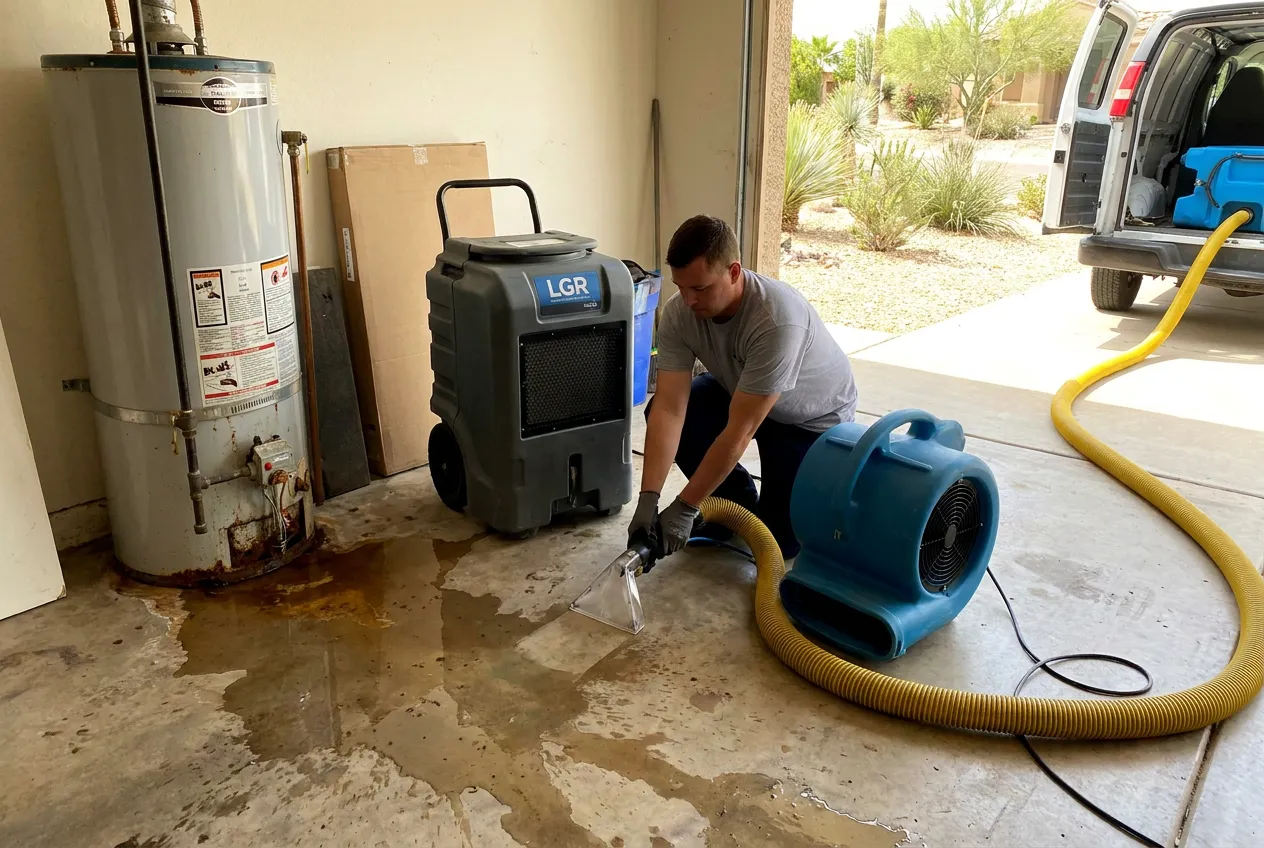
Every water heater is a countdown. In Phoenix, the countdown runs fast — our famously hard water scales the tank from the inside, the sacrificial anode rod that's supposed to die protecting the steel dies early, and corrosion gets the rest. A unit that might see fifteen years in a soft-water city often fails here around year ten, and it fails holding forty to fifty gallons with the supply line ready to feed it more.
The Biography of a Phoenix Water Heater
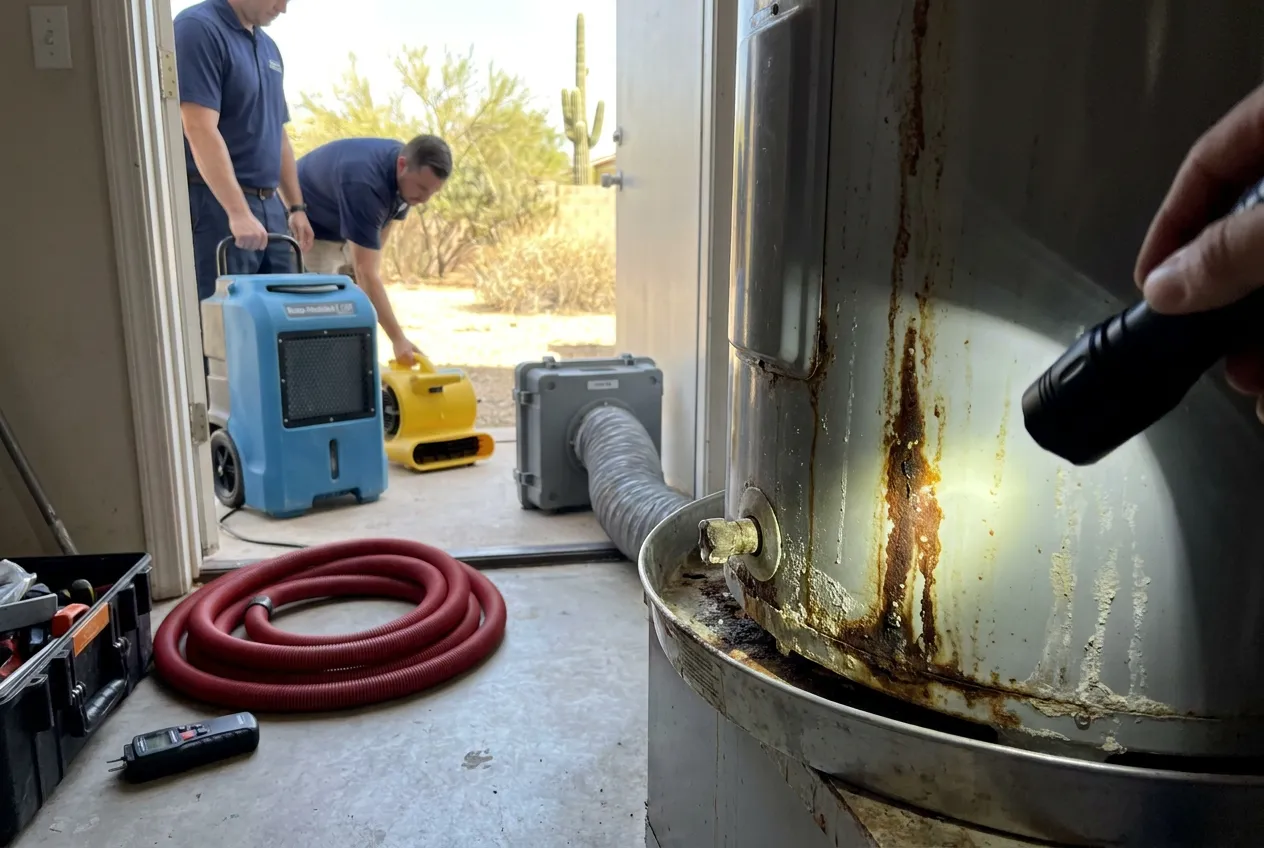
Years one through five, nothing. Years six through nine, the quiet tells: rumbling and popping as scale bakes on the bottom, hot water running out sooner, a rusty tint at the tap first thing in the morning. Year ten and beyond, the tank is living on the anode rod's leftovers, and the failure — when it comes — is either a slow seep from a fitting or a bottom seam letting go all at once. The tell most people miss is the humblest: a little rust trail or mineral crust at the base. That's not cosmetic. That's the tank negotiating.
Flush the tank annually, replace the anode rod when a plumber says it's gone, and treat year ten as the retirement conversation regardless of appearance. A new unit costs a fraction of what its predecessor's last act does.
Location Decides the Loss
The same failure produces wildly different damage depending on where the builder put the tank — and Phoenix builders have put them everywhere.
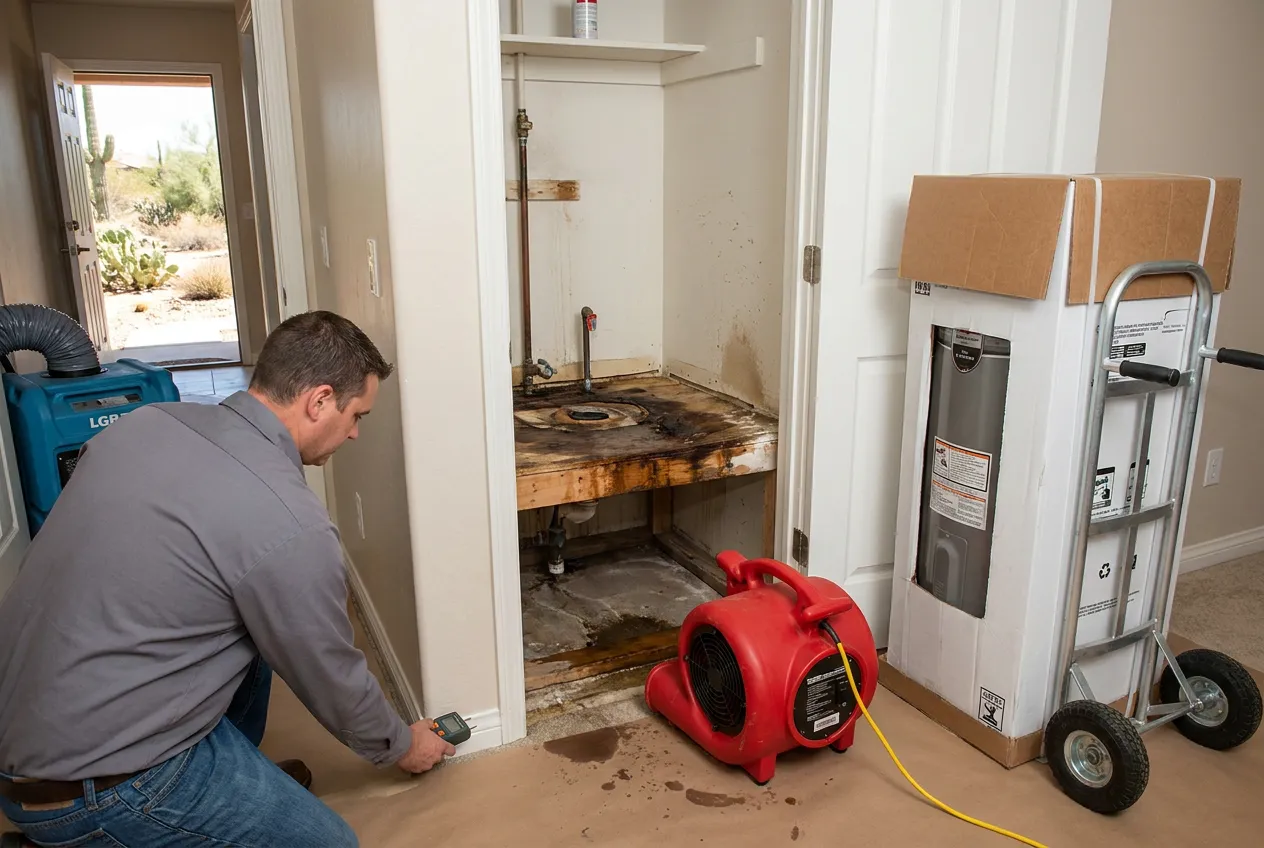
Garage: the merciful placement. Concrete floor, often a door to outside, damage frequently limited to stored belongings and the drywall the water reached. Interior closet: the common and cruel one — a hallway or laundry closet failure sends forty gallons across adjacent carpeted rooms with nothing to stop it, and the platform the tank sits on soaks first. Attic: the placement that turns a plumbing failure into a ceiling collapse — water finds the drywall seams below, and by the time it shows, insulation and framing are saturated across a span. Attic and closet units are exactly why the drain pan and its line exist; a pan with a clogged or unconnected drain is decoration.
Know which one you have, and if it's attic or closet, a leak sensor in the pan is the cheapest insurance in this entire trade.
Two Ways They Fail
The slow seep is the stealth version — a fitting, a valve, or an early seam weep that runs down the tank and into the platform, wall base, or ceiling below for weeks before anyone notices. These losses look small and rarely are; hidden duration is what pushes them toward mold territory and complicates the insurance conversation about when the damage began.
The catastrophic release is the loud version — a seam or bottom failure dumping the tank at once while the cold supply keeps refilling it until someone closes the inlet valve on top of the unit (or the main). If you hear water where the heater lives, that valve is the first move, the unit's gas or breaker is the second, and the phone is the third.
What We Do
Extraction starts where the water ended up, not where the tank sits — closet failures get every adjacent room metered, attic failures get the ceiling cavity mapped before it's opened. Drying runs to verified readings; the platform, base plates, and any ceiling below get particular attention because they're where these losses hide. Documentation separates the sudden failure (the classic covered loss) from the long seep (the argued one), which is the difference the adjuster will care about — the cost guide walks that line in detail. And because the rebuild is ours too, the closet, platform, drywall, and flooring go back with the same crew, while your plumber sets the new tank. One estimate covers all of it.
Common Questions
My water heater is leaking right now — what's the exact shutdown order?
Cold inlet valve on top of the unit closed; gas control to off or the unit's breaker off; then call. If the inlet valve won't turn, the house main takes its place. Never drain a gas unit's tank with the burner still able to fire.
The heater is in the attic and there's a ceiling stain. How bad is this?
Assume worse than it looks — a stain means the insulation and framing above have been wet long enough to saturate through drywall. Stay from under the sag, kill the unit's supply and power, and call; we map the cavity before opening it so the ceiling comes down on our terms, not its own.
Is water heater flooding covered by insurance?
The sudden failure and the damage it causes, typically yes; the tank itself and a leak that visibly ran for months, typically no. Duration is the battleground, and it's precisely what our moisture readings and photos establish.
Tank or tankless for the replacement — does it change flood risk?
That's your plumber's sale to make, not ours. What we'll say from the damage side: tankless removes the forty-gallon reservoir but keeps every supply connection, and an attic install of anything keeps the ceiling in play. Location and a working pan drain matter more than the technology.