
The Phoenix Water Damage Handbook
Published August 6, 2026 · Last reviewed October 8, 2026 · Water Fighters Restoration
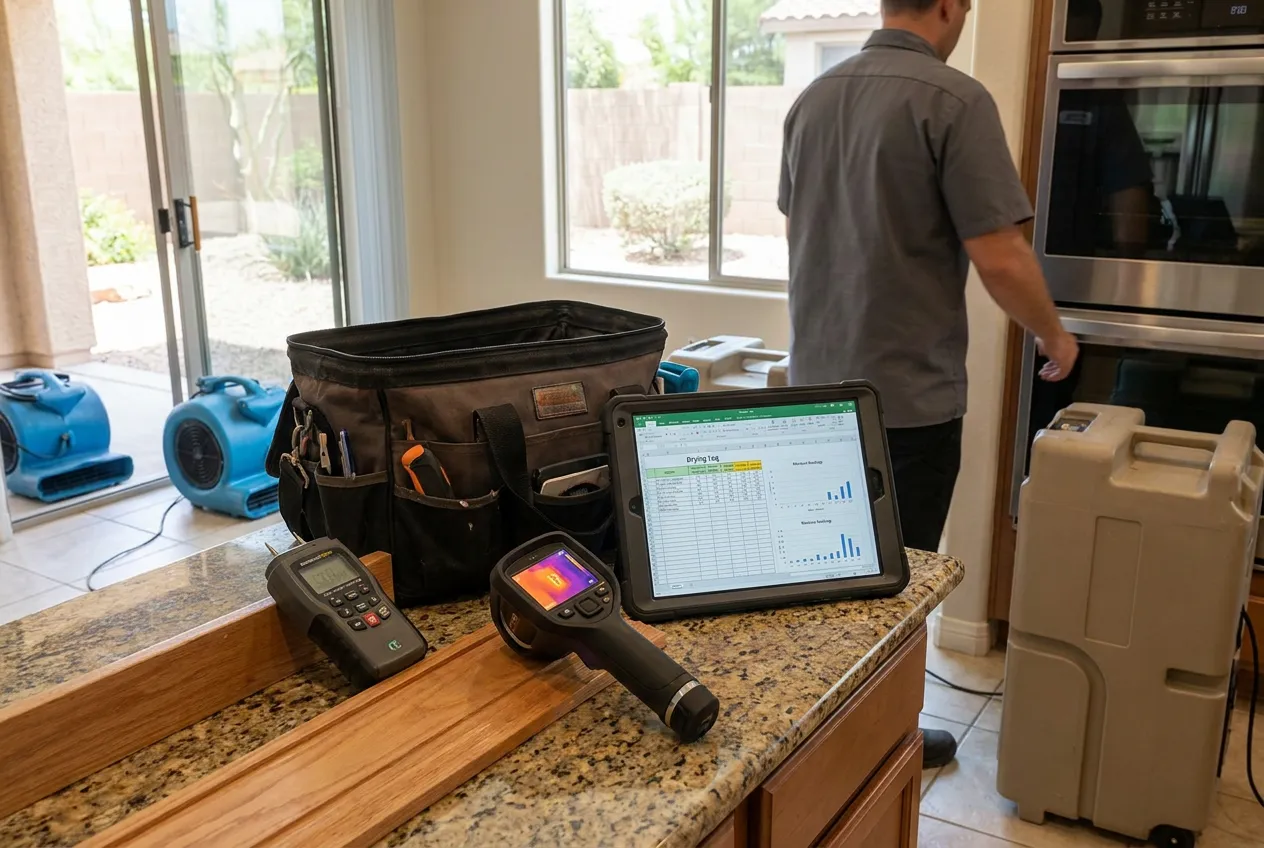
Water damage is the most common serious loss a Phoenix home will ever face, and almost everyone meets it unprepared, at a bad hour, with wet feet. This handbook is the preparation — everything we explain on a thousand driveways a year, written down in order. Read it dry and calm if you can. Skip straight to Chapter 1 if you can't.
Contents: 1. The First Hour · 2. The Damage Clock · 3. What's In the Water · 4. The Insurance Claim, Start to Finish · 5. How Drying Actually Works · 6. Keeping Mold Out of the Story · 7. Monsoons and Empty Houses · 8. Choosing a Restoration Company
Chapter 1: The First Hour
Five actions, in this order, before anything else.
Stop the water. Fixture valves first if you can see the source; the main shutoff if you can't. In most Phoenix homes the main is in the garage, beside the water heater, or on the outside wall where the line enters the house. The meter box at the curb belongs to the water provider. If the house valve won't close, call them to shut it off there (Phoenix Water: 602-261-8000, 24/7). Go find yours today — mid-flood is a bad time for the scavenger hunt.
Cut power to wet rooms. Breakers off for any room where water is near outlets or cords. If the panel itself is wet or you'd cross water to reach it, leave it and say so when you call.
Don't move air yet. No fans, no AC blasting across the wet zone. Airflow before extraction spreads moisture into dry rooms and pushes humidity into materials that were surviving.
Lift what matters. Electronics, documents, photos, medications — up and out. Leave the furniture; blocking and protecting it is our job and takes minutes with the right kit.
Call. (602) 884-5325, any hour. Dispatch starts during the call, and the crew arrives within the hour with everything the next twelve hours require.
Chapter 2: The Damage Clock
Water damage is a sequence of deadlines, and Phoenix runs the clock hot.
In the first hour, water spreads laterally — under walls, along the underside of flooring, into the carpet pad that acts like a sponge feeding everything above it. Within several hours, drywall wicks it vertically at roughly an inch an hour; MDF baseboards and particleboard cabinet bottoms swell and don't swell back. By the twenty-four-to-forty-eight-hour mark, mold can begin colonizing wet organic material — faster in a closed summer house holding heat. By seventy-two hours, clean water can have degraded to contaminated, salvageable materials have crossed into removals, and a drying job has become a demolition job.
Every chapter after this one assumes you understand the clock, because it's the answer to most "should I wait" questions. No. The cost mechanics are the clock wearing a price tag.
Chapter 3: What's In the Water
The industry sorts water into three categories, and the category decides what can be saved.
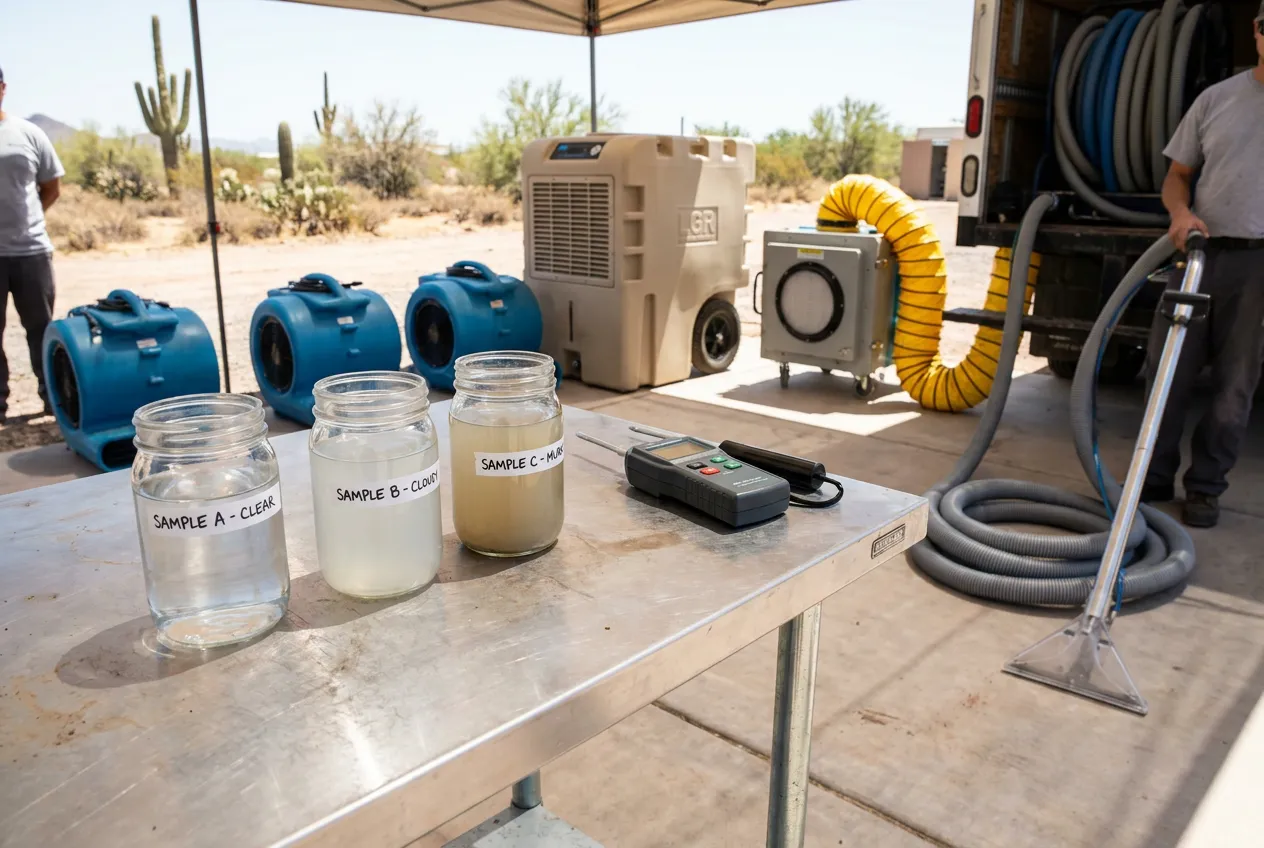
Category 1 is clean supply water — a burst line, a failed fitting, a water heater. Caught fast, most materials dry in place. Category 2 is contaminated — dishwasher and washer discharge, an aquarium, or any clean loss that sat a day or more. Some porous materials stop being savable. Category 3 is grossly contaminated — sewage, or floodwater that entered from outside, which includes every drop of monsoon water that crosses a threshold. Category 3 means containment, protective equipment, and mandatory removal of what it soaked.
Two Phoenix-specific notes. First, category degrades: today's Category 1 is Friday's Category 2. Second, storm water that ran across the street, the yard, or the desert is handled as contaminated no matter how clear it looks, and rain through a roof gets its category on site.
Chapter 4: The Insurance Claim, Start to Finish
Most Phoenix water losses are insurance claims, and the claim goes well or badly based on things that happen in the first two days.
What's typically covered: sudden and accidental losses — burst pipes, failed appliances and water heaters, roof intrusion a storm caused. What's typically not: long-term seepage and deferred maintenance, rising outside floodwater (that's separate flood insurance), and sewer backup unless your policy carries the endorsement — a detail worth checking today, not during. Mold sits in between: usually covered when it results from a covered loss handled promptly, often sublimited, excluded when it grew from neglect.
The sequence: mitigate immediately — policies require it, and waiting for an adjuster before stopping damage can create uncovered secondary loss. Document everything before and during: photos, moisture readings, an inventory of affected materials. You file the claim; it's your policy. From there, a good contractor carries the paperwork — scope written in the estimating format adjusters process, direct carrier billing, readings and photos behind every line item.
Your two rights worth knowing: in Arizona, you choose the restoration company — a carrier may suggest a preferred vendor, and you may decline. And you're entitled to see the full scope. Our version of that is structural: the estimate you receive is the estimate your carrier receives. One document.
Chapter 5: How Drying Actually Works
Dry is a measurement, not an appearance — the single most misunderstood fact in this industry.
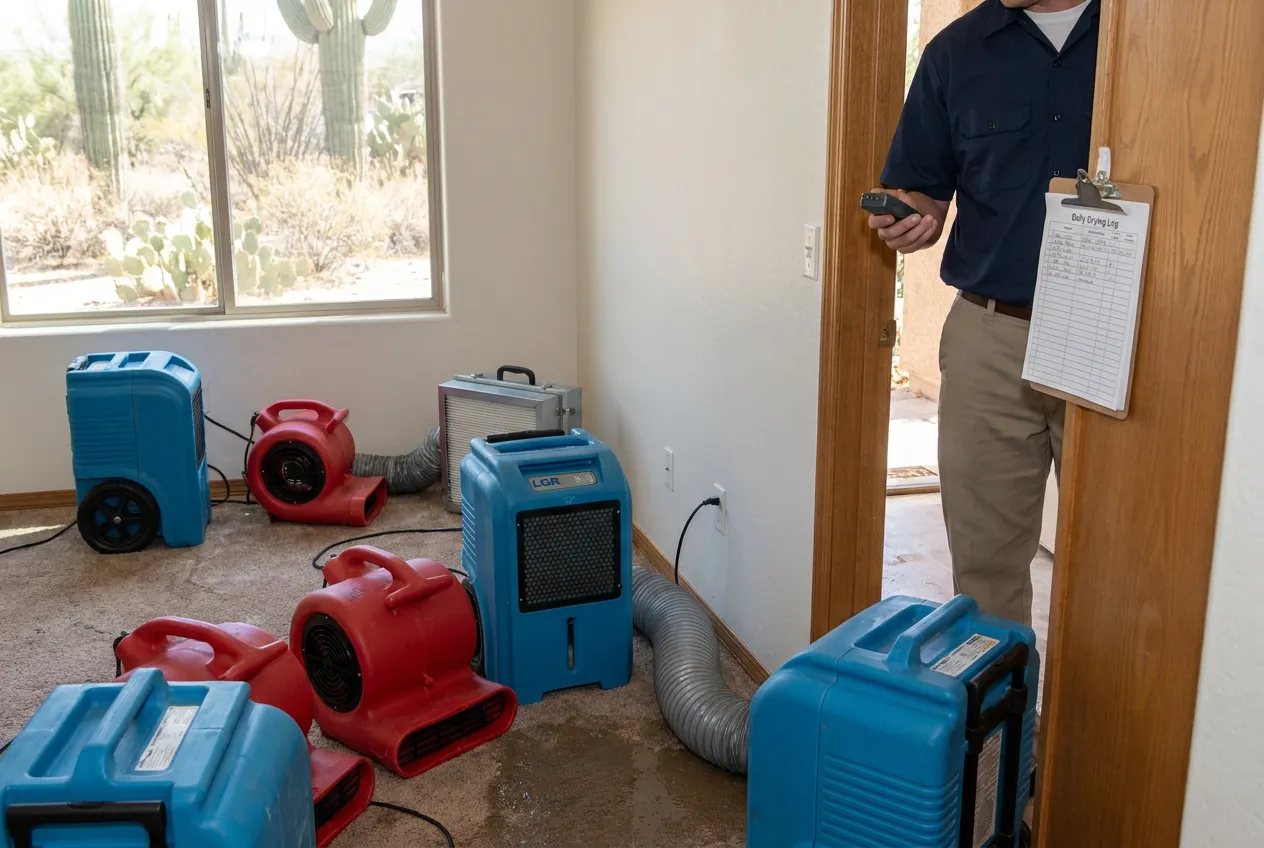
Real structural drying runs on the IICRC S500 standard: establish a dry target from unaffected material in the same building, extract everything a truck-mounted unit can pull (extraction removes water hundreds of times faster than evaporation), then place air movers and dehumidifiers against a moisture map — not in a decorative ring around the room. Every day, every affected surface gets metered and logged. Equipment moves when readings stall; equipment leaves when readings hit target. Three to five days is typical; wall cavities, plaster, and slab-adjacent framing can run longer.
What this means for you: a company that pulls equipment "because it's been three days" or because the wall feels dry is guessing with your house. Ask any bidder one question — how do you decide when it's dry? — and listen for the word "readings."
Chapter 6: Keeping Mold Out of the Story
Mold is not a separate disaster; it's what water damage becomes when the response fails. Every prevention lever is in the chapters above: speed (the 24-to-48-hour colonization window), complete extraction, verified drying, and honest material decisions — soaked pad and swollen MDF removed rather than optimistically dried.
If the response already failed — a leak that ran hidden, a flood handled with box fans, a musty smell that keeps returning — the game changes from prevention to testing and remediation, which has its own containment rules and its own page. The one rule that carries over: never seal a wet or suspect wall behind new drywall. It's the shortcut that turns one loss into two.
Chapter 7: Monsoons and Empty Houses
Phoenix adds two seasonal risks most water-damage advice ignores.
Monsoon season. June through September, the pattern is dust, wind, then rain — and the damage usually enters at the seams: roof penetrations, scuppers and flat-roof drains, west-facing doors and windows, garage thresholds. The June checklist that prevents most of it: clear every scupper and drain, walk your lot's runoff path, check door sweeps and thresholds, and know that any storm water that gets in is Category 3 from the first minute. The full anatomy is on the monsoon flood damage page.
The empty house. Snowbird season is leak season in reverse — supply lines don't check the owner's calendar, and a May failure discovered in October is a rebuild, not a dry-out. If your home sits empty for weeks: main valve off, someone walking the interior monthly, leak sensors at the water heater and under sinks, and a local contact authorized to act. Cheap, boring, and worth more than any restoration invoice ever written.
Chapter 8: Choosing a Restoration Company
Written knowing our competitors will read it — the standards hold anyway.
Verify the licenses actually required: an Arizona ROC license for the work, IICRC certification behind the drying claims. Ask the drying question from Chapter 5. Ask who does the rebuild — if the answer is "we'll refer you to someone," you're hiring half a company and project-managing the seam yourself. Ask for the estimate in writing and ask whether the carrier receives the same document. Ask how they document — daily readings and photos, or a final invoice and a handshake. And weight reviews for specifics: names, response times, and insurance experiences, not star counts alone.
Any company that clears every bar on that list will take good care of you. We built Water Fighters to clear them structurally — one licensed team from extraction through rebuild, one estimate, readings behind everything — which is the long way of saying we wrote the test we wanted to be graded on.
Common Questions
Where do I even start if water is spreading right now?
Chapter 1, top of this page: stop the water, cut power to wet rooms, don't move air, lift valuables, call (602) 884-5325. In that order, and the order matters.
Is this handbook a substitute for calling someone?
For the first hour, it's the checklist. Past that, no — extraction equipment and moisture meters aren't things a handbook replaces, and the damage clock doesn't pause while you research.
Does everything here apply to condos and rentals?
The physics, yes. The logistics add layers — HOA walls, unit-to-unit spread, landlord and tenant coordination — which is why multi-unit losses get their own workflow on our commercial side.
How current is this handbook?
It's maintained against the standards we work to daily and reviewed as they change; the dateline above tracks the last review. If something here ever contradicts what a crew tells you on-site, ask — one of the two needs updating, and we'd rather know.
What should I do today, while nothing is wrong?
Three things, ten minutes: find and test your main shutoff, check whether your policy includes sewer-backup coverage, and put our number in your phone. Future-you, standing in water at 2 a.m., will be grateful for all three.
Can I share or reference this guide?
Please do — link it, send it to a neighbor, hand it to your HOA. It exists to make Phoenix homeowners harder to surprise.
What happens if you ignore water damage?
It compounds on three separate clocks. Mold can start colonizing wet material within two days. Structural materials — subfloor, framing, sill plates — delaminate and rot over weeks. And your insurance position erodes the whole time, because every policy requires prompt mitigation, and "we let it sit" reads to a carrier as a reason to deny.
The cascade runs in one direction. A swollen baseboard becomes wicked drywall, becomes a colonized wall cavity, becomes framing rot and a subfloor that bounces underfoot — and the repair scope grows at each stage, because each stage adds materials the earlier response would have saved. The version that catches people is the quiet one: the leak that "dried on its own" dried at the surface while the cavity stayed wet, and surface-dry and structure-dry are different claims. Chapter 2 of this handbook covers the first days of that clock; this answer is about the months — and the months are where covered losses turn into arguments, because carriers pay for sudden damage, not for the neglect of it.
Water damage never gets cheaper by waiting. It changes category, grows a mold scope, and loses its coverage — in that order.