
Storm & Monsoon Damage Restoration in Phoenix
Published August 21, 2026 · Last reviewed October 8, 2026 · Water Fighters Restoration
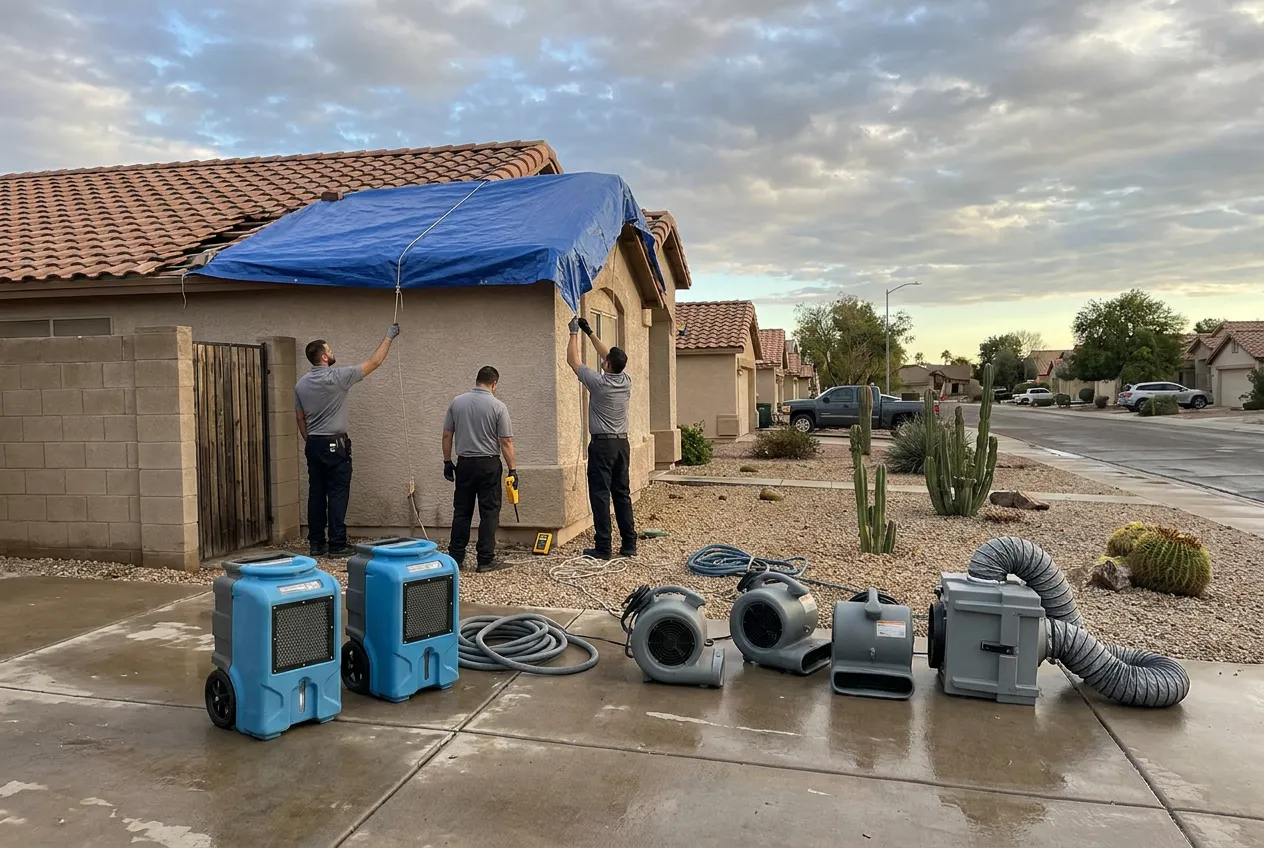
A Phoenix storm does its damage in about twenty minutes and then leaves behind a clear sky and a wet house. The wind opens something — tile, flashing, a window seal, a rooftop unit curb — and then an inch of rain goes through the opening. By the time the neighborhood is out looking at downed branches, water is already in the insulation.
What a Phoenix Storm Actually Does
Monsoon season runs June 15 through September 30, and the storms that matter here are not long soaking systems. They are microbursts: a column of collapsing air that hits the ground and spreads outward at highway speeds, often with a wall of dust in front of it. The sequence is dust, then wind, then rain, and the wind is what creates the opening the rain uses.
Four things account for most of the calls:
Roof intrusion. Wind lifts or breaks concrete tile, displaces flashing at a penetration, or peels a section of low-slope membrane. The tile itself is a rain shield; the underlayment is the actual waterproofing, and once wind has broken the system the next cell goes straight into the deck and the attic.
Driven rain. Horizontal rain finds window seals, door thresholds, and wall penetrations that handle vertical rain perfectly well. This is the one people argue about, because there is no visible hole.
Ground water. Streets and lots shed faster than they drain in a hard cell, and water finds the low point of a property — a garage threshold, a side yard, a patio slider.
Rooftop equipment. On commercial buildings, wind gets under curb flashing on a rooftop unit and the intrusion comes down through a ceiling grid into a tenant space.
The First Night
Two jobs run at once after a storm: stop more water from getting in, and deal with what already did.
Up top, get it covered. A storm-opened roof left uncovered through the next cell turns a repairable loss into an argument with a carrier about whether the later damage was preventable. Your policy expects reasonable steps to prevent further damage, and tarping is the textbook example. What it does not mean is you on a wet tile roof at night — concrete tile is slick, broken pieces hide underfoot, and walking it in the dark breaks more of it. Contain the water inside and let a crew place the tarp at first safe light, or tonight.
Below, treat it as contaminated. Storm water that ran in across a street or a yard is handled as Category 3 from the first minute regardless of how clean it looks, and rain through the roof is handled as Category 3 when it picked up contamination from the roof, the attic, or the walls. That determines what can be dried and what has to come out. Wet blown-in attic insulation is the specific Phoenix version of this: it does not dry in place, and leaving it means a wet ceiling cavity above a room that looks fine.
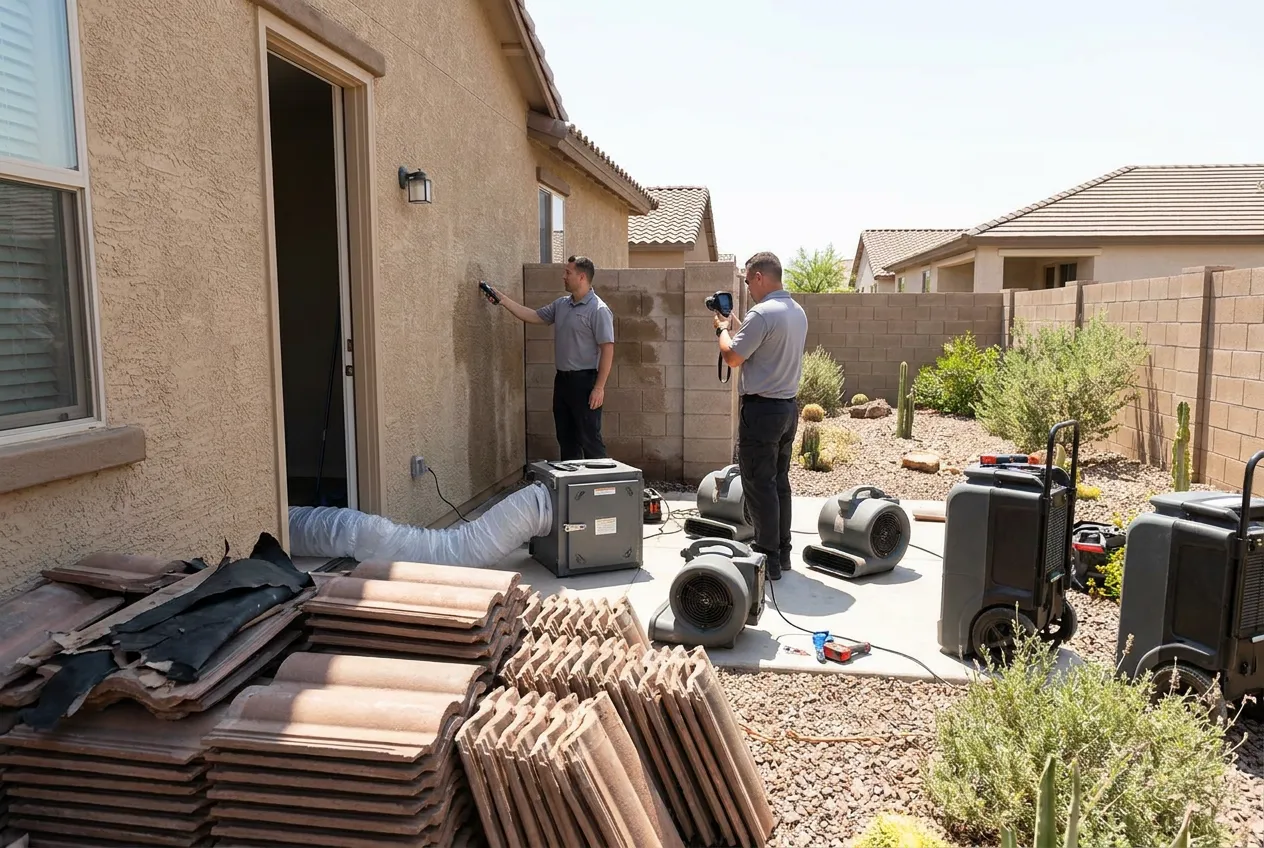
Photograph before anything moves. The opening, the interior damage, and the water's path. Storm claims turn on cause, and cause is established by evidence collected before cleanup.
The Coverage Question
Storm claims get argued more than any other kind, and almost always about the same distinction.
Wind-created openings are the covered path. A storm damages the roof or the building envelope, rain enters through that opening, and the resulting interior damage is generally covered by a homeowner policy. That is the ordinary case, and it is why establishing the opening matters so much.
Rising surface water is the excluded path. Water that comes up from the ground — a street that became a river, a wash that jumped, sheet flow crossing a threshold — is flood, and homeowner policies exclude it. That requires separate flood coverage, and the exclusion does not care whether you are in a mapped flood zone.
The same storm can produce both in the same house. Rain through a wind-opened roof upstairs and ground water in the garage downstairs are two different coverage conversations from one weather event, which is exactly why documentation is separated by entry point. The coverage guide walks the perils one at a time, and the claim guide covers the process end to end.
After the Water
Once the building is closed up and dried, there is a rebuild, and storm losses tend to involve exterior work that interior-only companies hand off.
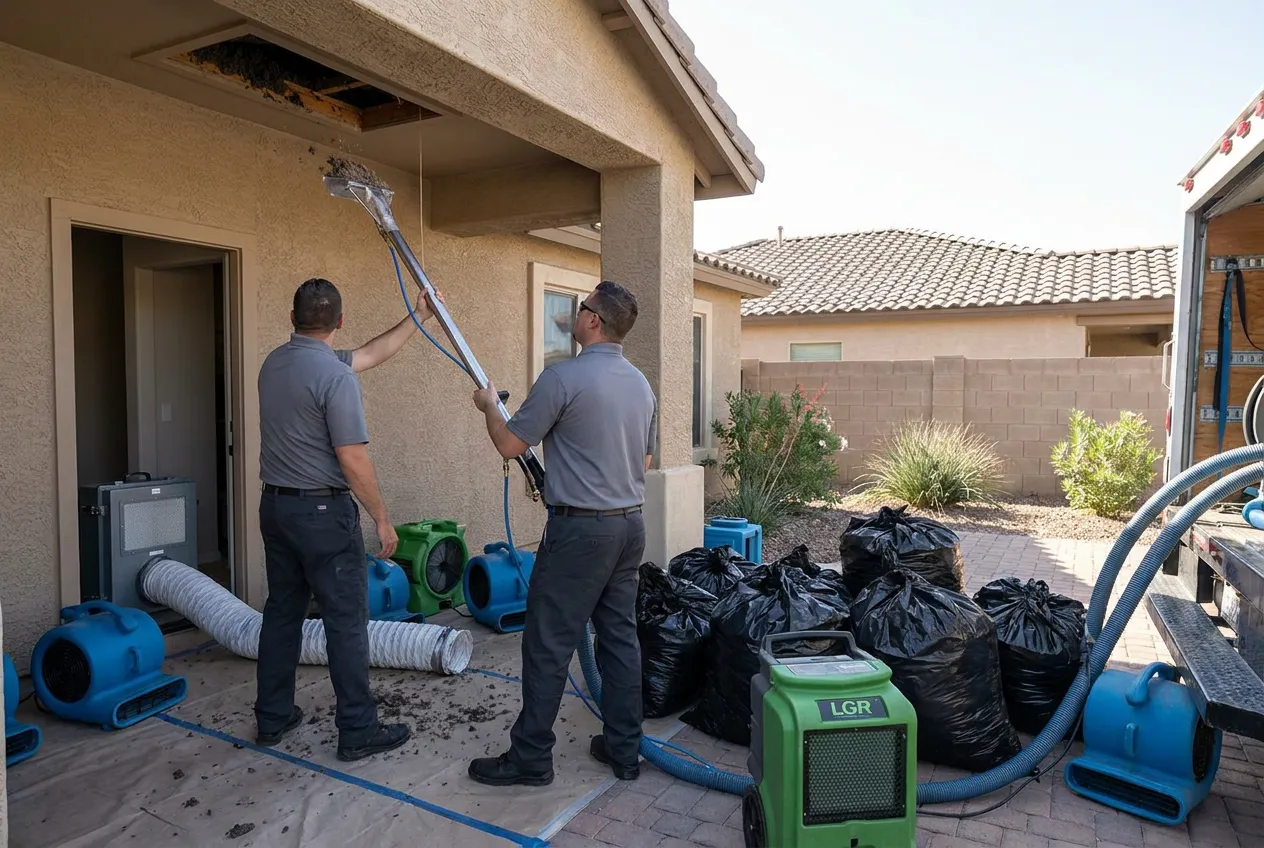
That handoff is where jobs stall. Tile replaced by one contractor, drywall by another, paint by a third, with a homeowner coordinating and a carrier waiting on three separate invoices. Holding both mitigation and general contracting licenses is what lets the same company tarp the roof, dry the attic, replace the ceiling, and repaint the room, under one estimate.
The prevention side is worth a paragraph, because storm damage is the most preventable category we handle. Before June: clear the roof drains and scuppers, look at the flashing around every penetration, cut back the branches that will become projectiles, check that the yard still grades away from the house, and know where your shutoff is. The monsoon guide has the full seasonal checklist.
Common Questions
The rain stopped and the ceiling stopped dripping. Do we still need someone out?
Yes. Dripping stops when the water has finished moving through the ceiling, not when the cavity is dry. Insulation, framing, and the top of the drywall stay wet and run on the same 24-to-48-hour clock as any other water loss.
Can you tarp a roof at night?
Sometimes, and it depends on the roof and the conditions. Wet concrete tile at night is genuinely dangerous, and there are nights where the right call is to contain the water inside and place the tarp at first light. We will tell you which one you have.
How do you prove the wind caused it?
Photographs of the opening, the debris pattern, the interior damage and its path, and the storm record for that date and location. Established at the start, it is a fact set. Reconstructed later, it is an argument.
A tree came down on the house. Is that you or a tree company?
Both, in order. Removal is a tree service, then the structure gets covered, dried, and rebuilt. We coordinate the sequence so the opening is not left standing overnight waiting on scheduling.
We're a business with a rooftop unit that leaked into a tenant suite.
That is routine commercial work — after-hours access, containment around the affected area, and documentation both the ownership group and the tenant's carrier can use. The commercial page covers how those jobs run.