
The Phoenix Mold Guide
Published September 1, 2026 · Last reviewed September 1, 2026 · Water Fighters Restoration
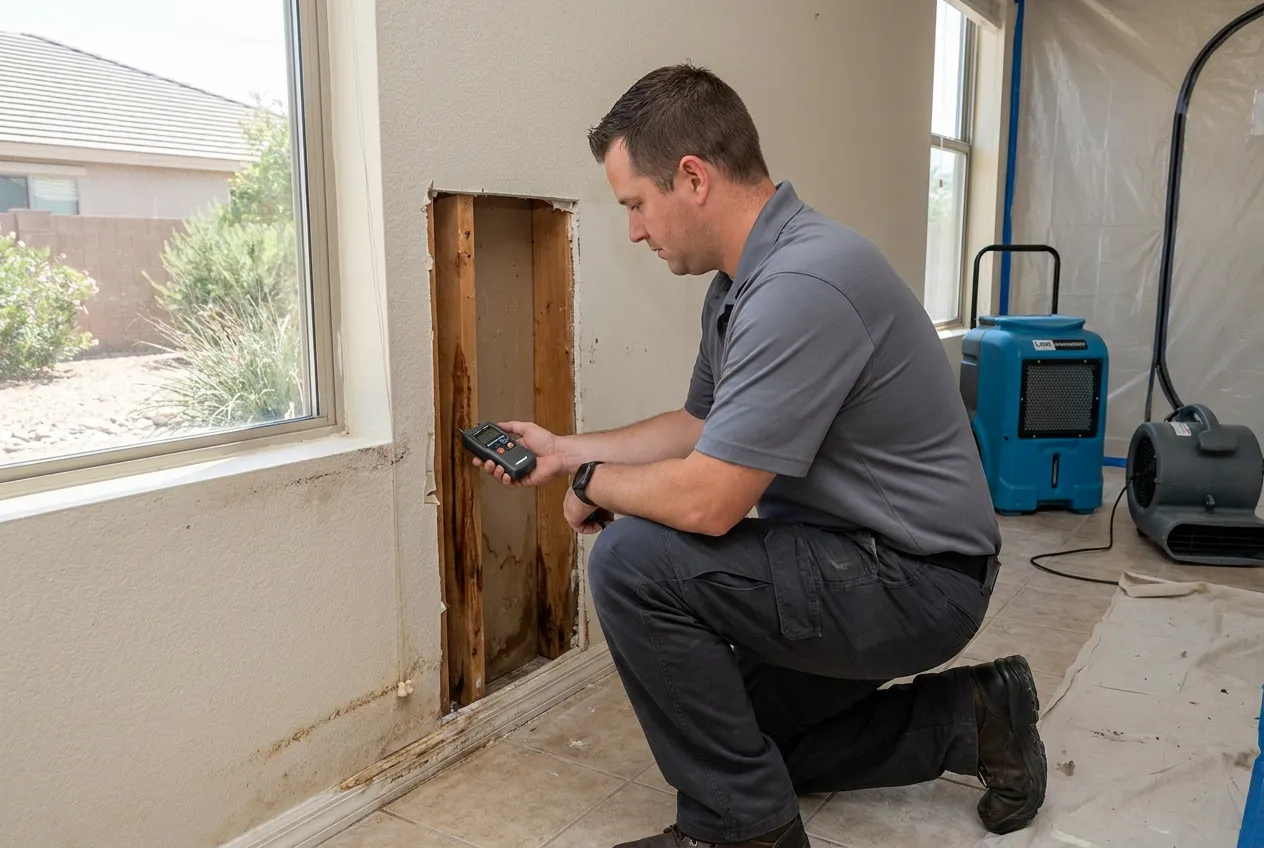
Phoenix is dry. That fact is useful outdoors and incomplete indoors.
The inside of a wet wall cavity does not share the afternoon forecast. Neither does damp insulation beneath an air handler, the space behind a cabinet, or the enclosed base of an evaporative cooler.
Mold needs moisture, a usable material, suitable conditions, and time. A plumbing leak or condensate overflow can provide all four inside a house surrounded by dry desert air.
That is why “Phoenix is too dry for mold” is the wrong test. The better question is whether one part of the building stayed wet long enough to support growth.
This guide explains how professionals evaluate that question. It covers testing, containment, HEPA filtration, clearance, insurance limits, and the rule that prevents repeat work: the moisture source has to be corrected.
The too-dry belief causes the wrong kind of waiting
A homeowner may notice a musty odor after the air conditioner starts. A baseboard may swell beside a bathroom wall. A ceiling stain may fade, then return during monsoon season.
Those signs are easy to dismiss in Phoenix because the outdoor air feels dry. The problem is that building assemblies create small enclosed climates.
Drywall paper, wood, dust, cabinet backing, insulation facing, and other common materials can support growth when moisture remains available. The wet area may be no larger than the space between two studs. It still has its own moisture conditions.
Air conditioning also changes the indoor picture. It removes moisture while operating correctly, but its condensate has to go somewhere. A blocked drain, failed pan, disconnected line, or overflow can place water inside an attic or wall path.
The desert does help exposed surfaces dry under the right conditions. It does not pull water through paint, tile, vinyl, cabinets, or sealed cavities on command.
A moisture meter is more useful than a weather app in that moment.
What mold needs inside a building
Mold growth is not explained by one ingredient. Professionals look for a combination:
- Moisture: a leak, overflow, intrusion, condensation path, or material that never finished drying.
- Material: paper-faced drywall, wood, settled dust, fabrics, insulation facing, and other organic residues.
- Time: enough continued or repeated wetting for growth to establish.
- An enclosed condition: a cavity or layered assembly that slows evaporation and hides the change.
Temperature matters too, but occupied buildings usually remain within a range where moisture becomes the controlling issue. Removing visible growth without controlling moisture leaves the main condition in place.
This is also why color does not identify the problem. Green, gray, brown, white, or dark growth cannot be reliably named from a photograph. The useful questions concern moisture, material condition, location, and extent.
Mold can raise irritant and allergen concerns that people reasonably have. A restoration company should not diagnose symptoms or promise a health outcome. Medical questions belong with a qualified healthcare professional.
The first 24 to 72 hours after water intrusion
The first 24 to 72 hours are a practical response window after water enters a building. They are not a guarantee that growth starts at a specific minute.
Materials, temperature, contamination, airflow, and prior conditions all affect what happens. A previously wet wall can behave differently from new drywall. A cabinet base enclosed on three sides can stay damp after the room surface feels normal.
The useful goal is to interrupt the wet condition early:
- Stop or isolate the water source through the appropriate trade.
- Classify the water and establish safe access.
- Extract standing water where conditions allow.
- Map moisture beyond the visible edge.
- Open or remove material only where evidence supports it.
- Dry the affected assembly and track its response.
- Reassess for odor, staining, deterioration, or visible growth.
Outside water and anything from a sewer or drain backup are Category 3. Those losses require contaminated-water controls rather than ordinary drying alone.
The Phoenix Water Damage Handbook explains the larger mitigation sequence. The monsoon flood guide covers outside-water entry, which is always Category 3.
Where mold grows in Phoenix homes
Mold does not need a Phoenix-specific species to become a Phoenix-specific building problem. The local pattern comes from cooling systems, roof and attic layouts, monsoon conditions, evaporative cooling, and housing eras.
AC condensate paths
Many Phoenix homes have air handlers in attics, though rooftop package units and closet installations also exist. An attic unit can leak above insulation and drywall before water becomes visible below.
Condensate may follow a framing member instead of dripping straight down. The first stain can appear several feet from the failed pan or drain. Insulation can hold water against ceiling drywall while the attic surface looks only slightly damp.
A recurring stain near a register, hallway, or mechanical route deserves source tracing. Painting over it removes the report, not the condition.
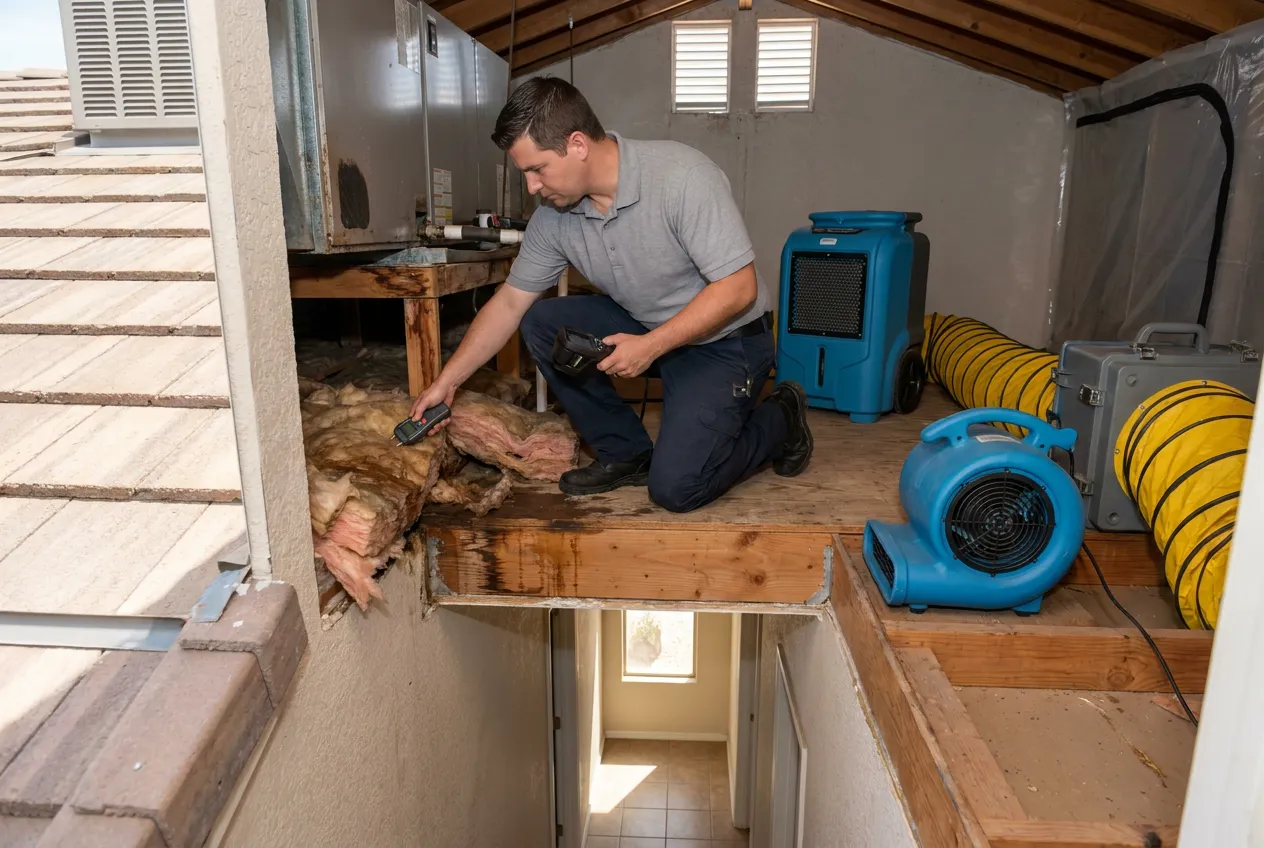
Attic and ceiling assemblies
Monsoon-driven roof or flashing failures can wet sheathing, insulation, trusses, and ceiling material. Thermal movement can open small paths that only leak during wind-driven rain.
Outside water entering the building is Category 3. Professionals plan containment and material handling accordingly.
Ceiling assemblies also have a safety issue. Saturated drywall softens and can sag or collapse. Older popcorn texture may require asbestos testing before disturbance. The ceiling water damage guide covers those immediate steps and the pre-1990 safety margin.
Behind-wall cavities
Supply lines, shower assemblies, appliance connections, and drain paths can wet a wall without producing a puddle. Paint may blister. A baseboard seam may open. The room may smell different after the door stays closed.
Behind-wall growth often follows a repeat source. A slow leak wets the same paper facing each day, then pauses long enough to hide at the surface.
Moisture mapping should include the other side of the wall. A bathroom leak may first show inside a bedroom closet. A kitchen line may reach a cabinet end panel before the drywall stain appears.
Evaporative coolers
An evaporative cooler intentionally uses water. Its water supply, distribution area, drain path, and roof or wall connection all deserve inspection when staining appears nearby.
The cooler itself is not proof of mold. A leak, overflow, or persistently wet surrounding assembly is the issue.
Because these units may sit above occupied rooms, the visible mark can be lower than the source. The inspection follows the water route through the roof or wall assembly.
Monsoon-season humidity spikes
Monsoon weather can raise outdoor humidity and add wind-driven rain. Indoor surfaces may also stay damp longer when cooling, ventilation, and enclosure conditions line up poorly.
Humidity alone does not prove hidden growth. It can slow drying after another moisture source has already wet the building.
The distinction matters. A remediation plan should correct the source rather than blame a season and leave the leak untouched.
Reading signs without pretending they are proof
Visible growth is one kind of evidence. It is not the only kind.
A professional assessment may consider:
- A recurring musty or earthy odor in one room.
- Staining that returns after painting.
- Soft drywall, swollen trim, or separating cabinet backing.
- Condensation where it should not remain.
- A known leak that was never moisture-mapped.
- Growth visible around an opening, register, baseboard, or access panel.
- A dry surface reading beside a wet concealed layer.
None of those details identifies a species. They help define where inspection should continue.
Odor can also have other sources. Staining can come from rust, dust, smoke, adhesives, or prior water movement. Testing and opening decisions should be tied to a question the result can answer.
Mold testing should have a purpose
Testing makes sense when the result will change the plan.
That may include a suspected hidden condition without visible growth, a disputed boundary, a need to compare areas, or a clearance requirement after remediation. It may also help when a property transaction, insurer, owner, or project standard requires documented findings.
Testing becomes theater when samples are collected without a defined question. A number on a report does not repair a condensate line. A swab does not show how far moisture traveled behind cabinets.
Visible growth with a known moisture source may not require testing before a professional begins defining the work. The project conditions and applicable requirements still control that decision.
Sampling also has limits. Air conditions change with doors, HVAC operation, cleaning, weather, and activity. A sample represents the place and time where it was collected. It does not make every concealed cavity visible.
The honest standard is simple: if testing comes back clean, we tell you so. A clean result may narrow the problem or redirect the inspection. It should not be turned into a sales tool.
What professional containment and HEPA work do
Containment separates the work area from occupied or unaffected space. Professionals build it around the location, amount of disturbance, and route used to remove material.
A typical professional sequence may include:
- Establishing a controlled work boundary.
- Protecting supply and return paths as the project requires.
- Using pressure control to keep disturbed particles from moving outward.
- Operating HEPA-filtered air-cleaning equipment.
- Removing affected porous material under controlled conditions.
- HEPA vacuuming and cleaning remaining surfaces.
- Correcting or coordinating correction of the moisture source.
- Drying the assembly and preparing it for verification.
This section describes what trained workers do. It is not a set of instructions for opening a contaminated wall without equipment, containment, or protective controls.
HEPA filtration is not a substitute for removal. It helps capture airborne particles while source material and settled residue are addressed.
The mold remediation service explains the residential process. The commercial mold remediation page covers occupied buildings, work zones, and operating constraints.
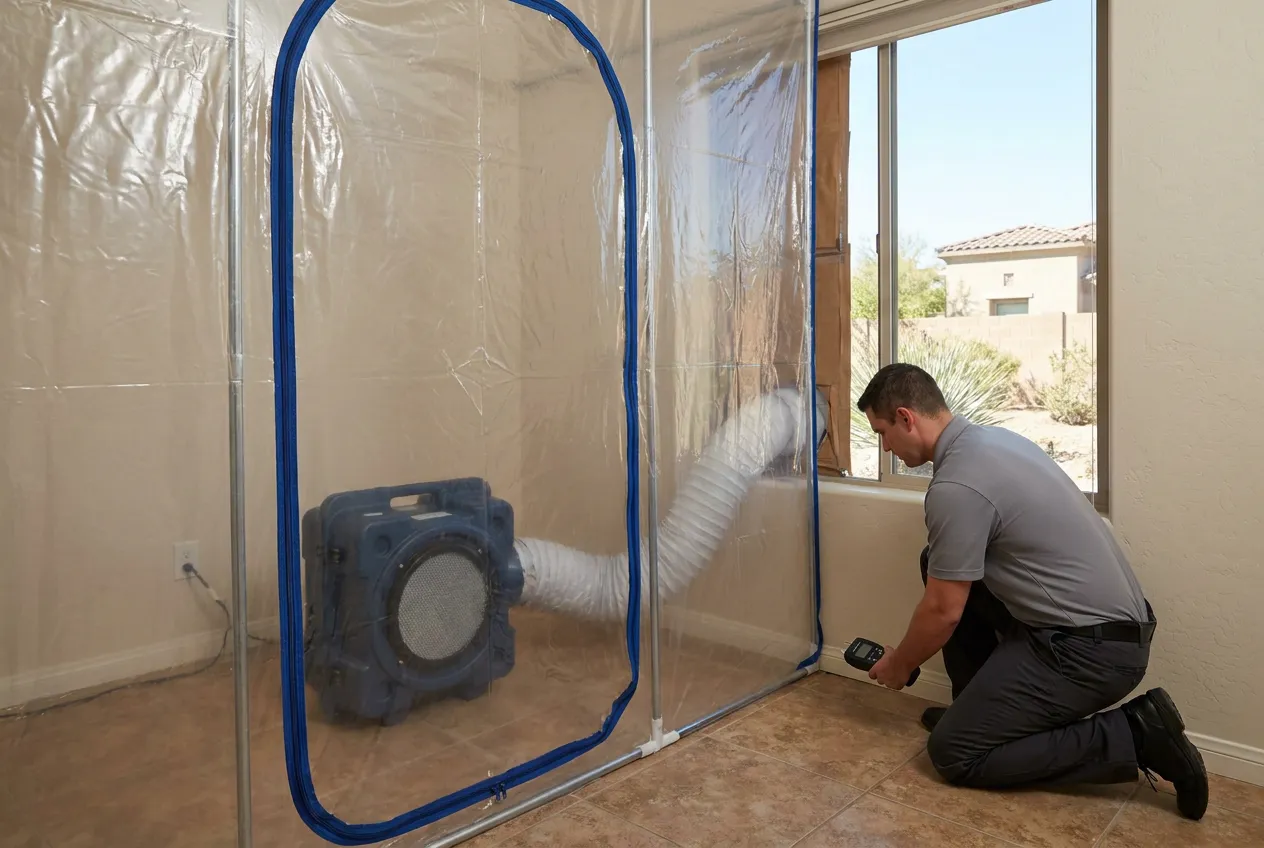
Clearance asks whether the work met its target
Clearance is the verification step after remediation. The required method depends on the project, written protocol, and reason for the work.
A clearance review may include a visual check, confirmation that removed material and residue are gone, moisture readings, and sampling when the protocol calls for it. The area should also be ready for reconstruction, not simply empty.
Clearance is most useful when the pass criteria were defined before work began. Otherwise, the project can end with several people using the word “clean” to mean different things.
A failed clearance is not a reason to hide the report. It is a reason to identify what remains, correct it, and verify again.
The moisture-source rule
Remediation without fixing the source is a repeat job.
That sentence is the center of the guide. Growth can be removed correctly and still return if the wall becomes wet again.
The source may require a plumber, roofer, HVAC contractor, pool company, or another appropriate trade. Restoration work then addresses the damaged building assembly and the conditions left behind.
Source control and remediation can overlap when emergency access is needed. They cannot be treated as unrelated jobs.
A slow slab-side leak is one example. The slab leak guide explains how concealed water can migrate before it appears. A pool line near a house can create another sustained moisture route, covered in the pool leak water damage guide.
Mold and the insurance policy
Insurance treatment varies by policy and cause. Mold coverage may have a sublimit, exclusion, endorsement, or requirement tied to a covered water event.
No contractor can promise coverage. The carrier interprets the policy and investigates the facts.
Documentation still matters. A useful file identifies the reported cause, discovery date, affected rooms, moisture readings, photographs, material condition, containment, removal, drying, and source-correction record.
The does insurance cover water damage guide explains common coverage questions without making a promise. The water-damage claim guide covers the records that help explain a loss.
Waiting can complicate both the building condition and the story. That does not mean every delayed claim is denied. It means the timeline should be accurate.
Housing eras change where the inspection starts
Phoenix-area homes do not share one pipe and assembly history.
Older galvanized-era homes
Older housing pockets may contain galvanized supply lines that corrode from the inside. A slow loss can continue behind a wall while pressure changes gradually.
The original core in El Mirage is likely the city's one galvanized-era pocket. The city around it is much newer, which shows why neighborhood and build era matter more than a city label alone.
Older finishes may also add lead-safe or asbestos questions before disturbance. Testing and regulated work belong with qualified professionals.
Polybutylene-window homes
Some homes built from roughly 1978 through 1995 may contain polybutylene, depending on phase and prior replacement.
Sun Lakes has phase-dependent exposure in Cottonwood, Palo Verde, and Ironwood. Apache Junction contains substantial housing from the broader installation era, including manufactured homes.
The pipe material is not the mold. It is the possible moisture source. The remediation plan still follows the wet assembly.
2000s production homes
Newer does not mean immune. Fast-growth communities can have shared ages among water heaters, appliance lines, valves, copper, and early PEX.
Roughly 91% of San Tan Valley homes were built after 2000. A concealed leak there may reach cabinets, continuous flooring, or slab-adjacent walls before the surface looks serious.
The common mistake is treating a modern finish as proof of a dry assembly.
Manufactured homes
Manufactured homes add an underfloor route. Water can reach particleboard subfloor, insulation, ducts, and belly-board material.
A room inspection alone may miss the wet layer below. Mold assessment and drying have to account for the assembly, access, and any contamination under the home.
Commercial mold work is an operating plan
A commercial building adds tenants, employees, customers, HVAC zones, access rules, and reporting lines.
Containment may allow unaffected areas to remain in use, but that decision depends on the building and work scope. It is not automatic.
Property management, ownership, tenants, the carrier, and the remediation team need the same room names and boundaries. After-hours work may reduce disruption. Certificates of insurance and vendor protocols may also be part of mobilization.
The commercial plan should state what remains open, what is isolated, how material leaves the building, and who receives daily updates.
Response, remediation, and rebuild
The first call establishes whether water is active, whether contaminated water is involved, where growth or odor appears, and whether occupants can avoid the area.
A professional assessment then defines moisture, visible conditions, likely concealed paths, and the purpose of any testing. Containment and removal follow a written scope. Drying and verification come before repair.
One team does mitigation and rebuild. That keeps opened drywall, removed baseboards, cabinets, or finishes connected to the same documented project.
Water Fighters Restoration is Open 24 hours, 7 days. The response promise is on-site within an hour. Water Fighters Restoration is IICRC Certified 70192944 · AZ ROC 324471 · ROC 324468 · EPA Lead-Safe Certified Firm · Licensed, Bonded & Insured.
Common Questions
What does a normal room-humidity reading fail to show inside a wall?
It cannot show moisture trapped between layers of a wall assembly. Paper facing, insulation, wood, or settled dust may remain damp behind a dry-looking finish even when the room reading appears normal.
Why should a mold test be tied to a decision before sampling?
The result should answer a question that can change the scope, boundary, or verification plan. Sampling without that purpose creates a report but does not define the remediation work.
What should mold-clearance criteria define before removal begins?
They should state what must be visually complete, dry, clean, and verified before containment comes down. Written criteria keep the final decision tied to the remediation protocol.
Can monsoon humidity slow drying without being the original moisture source?
Yes. Higher outdoor humidity can slow drying after a leak, overflow, or roof entry has already wet the building. The season can affect the drying conditions without replacing the source described in the monsoon flood guide.
What happens when a post-remediation clearance check does not pass?
The project returns to the unmet condition instead of hiding the result. The team identifies remaining residue, moisture, or another failed criterion, corrects it, and verifies the area again.
Why should mold documentation use consistent room names and sample locations?
A clear record lets owners, contractors, laboratories, and carriers refer to the same area. “Hall wall” is not enough when several corridors, samples, and containment boundaries appear in one file.
How does a manufactured-home floor assembly change a mold assessment?
The inspection may need to continue below the finished floor into particleboard, insulation, ducts, and belly-board material. Room conditions do not describe every underfloor layer detailed on the Apache Junction restoration page.
Why can two Phoenix homes of different build eras need different inspection starting points?
Their likely moisture sources and concealed assemblies can differ. A galvanized-era wall and a 2000s cabinet run call for different first checks, while the water path still controls the final scope.