Mold Remediation in North Phoenix
Published October 8, 2026 · Last reviewed October 8, 2026 · Water Fighters Restoration
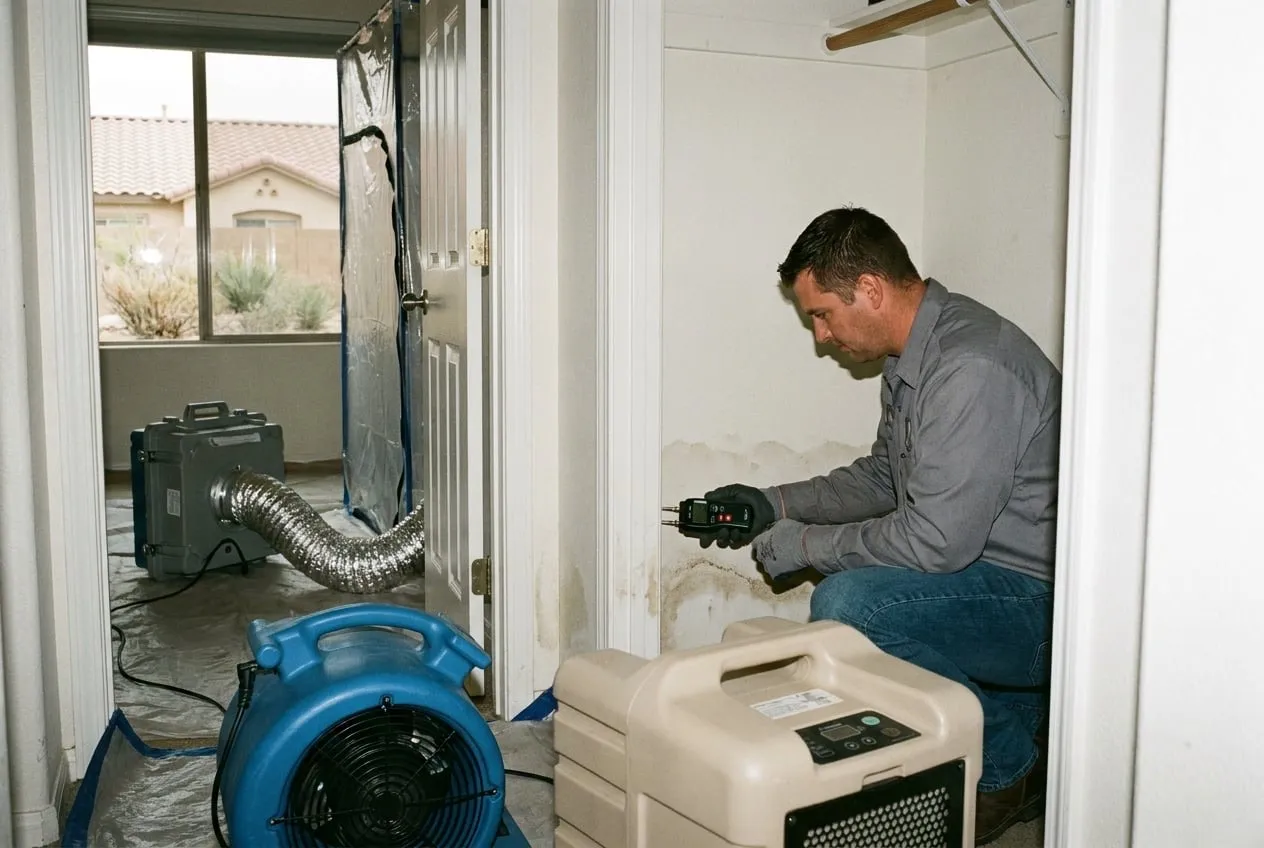
The laundry closet smells different when you open it after a weekend away. The baseboard behind the washer is soft at one corner, and the paint above it has gone faintly gray. The house was built in the 2000s, and nobody remembers a leak.
That is one way a mold question starts in a newer house. The water behind it almost always comes from the house itself: a supply line, a drain, or an air conditioner's condensate line. What you need first is an inspection that finds that source, because removing growth while the water keeps coming is a repeat job.
The houses on this page sit from roughly Bell Road north through Norterra and Stetson Valley, around Deer Valley and the I-17 corridor. The Deer Valley page covers the neighborhood around the company's staffed location there. South of Bell, the North Phoenix page picks up from Cactus to Bell. Neighborhoods to the east have the Desert Ridge page.
Young houses, and water that starts indoors
In 85085, about 9 in 10 homes date from 2000 or later: 47.4% from the 2000s, 34.4% from the 2010s and 9.3% from 2020 on. In 85083, more than 8 in 10 date from 2000 or later, and two-thirds (66.8%) come from the 2000s alone. 85027 is the older belt, with about 62% built from 1980 to 1999 and another 18.6% from the 1970s. Up here, the housing gets newer as you go north, not older.
That timing matters for mold. A Salt River Stories history published through ASU says "as many as 90 percent" of Phoenix-area homes had swamp coolers by the 1950s. The same history says central air "was included in much new construction by the end of the 1960s." The large majority of homes in these three ZIPs went up well after that point. Statewide, EIA's 2020 survey found 86% of Arizona homes use central air.
So the moisture behind a mold job here usually comes from the house's own water systems, not the weather. Think of a supply line weeping inside a wall, a drain joint under a vanity, or a condensate line that quits flowing in August. Supply-side failures have their own burst pipe and slab leak page, and drain backups have the north Phoenix sewage page. A ceiling stain near the air handler starts with the ceiling water damage guide.
If water got in during the September storms, the job starts differently. Outside water that entered the house is Category 3, and the monsoon flood guide covers how it gets in.
Inspection comes before any test
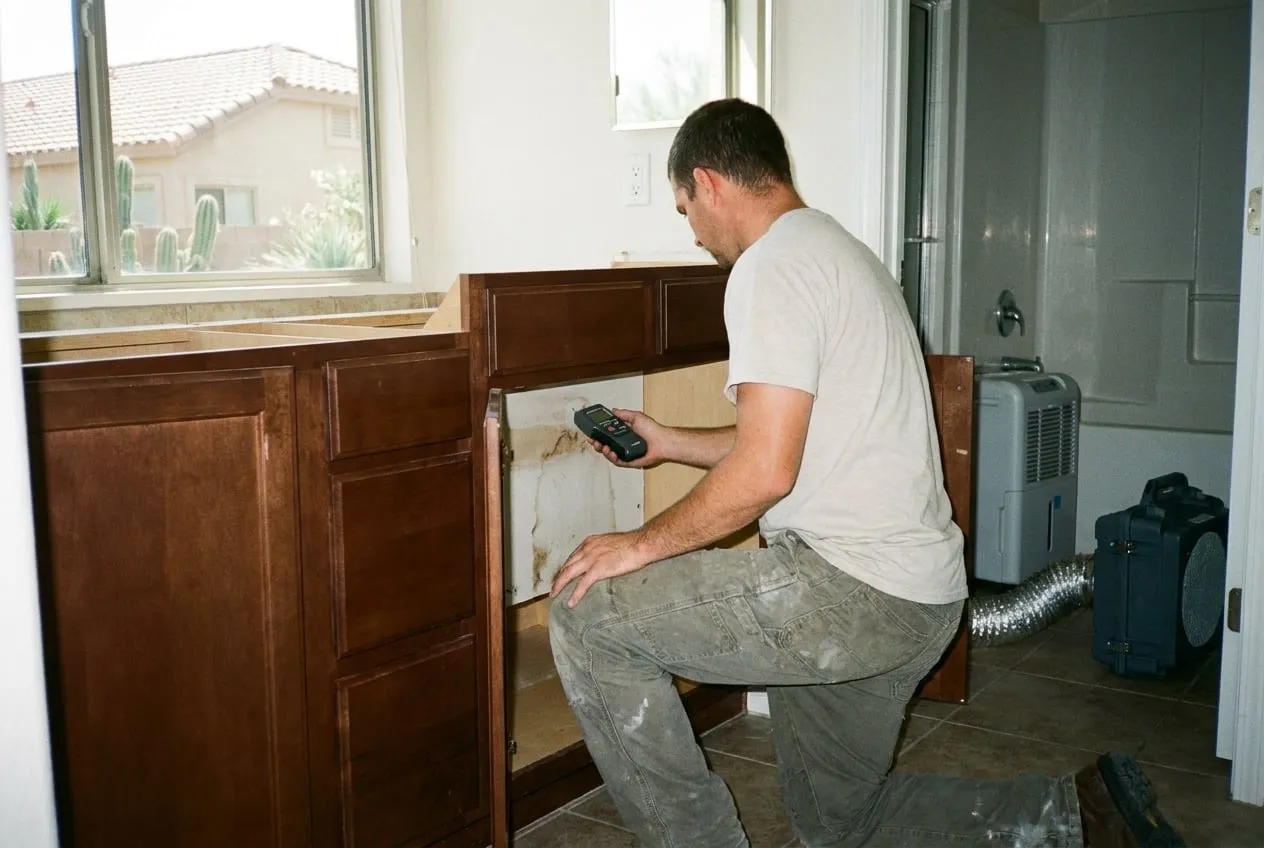
Visible mold usually does not need a lab test to prove it is there. EPA says "in most cases, if visible mold growth is present, sampling is unnecessary." CDC goes further: "CDC does not recommend mold testing," and it sets no standard for an acceptable quantity.
What decides the job is the moisture source. The inspection maps moisture with meters, follows the wet area back to where it starts, and marks the edge of the affected material. Finding that source comes first.
Testing earns its place when a result would change the plan. That can mean a suspected hidden source with nothing visible, a home sale, or clearance after the work. It is not a box every job checks before anyone opens a wall. The Phoenix mold guide explains containment, HEPA filtration and clearance step by step.
Choosing who opens the wall
Arizona has no state licensing program specific to mold inspectors or remediators. So there is no state mold-specific credential to look up when you call a company. Four questions cover part of that gap, and you should ask them of us too.
- Where is the water coming from? A scope that names the growth but not the source is half a scope.
- What comes out, and what stays? The industry's remediation standard emphasizes physical removal over spraying products on mold.
- How will we know it's finished? The pass criteria should be written down before the work starts, not after.
- Who puts the wall back? One team does mitigation and rebuild here, so the opened wall, the drying record and the new drywall stay in one file.
For rental owners and property managers, the commercial mold remediation page covers occupied buildings and tenant files.
After the wall closes
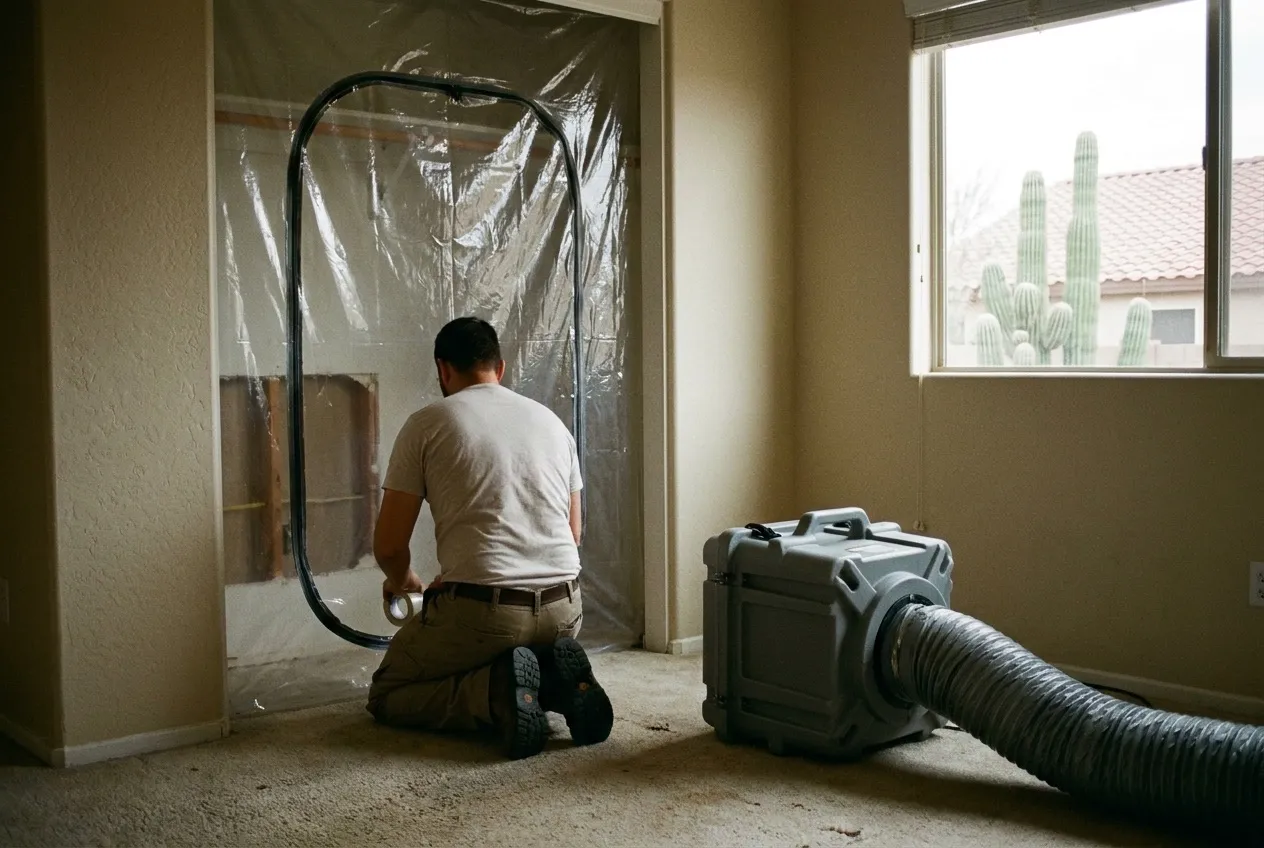
Mold that was removed stays gone only if the wall stays dry. In most of these houses, the air conditioner carries that load. EPA says to keep AC drip pans clean and drain lines "unobstructed and flowing properly."
That much is homeowner upkeep. Opening walls, scrubbing growth and cleaning HVAC components are professional work. If the condensate line backs up and wets a ceiling or wall again, call before the drywall gets a second season of water. The full mold remediation page walks through the service from inspection to rebuild.
Common Questions
Does Arizona license mold inspectors or mold remediation companies?
No. Arizona has no state licensing program specific to mold inspectors or remediators. The Environmental Law Institute's 2024 state mold-law database lists only two Arizona mold provisions: foster and group-care home rules, and ADHS lodging rules. ELI notes its chart is not exhaustive. States such as Texas, Florida, New York and Louisiana do run licensing programs. Without a state program, the working yardstick is ANSI/IICRC S520, 4th edition (2024), the industry standard. Water Fighters Restoration is IICRC Certified 70192944.
Will a city or county agency come inspect our house for mold?
Generally not, for a private home. Maricopa County's air-quality department lists "indoor air quality or mold" among the things it does not regulate and refers those questions to the Arizona Department of Health Services. In early 2022, the county's Environmental Services Department told ABC15 that "no governmental entity has jurisdiction" over residential mold. EPA has set no federal limits for mold or mold spores, so there is no indoor number an inspector would test against. The Phoenix mold guide explains when sampling is still worth doing.
We're selling. Does the Arizona REALTORS® disclosure form ask about mold that was already fixed?
It can. The standard Arizona REALTORS® seller disclosure form has an environmental section that covers mold, and it generally asks about past or present mold and about conditions like water damage or leaks. It is an association form most agents and brokerages require, not a state statute. Keep the remediation file with your house records. How to answer any line on the form is a question for your agent or a real estate attorney.
Was the 2026 monsoon actually wetter than normal up here?
Countywide, yes, by preliminary data, while Sky Harbor finished about at normal. Preliminary Flood Control District of Maricopa County gauge data, reported Sept. 30, 2026, put the season at roughly 130% of average countywide. Phoenix's official Sky Harbor gauge took 2.48 inches against a normal of 2.43, per KTAR. A meteorologist quoted by KTAR said the north and western Valley saw the most rain. NWS said the Sept. 16 storm's heaviest rain ran from northern Pinal through northern Maricopa County, "2 to 4 inches, most of which fell within a two- to three-hour period." County reporting also named Sept. 24 and the last week of September. Even so, most mold jobs start inside the house, and storm water that got in is Category 3, covered in the monsoon flood guide.
What indoor humidity should we keep after a mold job?
EPA says to keep indoor humidity below 60%, ideally between 30% and 50%, "if possible." CDC's figure is "no higher than 50%." Only about 3% of Arizona homes use a dehumidifier, per EIA's 2020 survey, so in most houses the air conditioner does that work. That makes a clear, flowing condensate line part of keeping the job finished.