
Water Damage Restoration in North Phoenix
Published September 2, 2026 · Last reviewed October 8, 2026 · Water Fighters Restoration
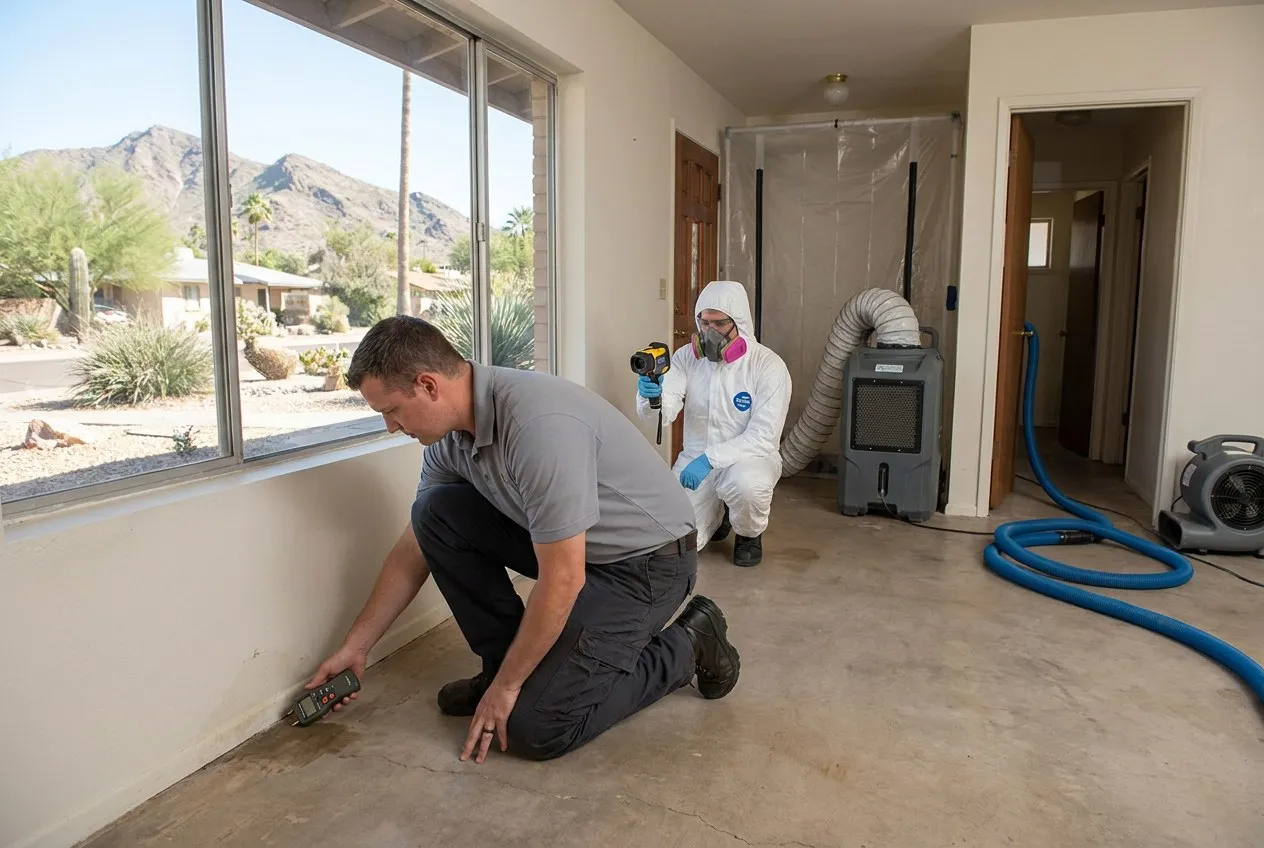
North Phoenix, for this page, means Moon Valley, North Mountain, Lookout Mountain, and the corridor between 7th Street and 7th Avenue. The working boundary runs from about Cactus Road to Bell Road, between Interstate 17 and State Route 51.
That boundary keeps four nearby pages from competing. Sunnyslope ends around Cactus Road. Deer Valley covers the northwestern growth and flood-control corridor. Desert Ridge covers newer development east of State Route 51.
Inside this area, the main water story is not a live river. It is 1960s copper, late-1970s-through-1990s pipe eras, slab construction, shared-wall hillside housing, and old shower assemblies.
The housing clock changes block by block
Most of the area west of 16th Street lies within Phoenix's North Mountain urban village, home to roughly 170,000 people; about 37 percent of that village's land is parks and preserves. The city's village map puts the Greenway-to-Bell blocks west of about 7th Avenue in Deer Valley Village, and the neighborhoods east of 16th Street in Paradise Valley Village.
Moon Valley began in the early 1960s. It contains roughly 1,600 homes in 29 subdivisions around the member-owned country club.
Median build years show the outward sequence. ZIP 85020, just south of Cactus Road, centers around 1978; inside the area, ZIP 85023 centers around 1984 and ZIP 85022 around 1986. The early golf-course core is older than the hillside townhome and patio-home growth around it.
North Mountain and Shaw Butte rise above the neighborhoods at just over 2,100 feet. Those elevations belong to the peaks, not the streets, so they do not create a neighborhood freeze narrative.
A century of engineering redirected the old flood route
Cave Creek Wash flooded Phoenix in 1905 and 1921. The 1921 flood reached the State Capitol.
Cave Creek Dam followed in 1923. The Army Corps later completed Cave Buttes Dam in 1979–80 as the working replacement. Dreamy Draw Dam was completed in 1973 on the southeast flank.
The Arizona Canal Diversion Channel runs about 13 miles along the canal and intercepts mountain runoff. A June 1972 storm ruptured an irrigation ditch and caused major flooding across Phoenix, helping drive the flood-control work of that era.
The August 19, 2014 storm dropped two to more than four inches across Cave Creek and New River headwaters. It showed the scale of water those structures and channels stand between and the city grid.
This is a protection history, not a claim that upstream flow ran through Moon Valley streets. No named Moon Valley Wash is used here. The city's planning material refers generally to Moon Valley washes and other natural features.
Water crossing a wash, street, or yard before entering a building is Category 3. The storm damage service covers that response.
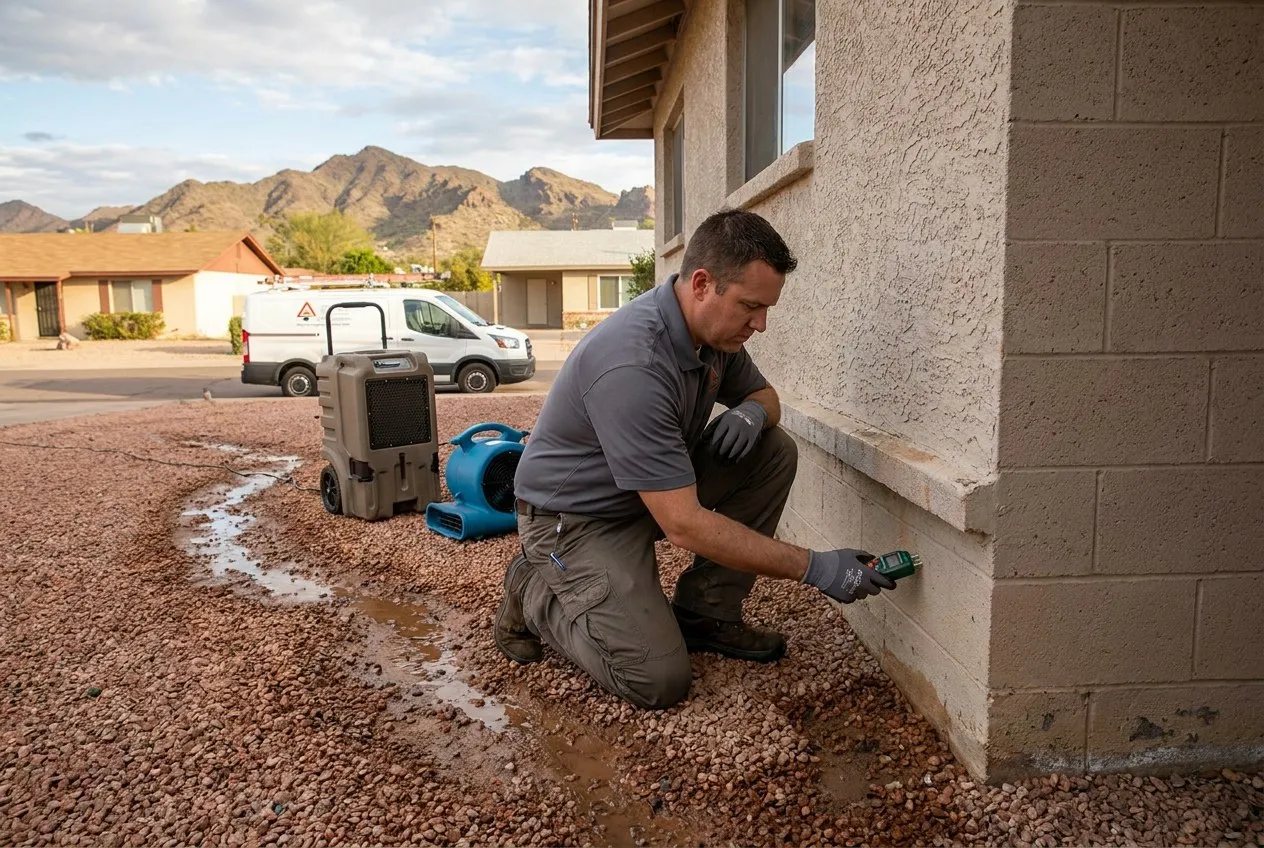
Water Fighters Restoration is Open 24 hours, 7 days. Crews stage as one licensed team, Valley-wide, with the promise on-site within an hour.
Three pipe eras guide the first inspection
- Early-1960s-through-1970s core: Copper-era slab homes now carry five to six decades of service. Pinhole and under-slab losses fit this group.
- Late-1970s-through-mid-1990s expansion: Some homes fall within the polybutylene window. Pipe material remains subdivision- and property-specific.
- Later remodels and infill: New fixtures and supply sections may connect to older concealed systems, creating mixed-era transition points.
The core should not be blanketed with polybutylene. Many Moon Valley homes predate its common use and belong to the copper-era slab story.
The slab leak guide explains warm flooring, meter movement, pressure changes, and concealed moisture. The burst-pipe guide covers active pressurized releases above the slab.
Preserve-edge housing adds slope and shared walls
Hillside townhomes and patio homes expanded along the preserve edges during the late 1970s and 1980s. The Pointe at Tapatio Cliffs opened in 1982 and anchored the 7th Street corridor's early-1980s build-out.
Shared walls change the map. Water from one roof, shower, supply line, or patio can move downslope or into the adjoining unit. Association documents and building access may become part of the response.
Slope also changes exterior entry. Runoff can collect at a patio wall, descend stairs, or enter a lower room even when the street remains dry.
North of the Arizona Canal, flood-irrigated-yard copy does not belong. Irrigation did not extend north into this corridor.
Interior losses follow familiar rooms with older assemblies
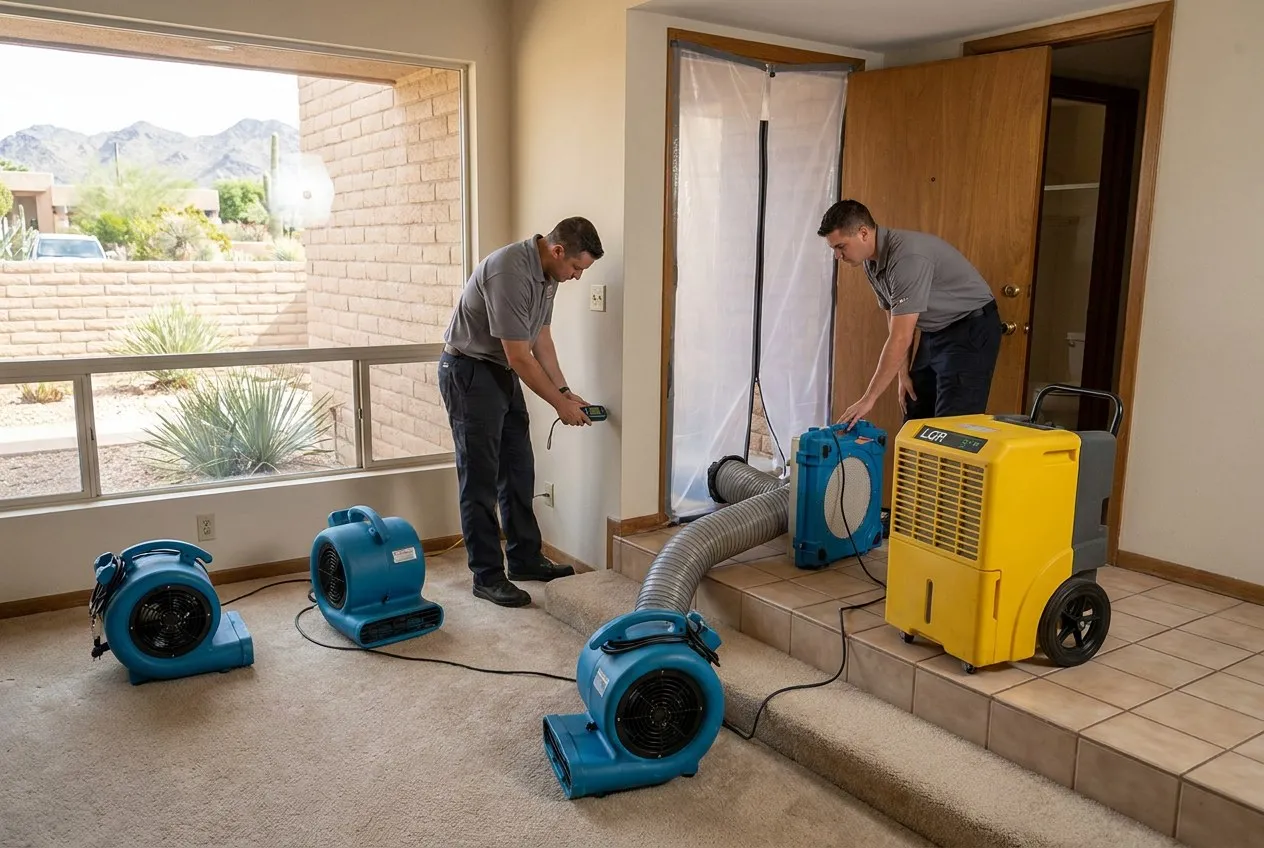
A sunken living room becomes the lowest collection point during a supply loss. Extraction starts there, but moisture mapping must continue up the step and beneath adjoining flooring.
Original tile showers can fail at the mortar-bed pan, drain connection, curb, or wall transition. Water may reach a hallway before the shower surface looks damaged.
Block masonry also changes drying. Moisture can remain in mortar joints, filled cells, coatings, and adjoining finishes after the room surface looks dry. Readings at several heights show the retained path.
The first sign may be one cool rectangle behind a sofa, followed by a white mineral edge as the wall dries.
City of Phoenix water and sewer serve the area. Wells and septic are not the local default.
Once the source is controlled, technicians extract water, map the assembly, and make selective openings where needed. One team does mitigation and rebuild.
Water Fighters Restoration is IICRC Certified 70192944 · AZ ROC 324471 · ROC 324468 · EPA Lead-Safe Certified Firm · Licensed, Bonded & Insured.
Common Questions
Does 1960s or 1970s block masonry hold water longer than wood framing?
It can retain water differently in mortar joints, cells, coatings, and attached finishes. Drying time depends on the exact assembly, so technicians compare several heights through the water damage process.
Once copper pinhole leaks begin, do they usually cluster?
They can appear in more than one location because nearby pipe shares age and service conditions. One pinhole does not prove the whole system will fail, but it supports a broader plumbing assessment and slab-loss review.
Does a sunken living room change extraction and drying?
Yes. It becomes the lowest collection point, so extraction begins there while moisture mapping continues into the higher adjoining floor and wall bases.
Why can an original tile shower leak into the hallway?
Water can escape through a failed mortar-bed pan, curb, drain connection, or wall transition. The opening plan follows the wet path below the tile rather than replacing only the visible grout.
What is Orangeburg sewer pipe, and why does it fail?
Orangeburg is a compressed fiber pipe used in some mid-century metro construction. It can deform, blister, or lose shape. No neighborhood-wide prevalence is claimed. Any indoor release is Category 3 and belongs in sewage cleanup.