
Emergency Flood Cleanup in Phoenix
Published August 4, 2026 · Last reviewed October 8, 2026 · Water Fighters Restoration
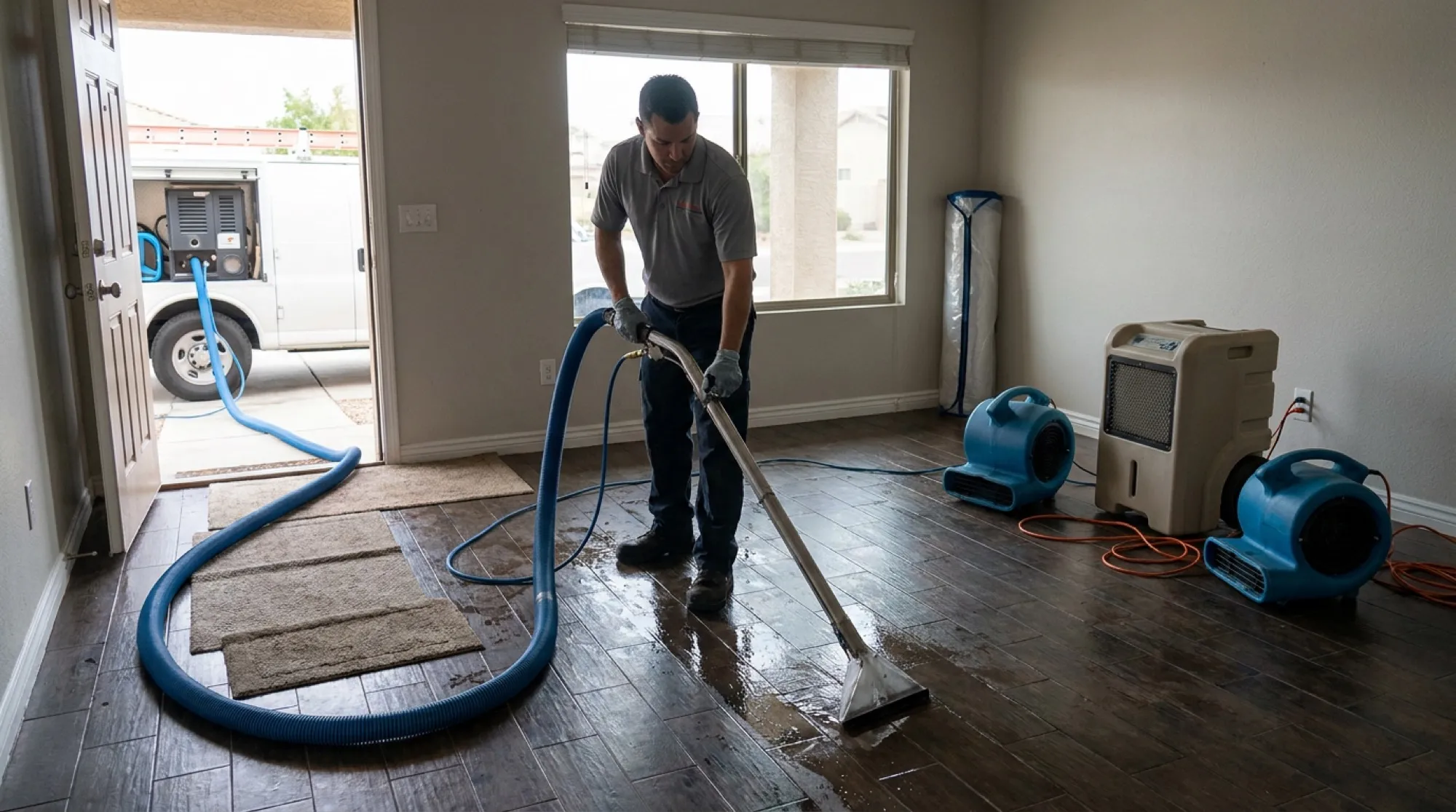
A supply line lets go under the kitchen sink. A water heater splits in the garage. The washing machine hose bursts while you're at work, and you come home to an inch of water moving through the hallway. However it started, you're standing in it now — and every minute the water sits, it's soaking deeper into drywall, baseboards, and the pad under your carpet.
Water Fighters answers the phone 24 hours a day and is on-site within an hour, anywhere in the greater Phoenix Valley. One call gets a crew, truck-mounted extractors, and a plan.
What To Do Right Now
Before we get there, five things — in this order:
- Stop the water if you can. The main house shutoff is usually near the water heater, in the garage, or on the outside wall where the line enters the house. Turn it clockwise. Leave the meter box at the curb to your water provider; if the house valve won't close, call them to shut it off at the meter (Phoenix Water: 602-261-8000, 24/7).
- Kill power to wet rooms. If water is anywhere near outlets or the breaker panel looks dry and reachable, flip the breakers for the affected rooms. If the panel itself is wet, leave it alone and tell us when you call.
- Don't run the AC or fans yet. Moving air before extraction spreads moisture into rooms that are still dry.
- Move what matters. Electronics, documents, photos — up and out. Leave furniture; we bring blocks and foil for that.
- Call (602) 884-5325. Tell us what's flooding and where. A crew starts rolling while we talk.
What Happens When We Arrive
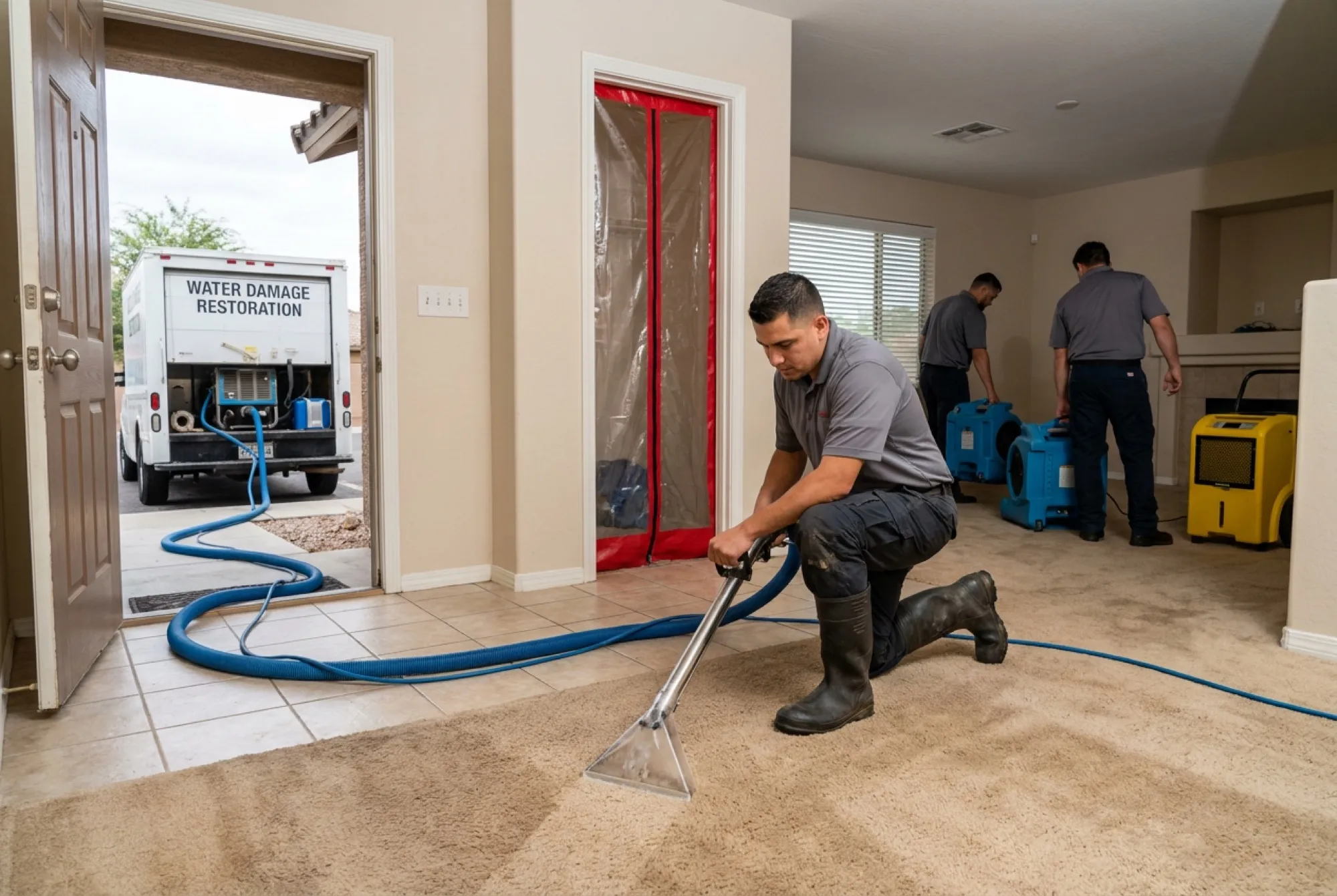
The first hour on-site follows the same sequence every time, because the sequence is what saves your floors and walls.
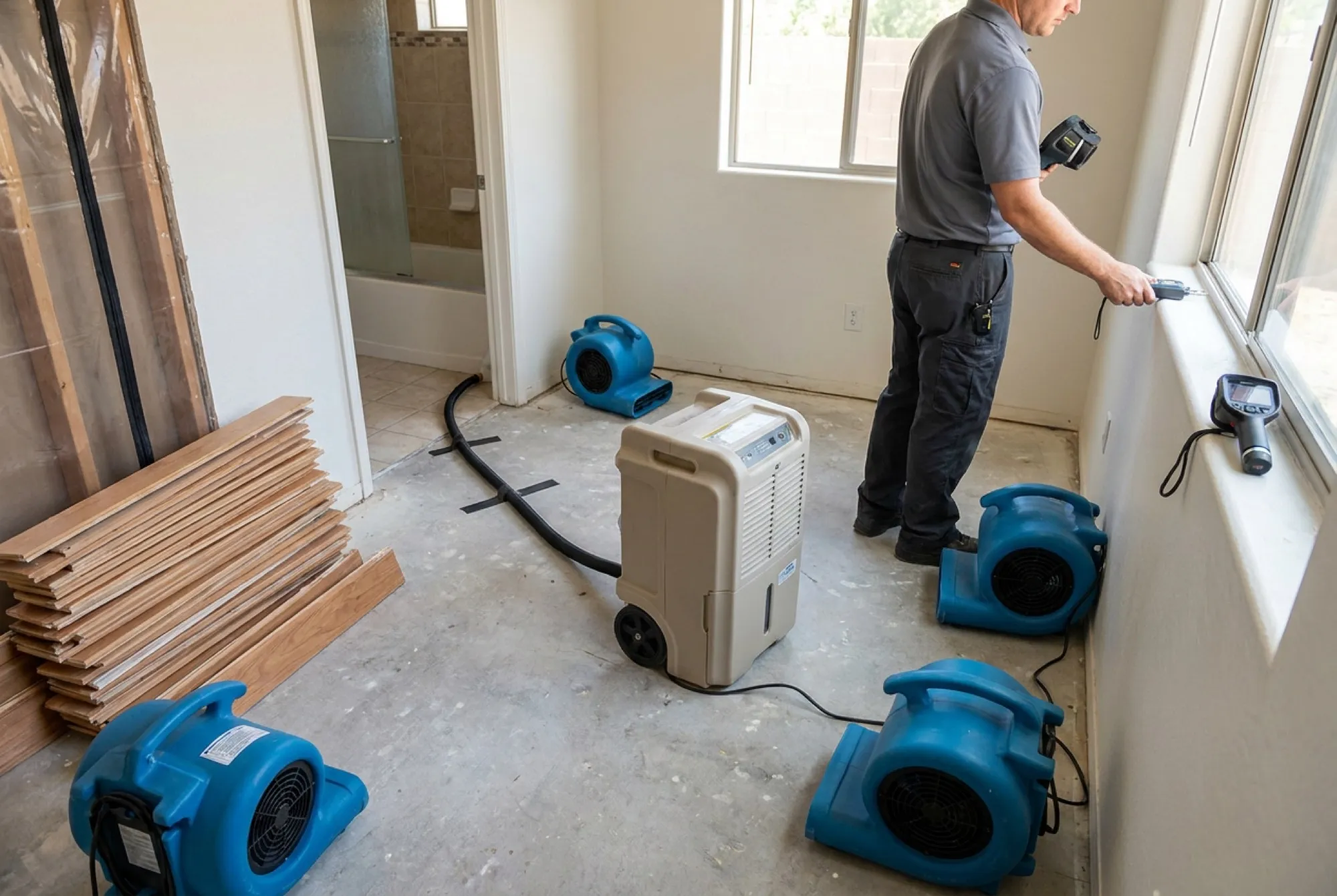
We find and confirm the source first. There's no point extracting water that's still coming. If the leak is inside a wall or under the slab, we trace it with moisture meters and thermal imaging rather than opening drywall on a guess.
Extraction starts immediately after. Truck-mounted units pull hundreds of gallons an hour — standing water off tile, and the water you can't see out of carpet and pad. Then we map the damage: moisture readings on every affected wall, floor, and ceiling, photographed and logged. Those readings and photos become the file your insurance adjuster works from, which is why we document like it's evidence. Because it is.
Before we leave, drying equipment is placed and running — air movers positioned by the moisture map, dehumidifiers sized to the room volume, wall cavities opened only where the meters say they must be. You get a walkthrough of exactly what's wet, what's drying, and what happens next.
Why the First 24 Hours Decide Everything
Water damage is a clock, and in Phoenix the clock runs fast.
Drywall wicks water upward — a half inch of standing water becomes a wet wall two feet high by the next morning. Baseboards and MDF cabinets swell within hours and don't swell back. And in a Phoenix summer, with monsoon humidity or an air-conditioned 78 degrees indoors, mold can begin colonizing wet materials in 24 to 48 hours. Once that happens, a drying job becomes a mold remediation job, with containment and removal added before anything gets put back.
The category of water matters too. Clean supply-line water (what the industry calls Category 1) is the easy case if it's handled fast. Water that sat, or came through a dishwasher or washing machine, is Category 2 and contaminated. Anything touching sewage is Category 3 — that's a different job entirely, and it's why we run a dedicated sewage cleanup service. Fast response keeps a Category 1 loss from becoming a Category 2 problem.
What It Costs & How Insurance Works
Every job is priced off what the water actually reached — how many rooms are affected, how long it sat, and whether wall cavities need drying. Whole-home floods run higher than a single room. You'll know the number before we start — the estimate is free, and it's the same estimate we send your insurance company. No contractor math, no second version.
Sudden and accidental water damage — burst pipes, failed supply lines, appliance failures — is covered by most homeowner policies. We bill your insurance directly, work with every major carrier, and handle the documentation the adjuster needs. If you'd rather not file a claim, or the damage falls under your deductible, we offer financing. Either way, the water comes out tonight.
Where We Respond
Everywhere in the Valley, within the hour: Phoenix, Scottsdale, Peoria, Glendale, Mesa, Chandler, Gilbert, Tempe, Surprise, Paradise Valley, Cave Creek, Anthem, Fountain Hills, Queen Creek, and the rest of Maricopa County. If you're not sure you're in range, call — the answer is almost certainly yes. See the full service area.
Flood cleanup, by city: Peoria · Glendale · Scottsdale · Paradise Valley · Mesa · Chandler · Gilbert · Tempe · Surprise · Cave Creek · Anthem · Fountain Hills · Queen Creek
Common Questions
How fast can you actually get here?
On-site within an hour, anywhere in the greater Phoenix Valley, any hour of the day or night. The crew is dispatched during your call, not after it.
Should I try to remove the water myself first?
Shut off the source and move valuables — that genuinely helps. But a shop vac can't pull water out of carpet pad, drywall, or sill plates, and those are the materials that grow mold. Leave the extraction to truck-mounted equipment.
Does homeowners insurance cover flood cleanup?
If the water came from inside the home — a burst pipe, a failed water heater, an appliance line — most policies cover it as sudden and accidental damage. Rising water from outside (a true flood) requires separate flood insurance. We'll tell you honestly which situation you're in during the free estimate.
How long does drying take?
Typically three to five days of equipment run time, verified by daily moisture readings — not by guessing. We don't pull equipment until the numbers say the structure is dry.
Will you have to cut open my walls?
Only where the meters say water is trapped. We drill discreet weep holes or remove baseboards first when that's enough. When drywall must come out, we cut clean lines that make the rebuild simple.
The water stopped spreading. Do I still need to call tonight?
Yes. The visible spreading stopped; the wicking didn't. Water keeps climbing drywall and soaking into framing for hours after the surface looks stable, and the mold clock is already running.
Can you dry it without me filing an insurance claim?
Of course. About a third of our emergency calls are paid out of pocket, either by choice or because the loss is near the deductible. The free estimate gives you the real number so you can decide with facts.
Do you handle water from a roof leak during a monsoon storm?
Yes — monsoon season is our busiest stretch. Storm-driven roof and window intrusion is handled the same way: extract, dry, document. If wind or rain caused the opening, that's typically a covered peril too.
What if the leak is under my slab?
Slab leaks are common in Valley homes, especially older ones with copper or polybutylene lines. We locate the moisture, dry the affected flooring and walls, and coordinate with your plumber on the line repair — then handle the restoration and rebuild as one job.
Should I turn off the electricity after a water leak?
Yes — kill the breakers for any room where water has reached outlets, cords, or appliances, if you can get to the panel without stepping in water. If the path to the panel is wet, or the panel itself is, stay back and leave it alone until an electrician or the fire department clears it.
In most Phoenix homes the panel is in the garage or on an exterior wall, which usually keeps the path dry even when a hallway is flooded. Flip the individual room breakers rather than the main if you can identify them; a dark house at night creates its own hazards. Once a breaker is off, leave it off — do not reset it because the floor looks dry, because the outlets and junction boxes behind that wall may not be.
Cutting the power is the one job in the first ten minutes that is genuinely yours. Everything after it runs faster when it's done: tell us on the call whether the affected rooms are live or dead, because it changes what the crew stages and how fast extraction starts.
Should I poke a hole in a bulging ceiling to let the water out?
Yes, if the bulge is drywall and you can reach it safely. Put a bucket under it, stand to the side, and drive one small hole at the lowest point of the sag with a screwdriver. Controlled draining beats the ceiling letting go on its own.
Do not do it if the ceiling is old plaster over lath, if the water could be sewage from a bathroom above, or if there is a light fixture or ceiling fan near the sag. Water tracks along wiring, and the box above that fixture may be holding some of it. Kill the breaker for that room first if you are unsure. One hole drains it. Ten holes turns a repairable ceiling into a replaced ceiling.
Draining the bulge buys you an hour. It does not dry what is above it, and in most Valley houses that is a vented attic packed with blown-in insulation, which does not dry in place — it comes out. Call while the bucket is filling.
How do I know if my ceiling is about to collapse?
A sagging or bowing section is the last warning — get everyone out of that room now. The earlier signs: new spider cracks spreading out from a stain, nail pops or screw heads pressing through the paint, texture bubbling, and a damp line that keeps widening. Drywall holds water until it doesn't, and the failure is sudden, not gradual.
The physics is weight. A gallon of water weighs a little over eight pounds, and a soaked ceiling cavity can be holding dozens of gallons across insulation and drywall that were engineered to hold none. When saturated drywall lets go, it comes down as a sheet, not a drip — which is why the rule is simple: nobody stands or sleeps under a stained, cracking, or sagging ceiling, and kids and pets stay out of the room entirely. If the bulge is small and reachable, the previous answer covers the controlled drain that buys time.
The ceiling coming down is the visible risk. The saturated framing and insulation above it are the expensive one, and they do not dry on their own. A crew can drop the compromised section with one controlled cut and have drying equipment in the cavity the same visit — which is the difference between replacing a ceiling and replacing a room.
Are fans enough to dry out water damage?
No. Fans move water into the air; they don't remove it from the room. Without dehumidification pulling that moisture back out, you're recirculating it — the carpet feels drier while the drywall, baseboards, and framing keep absorbing. Surface-dry and structure-dry are different claims, and fans only make the first one.
The physics is short: evaporation loads the room's air with moisture, and once humidity climbs, evaporation slows to a crawl — a box fan pointed at wet carpet in a closed house mostly relocates the problem into cool wall cavities and the rooms next door, spores included. A real dry-out inverts the order: extraction first, because a truck-mounted unit removes water hundreds of times faster than evaporation ever will, then air movers and dehumidifiers sized to the room's volume, repositioned daily against moisture readings. The 24-to-48-hour mold clock doesn't pause because air is moving.
The honest test is measurement, not touch — how drying actually works covers the standard. If fans were enough, drying logs wouldn't exist.