Frequently Asked Questions
Published August 4, 2026 · Last reviewed October 8, 2026 · Water Fighters Restoration
Forty questions we get asked most, grouped by topic. If yours isn't here, call (602) 884-5325 — we answer 24 hours a day and there's no charge for a question.
Right Now: Emergencies
Who should I call first — a plumber or you?
Call us first if water is actively in the house. We stop the spread, extract, and start drying while you arrange the plumbing repair; waiting for a plumber to finish before starting mitigation costs you hours the drywall doesn't have. If the leak is contained and nothing is wet, call the plumber first.
Should I shut off my water main?
If water is running and you can't isolate the fixture, yes. The main house valve is usually in the garage, near the water heater, or on the outside wall where the line enters the house. Turn it clockwise. Leave the meter box at the curb to the water provider. If the house valve won't close, call your provider to shut it off at the meter (Phoenix Water: 602-261-8000, 24/7). Tell us it's off when you call.
Is it safe to walk through standing water in my house?
Not if it's near outlets, extension cords, or a breaker panel, and not if it came from a sewer line. If you're unsure of either, stay out and tell us when you call.
My AC is dripping through the ceiling. Is that an emergency?
It's the most common non-obvious water emergency in Phoenix. A clogged condensate line dumps into the ceiling cavity for days before it shows, and by the time you see a stain the drywall and insulation above it are saturated. Treat it as urgent.
Water came in during a monsoon storm. Do I call you or a roofer?
Both, in that order. We extract and dry the interior and tarp the opening; the roofer makes the permanent repair. Interior drying can't wait for a roofing schedule.
What should I do if water is dripping near a ceiling light?
Don't touch the switch — flipping it either way can arc a wet fixture. Kill that room's breaker at the panel, then keep everyone out from under the light. Recessed cans and fixture boxes hold water like cups, and a filled one can drop its trim, its bulb, or the whole fixture.
Two things make this trickier than it looks. Water travels along wiring and joists before it falls, so the dripping fixture often isn't under the actual leak — it's just the lowest exit the water found. And the hazard doesn't end when the dripping does: moisture inside a junction box keeps corroding contacts after everything looks dry, which is why that circuit stays off until an electrician checks it, not just until the ceiling stops. Put a bucket under it and resist the urge to drain the ceiling through the fixture opening — the bulging-ceiling answer on the emergency page covers where a drain hole actually goes, and it is never through an electrical box.
The breaker makes the room safe for tonight. The cavity above the fixture is still wet, and wet runs on the 24-to-48-hour clock — that part doesn't wait for an electrician's schedule or yours.
Insurance and Claims
Will filing a claim raise my rates?
It can, and it depends on your carrier, your claims history, and the size of the loss. That's a conversation for your agent, not for us. What we can do is give you the real repair number up front so you can decide whether filing makes sense.
What if my insurance denies the claim?
It happens, usually over cause of loss or a maintenance exclusion. The documentation we produce — moisture maps, photos, daily logs, cause-of-loss notes — is what supports an appeal. We can't overturn a denial, but we can make sure the file is complete. Financing is available either way.
What is Xactimate and why does it matter?
It's the estimating software most insurance adjusters use to price claims. We write scopes in that format, which means the adjuster is reviewing a document in the pricing language they already work in — fewer revisions, faster approval.
Do I have to use the company my insurance recommends?
No. In Arizona you choose your restoration contractor. Carriers maintain preferred vendor programs, and you're free to decline them.
What's a deductible have to do with the job?
Your deductible is the portion you pay before coverage starts. The carrier covers the approved scope above that amount and you cover the deductible. We bill the carrier directly for their portion.
Should I wait for the adjuster before you start work?
No — and most policies actually require you to mitigate promptly. Letting a wet house sit until an adjuster's schedule opens can create secondary damage the carrier won't cover. We document exhaustively before and during so the adjuster sees the original condition.
What's the difference between a mitigation invoice and a rebuild estimate?
Mitigation is emergency work — extraction, drying, demo. Rebuild is putting it back. Most companies produce two separate documents from two separate companies. We produce one scope covering both, which is why our files move through claims faster.
Cost and Payment
Do you really give free estimates?
Yes. Walkthrough, moisture assessment, and written scope, at no cost and with no obligation. It's the same document your carrier receives.
How can you quote a price before you know what's behind the wall?
We quote what we can measure and flag what we can't. If opening a wall reveals more damage, it's documented, priced, and approved before work continues — never added to the invoice afterward.
What if I'm paying out of pocket?
About a third of our jobs are. The estimate is the same, financing is available, and we'll tell you honestly where you could reduce scope without creating a future problem.
Is emergency after-hours service more expensive?
No premium for nights, weekends, or holidays on emergency response. Same rates at 3 a.m. as 3 p.m.
Drying and the Process
How do you know when my house is actually dry?
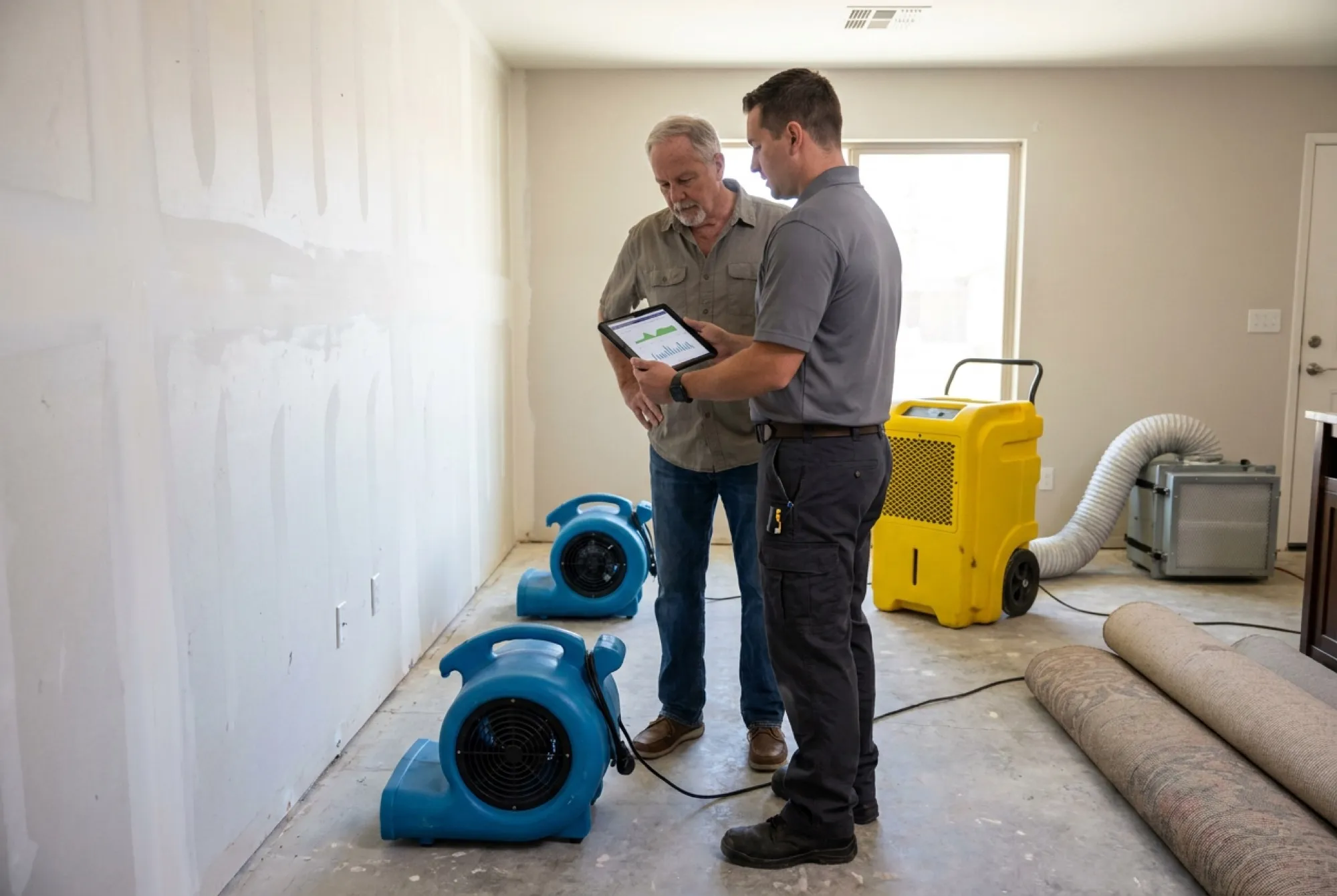
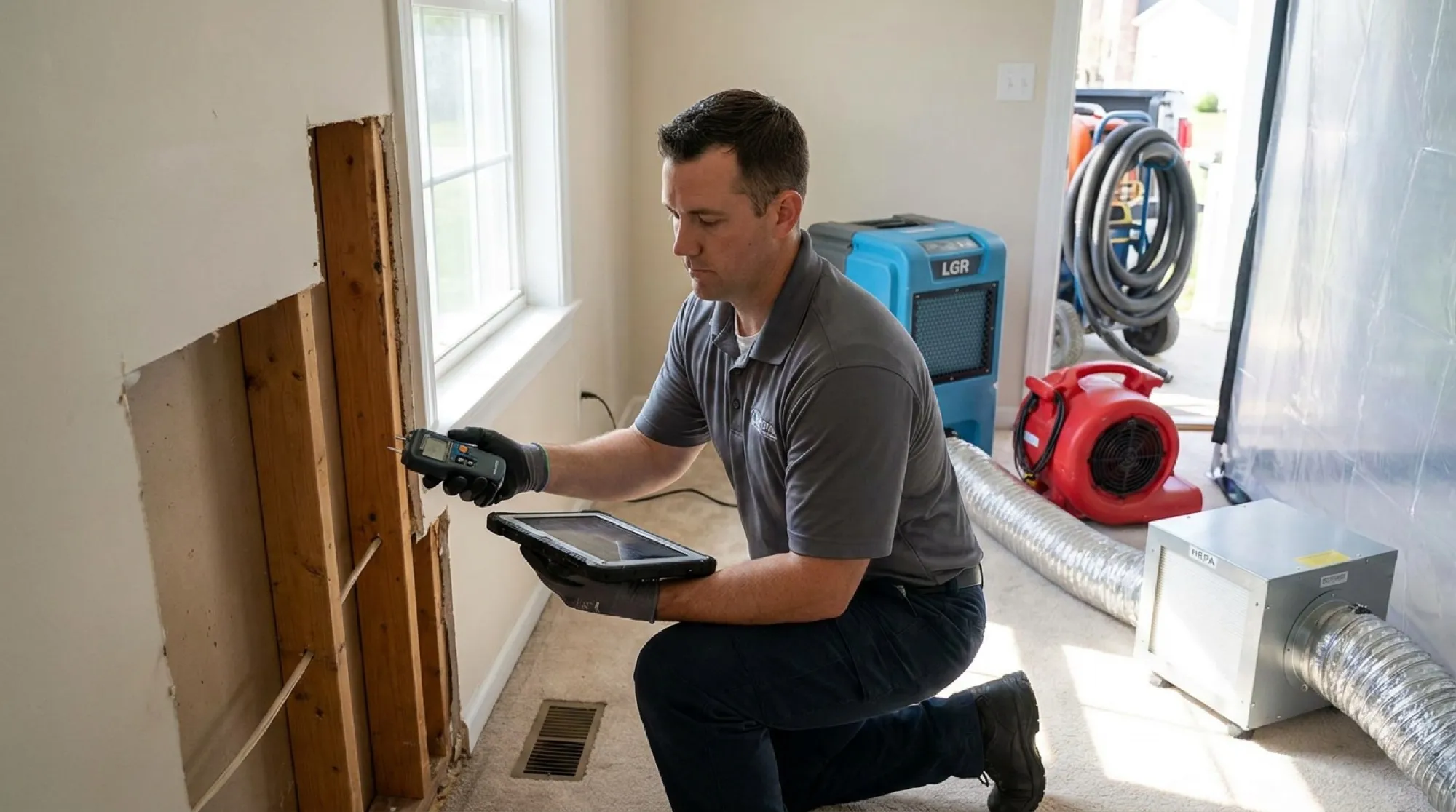
Moisture meters, measured daily against a target based on unaffected material in the same building. Equipment stays until the readings hit the target, not until the calendar says so or the surface feels dry.
How loud is the drying equipment, and can I turn it off at night?
Loud — think a box fan times several, running continuously. Please don't turn it off. Drying is a continuous process, and eight hours off can add a full day to the schedule. If sleep is impossible, tell us and we'll look at placement.
Will the equipment run up my electric bill?
Some. Air movers and dehumidifiers run continuously for three to five days, so it shows up on that month's bill. If the loss is a covered claim, that cost is often reimbursable — save your bill.
Can I stay in the house while it's drying?
Usually yes for clean-water losses. Contaminated water, sewage, or extensive mold changes the answer, and we'll say so plainly at the assessment.
What about my pets during the work?
Keep them out of work areas and containment zones. Equipment, open walls, and doors propped for hoses are all hazards. Tell us about pets when we arrive so we plan access.
Why do you have to remove my baseboards?
Because water hides behind them, and the drywall directly above the floor is where wicking starts. Removing baseboard often lets us dry a wall in place instead of cutting it — it's the less invasive option, not the more.
What is "wicking" and why does it matter?
Water climbs porous material against gravity. Drywall wicks upward at roughly an inch an hour, which is why a half-inch of water on the floor becomes a wet wall two feet high overnight. It's the reason response speed matters more than volume.
What do Category 1, 2, and 3 water mean?
Category 1 is clean water from a supply line. Category 2 is used or contaminated water — dishwasher, washing machine, an aquarium. Category 3 is grossly contaminated, including sewage and floodwater from outside. Category determines whether materials can be dried and saved or must be removed. Clean water that sits long enough degrades to Category 2.
Mold
How do I know if my musty smell is mold or just an old house?
Musty odor that returns after you clean and ventilate usually has a moisture source behind it. A smell that clears with airflow and doesn't come back is generally not a colonization problem. Testing settles it either way.
Does an air purifier fix a mold problem?
No. It may reduce airborne spores in one room while the colony and its water source continue growing inside the wall. It treats a symptom.
Can mold grow inside my walls without any visible signs?
Routinely, and it's the norm in Phoenix. Dry indoor air masks the smell that would give it away in a humid climate, so a wall cavity can hold high moisture and colonize for months while the room feels perfectly normal.
Is there such a thing as "toxic mold"?
Some species produce mycotoxins, and reactions vary widely between people. The practical answer is that species matters less than you'd think — any significant indoor colonization gets remediated the same way, and lab testing identifies species when documentation requires it.
How much mold is normal in a house?
Some spores are in every building on earth. The question testing answers is whether indoor counts are elevated against an outdoor control sample, and whether species indicate active indoor growth rather than what blew in the door.
Fire and Smoke
Why does a water damage company handle fire jobs?
Because firefighting puts hundreds of gallons into a structure in minutes, and that water does the same wicking, warping, and mold-growing that any water loss does. Fire restoration is water restoration plus soot and odor.
Can you clean smoke damage without replacing everything?
Often, yes — hard surfaces, many textiles, and a lot of electronics restore successfully. What has to go is porous material that absorbed residue and odor: insulation, some drywall, carpet pad.
How long does smoke odor take to fully disappear?
If the source material is removed or sealed and treatment is done properly, the odor is gone when we finish. Odor that returns weeks later means penetration wasn't addressed — surfaces were cleaned but saturated materials stayed.
What is a puff-back?
A furnace or water heater misfire that blows soot through the ductwork and across the house with no visible flame. The classic puff-back comes from an oil burner, and almost no Phoenix home heats with oil, so they're rare here. A malfunctioning gas appliance can still put out soot, and when it does the cleanup is deceptively expensive, because the residue is fine and travels everywhere the air goes.
Working With Us
Will the same crew be on my job the whole time?
Yes on the mitigation side, and the same company through rebuild. Larger jobs get a dedicated project manager as your single point of contact rather than a rotating lead.
How often will I hear from you during the job?
Daily during active drying, with the day's moisture readings. Weekly or per-milestone during rebuild, plus a call any time something changes the scope or the schedule.
Do you pull permits for reconstruction work?
When the scope requires it, yes — that's part of holding the general contracting license. Structural, electrical, and plumbing changes generally require permits, and paint and flooring generally don't. Drywall depends on the size of the job: the City of Phoenix's permit guidance treats patching a hole as exempt, but removing and replacing a whole sheet as permit work. Other Valley cities set their own rules.
What if I need HOA approval for exterior repairs?
We'll provide the scope documentation your HOA architectural committee needs. Submission and approval are the owner's to file, and we schedule around the timeline.
Property and Belongings
Will you move my furniture?
Yes. Contents are moved, blocked, and protected as part of the job, not billed as an extra.
Can water-damaged photos, documents, or electronics be saved?
Sometimes, and speed decides it. Tell us about irreplaceable items the moment we arrive so they're pulled first and handled separately rather than moved with the rest.
What happens to materials you remove?
They're documented and inventoried for your claim before disposal. Category 3 materials are handled as regulated waste rather than set at the curb.
Can you match my flooring or tile if it's discontinued?
Often, through supplier networks and salvage. When an exact match genuinely doesn't exist, most policies address it — we document the discontinuation and work with the adjuster on the alternative rather than installing something close and hoping you don't notice.