
What Determines Water Damage Restoration Cost in Phoenix?
Published August 4, 2026 · Last reviewed August 21, 2026 · Water Fighters Restoration
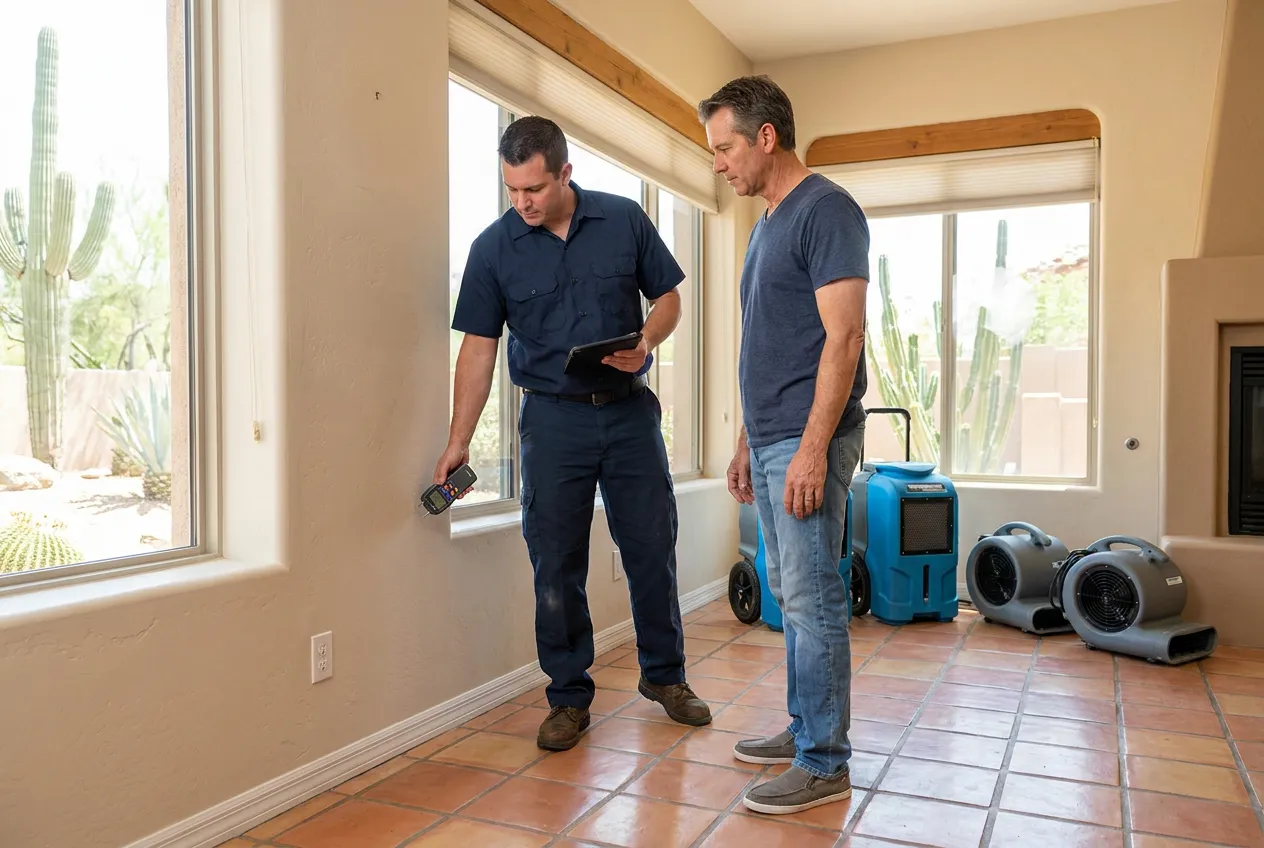
You want a number. Every page promising one is guessing, because water damage cost isn't a price — it's a measurement. Two identical Phoenix kitchens with the same burst supply line can land far apart on the invoice, and the difference comes down to six factors you can actually understand. Here's each one, plainly, so the estimate you eventually get — from us or anyone — makes sense line by line.
The Honest Framing
Restoration cost is driven by what the water touched, what it was carrying, and how long it sat. Everything else is detail. A fast-caught clean-water leak on tile is the cheap end of the spectrum. Contaminated water that sat a weekend in carpeted rooms is the expensive end. Most losses live in between, and the walkthrough is how the number gets real.
Factor 1: What Was in the Water
Clean supply-line water (Category 1) can often be dried in place — materials saved, costs contained. Water from a dishwasher, washing machine, or a leak that sat for days (Category 2) is contaminated, and some porous materials stop being savable. Sewage or outside floodwater (Category 3) changes the job entirely: containment, protective equipment, regulated disposal, and mandatory removal of what it soaked. Category is the single biggest cost lever, and it's also the one that degrades — clean water that sits becomes contaminated water. Speed is a discount.
Factor 2: How Far It Traveled
Water doesn't stay where it lands. It runs under walls, follows the underside of flooring, and wicks up drywall at roughly an inch an hour. Cost scales with affected area — not the puddle you can see, but the wet footprint the moisture meters find. A leak contained to one bathroom is a different invoice than the same leak that reached the hallway, two bedrooms, and the wall cavities between them. This is why "it was just a small leak" and a large scope can both be true.
Factor 3: What It Soaked Into
Tile and sealed concrete shrug water off. Carpet pad, MDF baseboards, particleboard cabinet bases, and laminate flooring don't — once saturated, they're removals, not dry-outs. Hardwood sits in the middle: catch it fast and specialty drying often saves it; let it cup for days and it's replacement. The material mix of the affected rooms moves the number as much as the square footage does.
Factor 4: How Long Drying Takes
Equipment time is a real cost line — air movers and dehumidifiers running three to five days on a typical loss, longer when wall cavities or slab-adjacent framing are holding moisture. What stretches drying: water that sat before the call, dense materials like plaster in older Phoenix homes, and trapped moisture that requires opening walls. What shortens it: fast response and aggressive early extraction, which is most of what you're buying when you call emergency flood cleanup at 2 a.m. instead of 9 a.m.
Factor 5: What Has to Be Rebuilt
Mitigation ends when the structure is dry. The rebuild — drywall, texture matching, paint, flooring, cabinetry — is its own scope, and it's where losses diverge most. A dried wall needing baseboard and paint is minor. A kitchen that lost its lower cabinets is not. Because we handle restoration and rebuild with one licensed team, both halves land in one estimate instead of a mitigation invoice plus a contractor's bid that don't reconcile.
Insurance Changes the Question
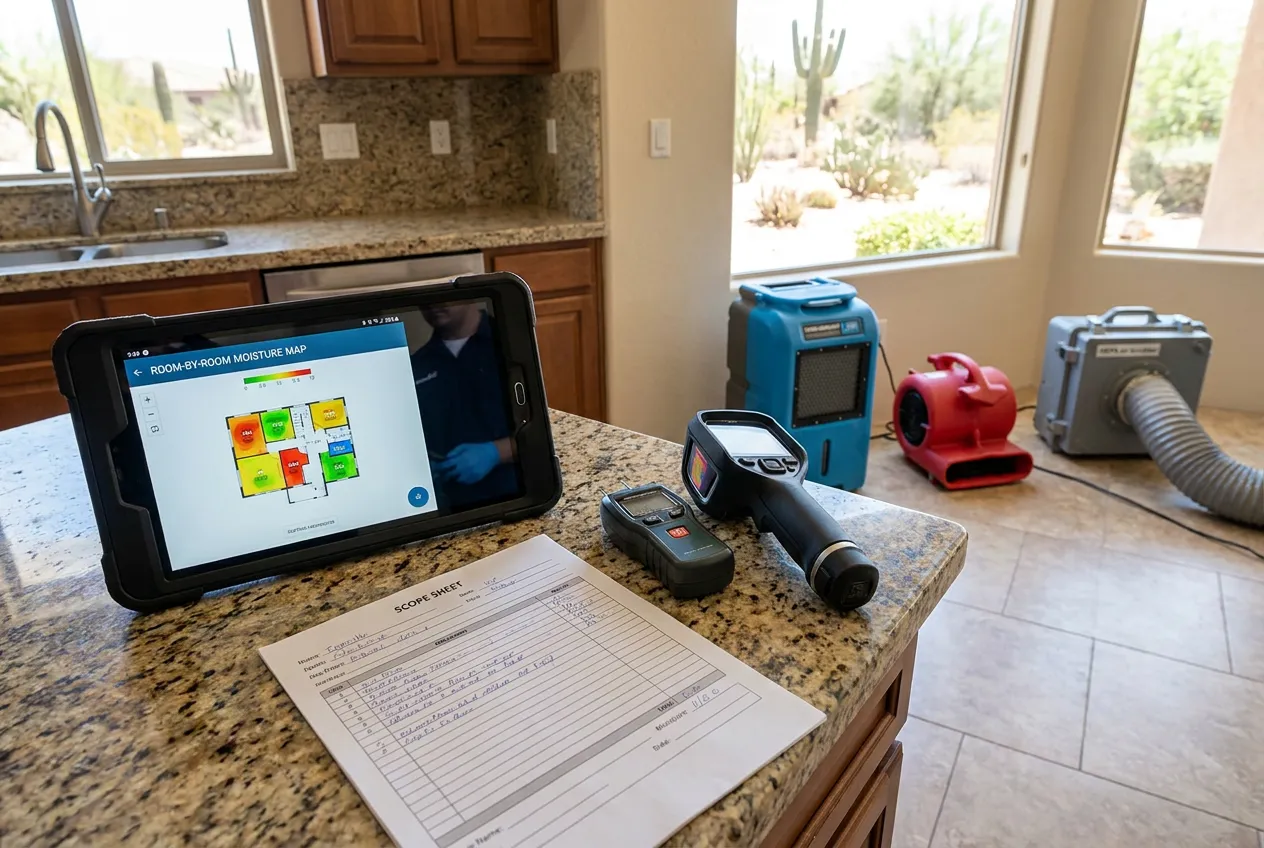
For most Phoenix homeowners, the real question isn't the total — it's the deductible, because sudden water losses are covered by most policies. That reframes everything: the number that matters to you is your out-of-pocket, and the thing that protects it is documentation. We photograph, meter, and log every affected surface, write the scope in the estimating format adjusters use, and bill the carrier directly. The estimate you see is the estimate they see. Where coverage gets complicated — long-term seepage, mold sublimits, sewer-backup endorsements — we tell you where you likely stand before work starts, not after. For whether a specific peril is covered at all, does insurance cover water damage walks it peril by peril.
Why Two Estimates Differ
When homeowners collect competing bids, the gap usually isn't greed — it's scope. One company measured the visible room; the other metered the wall cavities and found the water in the next room. One priced drying in place; the other priced demolition. One included rebuild; the other stopped at "dry." Comparing totals without comparing scope lines is how people pick the bid that costs more by the end. Ask every bidder the same question: show me what you're treating, and what happens after it's dry.
What You Actually Control
Three things, and they're all speed. Stop the water at the valve. Call before the wicking clock runs — the difference between a two-hour response and a next-morning response is often the difference between drying and demolition. And don't run fans or the AC across the wet area before extraction; spreading moisture grows the footprint you'll pay for.
Common Questions
Why won't anyone give me a price over the phone?
Because the number lives in the moisture readings, and those require being in the house. Anyone quoting a total sight-unseen is quoting their minimum, not your job. What we can do by phone is tell you what category of loss you're describing and what the process will look like.
Does the size of my home drive the cost?
No — the size of the affected area does. A large home with one wet bathroom is a smaller job than a small home with water across three rooms. Square footage of damage, not square footage of house.
Is the mitigation or the rebuild usually the bigger portion?
It depends on materials. Tile-heavy rooms often make drying the larger share; kitchens and rooms with cabinetry or wood flooring usually make rebuild the larger share. The estimate breaks the two apart so you can see exactly where the scope sits.
Does insurance pay whatever the estimate says?
Carriers pay for the documented scope at rates their platform recognizes — which is why we write in that format and document every line. Disputes happen when scope is asserted without measurement; they're rare when every item traces to a photo and a reading.
What makes drying take longer than expected?
Trapped moisture, mostly — wall cavities, under cabinets, beneath flooring, and dense older materials like plaster. That's also why daily metering matters: the readings tell us where drying has stalled and where equipment moves next.
Is mold testing an added cost on a water job?
Testing is separate and only recommended when there's a reason — visible growth, a loss that sat, or documentation needs. Fast, complete drying is specifically how you avoid ever needing the mold remediation conversation.
Can I reduce the cost by doing demolition myself?
Usually it costs you more. DIY demo before documentation destroys the evidence your claim depends on, and tearing out more than the readings require adds rebuild scope. If you want to contribute effort, move contents and stop the source — leave the cutting to the meters.
Is my restoration company overcharging me?
Check four things before assuming so: a line-item scope rather than a lump sum, equipment counts with days on-site, daily moisture logs proving the drying those days claim, and whether demolition and rebuild sit inside the number or outside it. A bill that survives those four checks is usually a real bill. One that can't produce them is a guess.
What padding actually looks like when it happens: equipment still billed after the readings hit dry standard, duplicated line items across mitigation and rebuild, and emergency multipliers applied to hours that weren't. What is not overcharging, even when it stings: cavity-drying days the meters justify, and contaminated-material removal the water category requires — those are scope surprises, not price surprises, and the difference lives in the documentation. Two rights worth using: you can request itemization at any point, and a second opinion mid-job is legitimate, not rude. Your insurance adjuster reviews the same scope line by line anyway, which functions as a built-in audit when the company writes in the format carriers process.
Ask for the moisture log first. Companies that keep one rarely need auditing. Companies that don't can't prove the invoice happened.
How do I compare two water damage quotes that look completely different?
Line them up on four things: what each one says caused the loss, how many days of drying equipment each includes, whether demolition and rebuild are in the number or excluded, and who bills your insurance. Two honest estimates differ on scope, not on price.
The gap is almost always scope. One company plans to remove two feet of drywall and dry the wall cavity; the other plans to point air movers at the surface and leave. One counts seven days of dehumidification; the other counts three. One puts the baseboards, texture, and paint back; the other stops when the meters read dry and hands you a rebuild problem. Those are different jobs, and the cheaper one is often the one that gets done twice.
Ask both companies for the same three documents: a line-item Xactimate scope, the equipment list with days, and the daily moisture log they intend to keep. If a company cannot produce those, you are not comparing estimates — you are comparing guesses. We will hand you ours to hold next to anyone else's.