
Fire Sprinkler Water Damage in Phoenix
Published September 1, 2026 · Last reviewed September 1, 2026 · Water Fighters Restoration
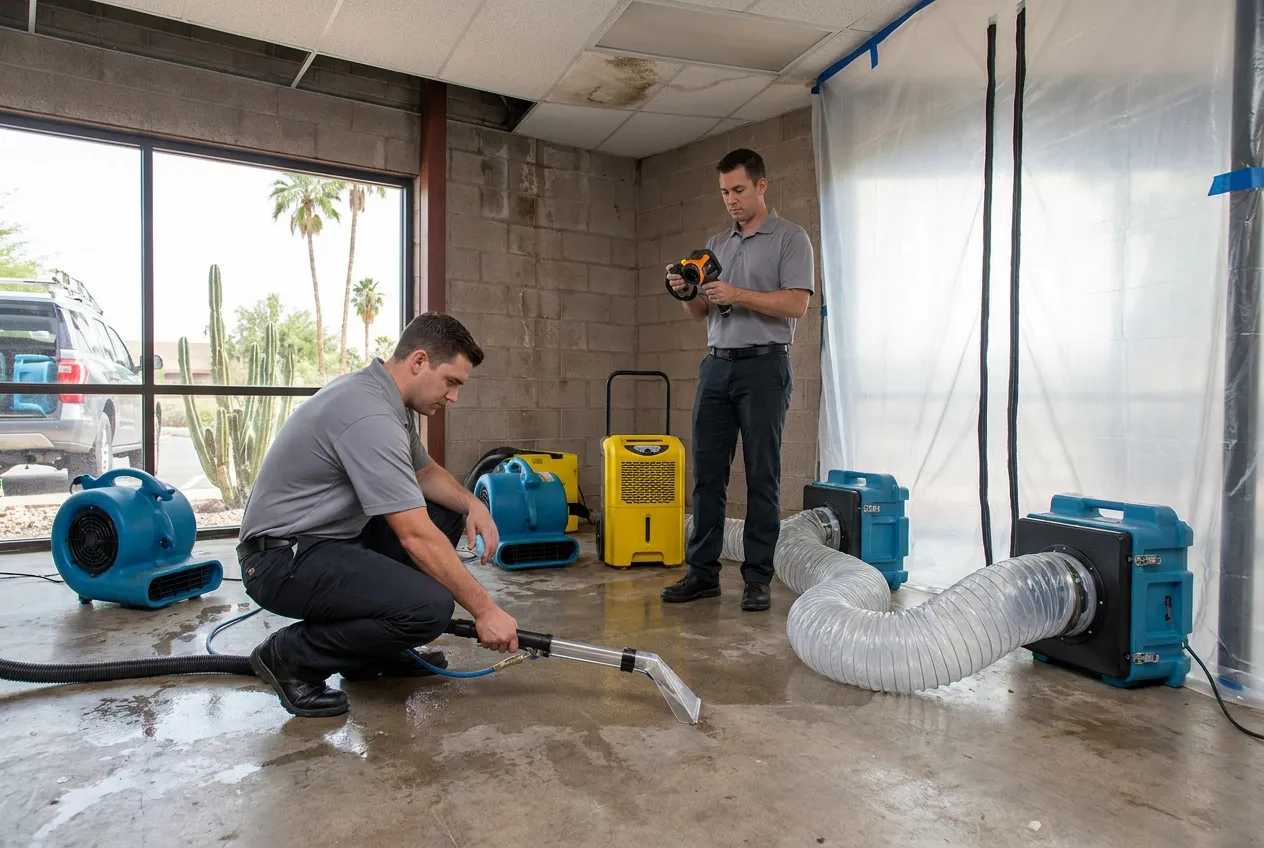
At 2 a.m., one sprinkler head opens above a tenant space. By the time the call reaches property management, water has crossed the suite and entered the corridor.
The first question is not who will replace carpet. It is whether there is a fire condition, who has authority over the sprinkler system, and how far the water has traveled.
A standard commercial sprinkler head typically discharges roughly 20 to 40 gallons per minute. Warehouse ESFR heads can run around 100 gallons per minute. Those are different loss scales.
The response has to protect life safety, building operations, evidence, tenants, and the property at the same time.
Water Fighters Restoration is Open 24 hours, 7 days. Crews stage as one licensed team, Valley-wide. The response promise is on-site within an hour.
The first hour needs one command path
A useful first-hour plan has six parts:
- Confirm the fire and life-safety status. Building staff should follow the site's emergency plan and fire-department direction.
- Use only authorized sprinkler controls. A riser or zone should not be shut down casually while a fire condition remains possible.
- Keep people out of wet electrical and ceiling areas. Water may reach lights, devices, ceiling grid, and energized equipment.
- Start extraction and vertical tracing. Check the loss floor, spaces below, wall paths, shafts, and adjoining suites.
- Notify the required parties. Ownership, property management, tenants, the carrier, and the fire-sprinkler contractor may all need the same facts.
- Set an operating boundary. Identify what is closed, what can remain open, and how crews will move through the building.
Sprinkler heads do not all open at once
A standard sprinkler head responds to heat at that individual head. Smoke alone does not activate every head. One open head does not command the rest to open.
The movie version, where every sprinkler in a building begins flowing together, is not how ordinary systems operate.
NFPA reporting shows that the large majority of real fires are controlled by one or two heads. That is a life-safety strength. It also means a single accidental discharge can create a concentrated water loss without involving the rest of the system.
The fire-sprinkler contractor handles system inspection, reset, head replacement, and restoration of protection. The restoration team handles water extraction, affected materials, drying, documentation, and rebuild.
The discharge rate changes the first inspection
At roughly 20 to 40 gallons per minute, ten minutes of flow can spread through a suite before anyone reaches the valve. An ESFR warehouse head is a different magnitude and can move around 100 gallons per minute.
Actual flow depends on the system, pressure, head type, and duration. The project should use system information when available rather than one generic number.
Sprinkler flow is still far less than fire-hose flow. The claim that sprinklers use more water than fire hoses is backward.
The building assembly controls spread. Water can pass through acoustic ceiling tile, light openings, wall tops, penetrations, and floor joints. It may enter insulation, tenant demising walls, raised flooring, or stock below.
Accidental discharge usually has a cause
Truly spontaneous sprinkler-head failure is rare. Accidental discharge more often follows impact, freezing, overheating, corrosion, or work near the system.
Impact can come from ladders, forklifts, carts, lifts, stored materials, or objects hung from a head. A small glass bulb or fusible element is not designed to serve as a hanger.
Freezing can affect unconditioned parking areas, exterior canopies, and exposed sections during a hard Phoenix freeze. It is not an everyday Valley event, but it belongs in winter planning.
Overheating can occur when a head sits near a heat source outside its design conditions. Corrosion can weaken components or create system problems that require a sprinkler professional.
The incident record should preserve the condition found around the head. Moving the ladder and clearing the ceiling before photographs may erase the simplest explanation.
Tenant improvement work is a predictable trigger
Tenant improvement work places crews, ladders, carts, lifts, tools, and temporary conditions near ceiling heads.
A head may be struck while grid is removed. Materials may be lifted into it. Heat-producing work may affect a nearby device. The risk plan should begin before demolition. Contractors need the sprinkler layout, protected clearances, shutoff authority, emergency contacts, and the rule for reporting even a brief impact.
The commercial water damage service covers extraction and drying in occupied or active properties.
Keep the building operating where conditions allow
A commercial response is not simply a larger residential job. The building may contain several tenants, public corridors, elevators, server rooms, inventory, records, or regulated operations.
The first moisture map should support an operating decision. A dry suite on the other side of a demising wall may stay open. A wet corridor below the discharge may need closure.
Containment can separate work zones. After-hours removal can reduce disruption. Equipment placement must preserve safe exits and required access.
No contractor can promise that a tenant space will remain open. That decision depends on water spread, electrical conditions, contamination, fire protection status, and the work required.
The commercial mold remediation page becomes relevant when wet materials remain enclosed or the loss was discovered late. The commercial sewage cleanup page covers a different Category 3 event and should not be confused with sprinkler discharge.
Ownership, tenants, and the carrier need the same record
Commercial files fail when every party uses a different map.
The project record should identify the activated head area, reported cause, flow duration, and shutoff time when known. It should also record floors checked, suites affected, water paths, equipment, removal, and daily moisture results.
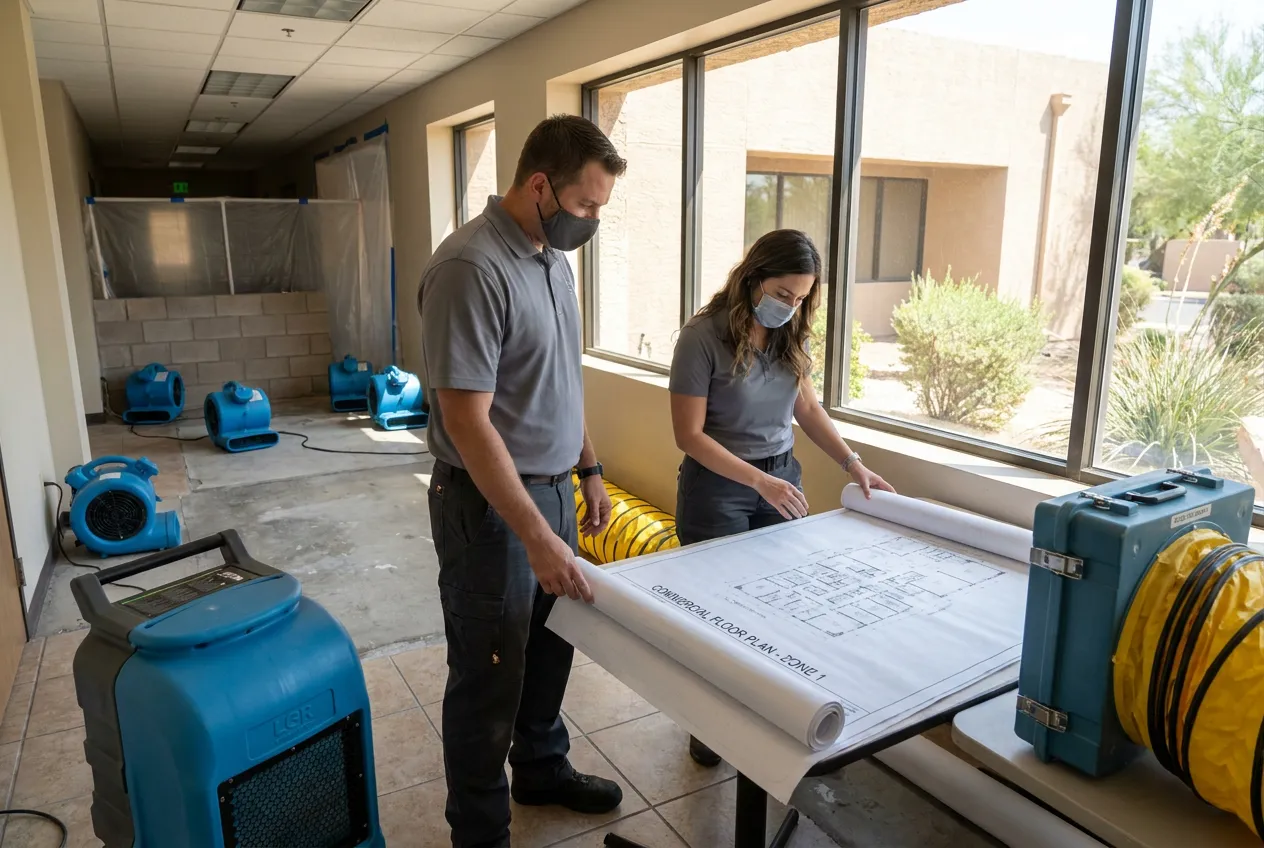
Room names should match the building plan.
Photographs should show the head, nearby conditions, water spread, affected contents, ceiling openings, and readings. The fire-sprinkler contractor's report belongs beside the restoration record, not in a separate story.
Coverage depends on the policy and facts. The water-damage insurance claim guide explains documentation without promising an outcome.
Preferred-vendor and after-hours protocols shorten confusion
A useful commercial protocol names the person who can authorize access and the backup contact. It also lists the sprinkler contractor, alarm contact, electrical contact, carrier path, and tenant-notification method.
It also records loading access, elevator rules, certificates of insurance, parking, keys, alarm codes, and after-hours building procedures.
Water Fighters Restoration can work within required certificate-of-insurance and vendor documentation processes. Commercial areas in Chandler and Tempe carry the same need for a written response chain, though every property has its own system and tenant plan.
Mitigation and rebuild should remain one project
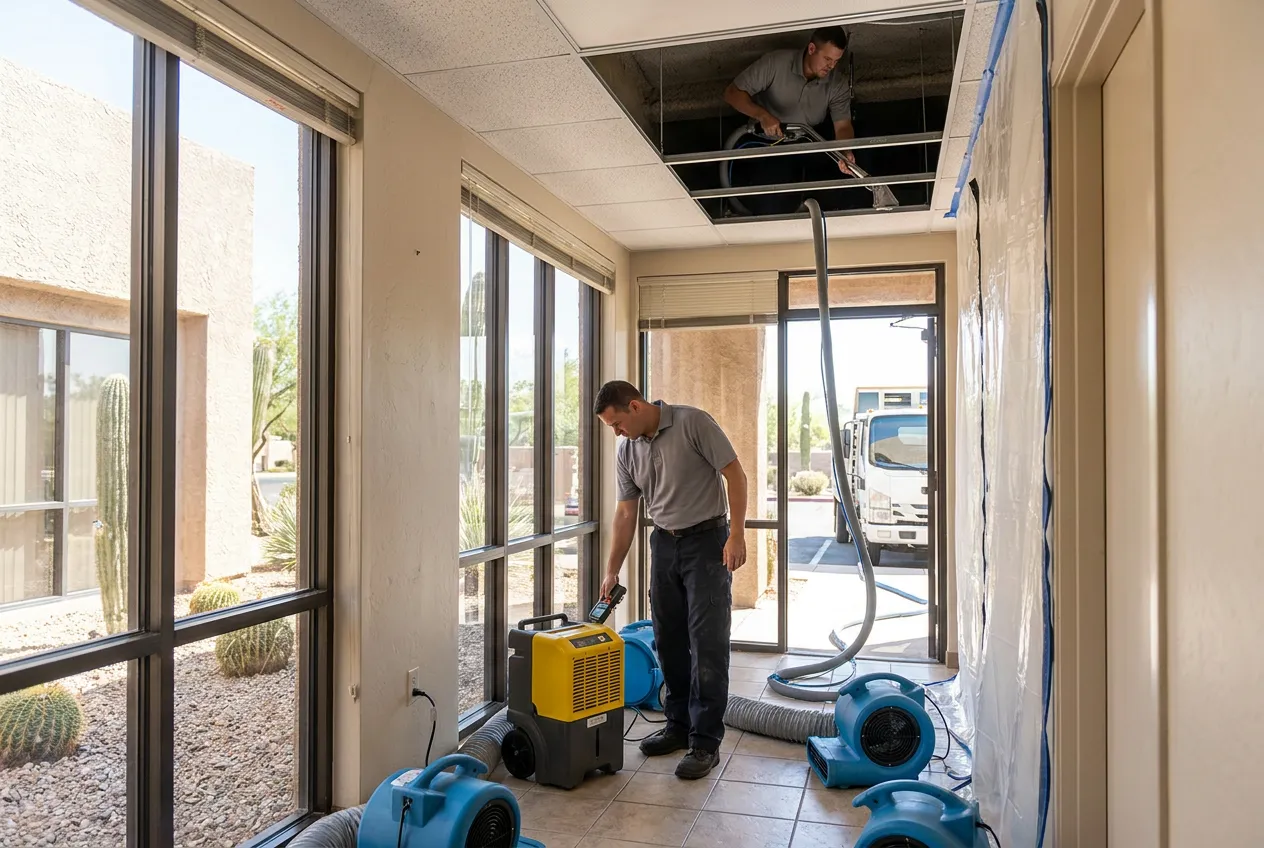
Extraction begins where water is standing and continues along the concealed route. Technicians check ceiling plenums, wall cavities, flooring, lower levels, and contents exposed below.
Material decisions depend on condition, water quality, fire-related residue if present, and the time before discovery. Ceiling tile may fail quickly. Drywall, insulation, flooring, and millwork require measured evaluation.
Drying is monitored by area and material. Equipment changes as the building responds. Daily notes support operating decisions and the eventual repair scope.
One team does mitigation and rebuild. That keeps ceiling grid, drywall, flooring, paint, and tenant finishes tied to the same loss record.
Water Fighters Restoration is IICRC Certified 70192944 · AZ ROC 324471 · ROC 324468 · EPA Lead-Safe Certified Firm · Licensed, Bonded & Insured.
Common Questions
Does one activated sprinkler head make every head in the building open?
No. Standard heads activate individually from heat at that head. Smoke alone and one open head do not trigger every other head, which shapes the commercial water response.
How much water does a standard commercial sprinkler head release?
A standard head typically flows roughly 20 to 40 gallons per minute while active. ESFR warehouse heads can run around 100 gallons per minute, so head type and flow duration belong in the first loss record.
Should building staff close the sprinkler riser immediately after an accidental discharge?
Only authorized personnel should operate system controls after the fire condition and life-safety procedure are addressed. A casual shutdown can leave the building unprotected or conflict with fire-department direction.
Why should the suite below be checked when only one sprinkler head opened?
Water can pass through ceiling openings, wall tops, penetrations, and floor joints before appearing below. The lower suite may be wet even when the discharge stayed in one small area upstairs.
Why is tenant improvement work a common setting for accidental discharge?
Ladders, lifts, carts, materials, and open ceiling work place crews close to sprinkler heads. Before construction begins, the project plan should identify shutoff authority, emergency contacts, and reporting rules.