Commercial Water Damage Restoration in Phoenix
Published August 4, 2026 · Last reviewed August 21, 2026 · Water Fighters Restoration
A riser lets go on the third floor at 11 p.m. A rooftop unit's condensate line backs up over a weekend and finds its way down two floors of drywall. A supply line under a break room sink runs all night into the suite next door.
By morning you have three problems at once: a building that's wet, tenants or customers who need answers, and a claim that starts the moment you report it. What you need is one company that handles all three and doesn't disappear between the drying and the repair.
Who We Work With
Property managers and building owners who need a vendor that responds at 2 a.m., documents everything, and communicates clearly enough to forward straight to ownership.
Facility managers who need work sequenced around occupancy — floors done at night, corridors kept passable, equipment placed where it won't trip a fire alarm or block egress.
Restaurant and retail operators who need the doors open. Health department requirements, walk-in coolers, dining rooms, and the reality that every closed day is gone.
Multifamily and HOA managers dealing with a loss that crosses units — where one supply line becomes four affected apartments, three insurance conversations, and a habitability question.
Medical, dental, and professional offices where equipment, records, and patient scheduling all complicate the response.
Schools, churches, and community facilities with fixed calendars that don't move for a burst pipe.
The First Hour
Same promise as residential — on-site within an hour, 24/7 — with commercial-scale equipment behind it.
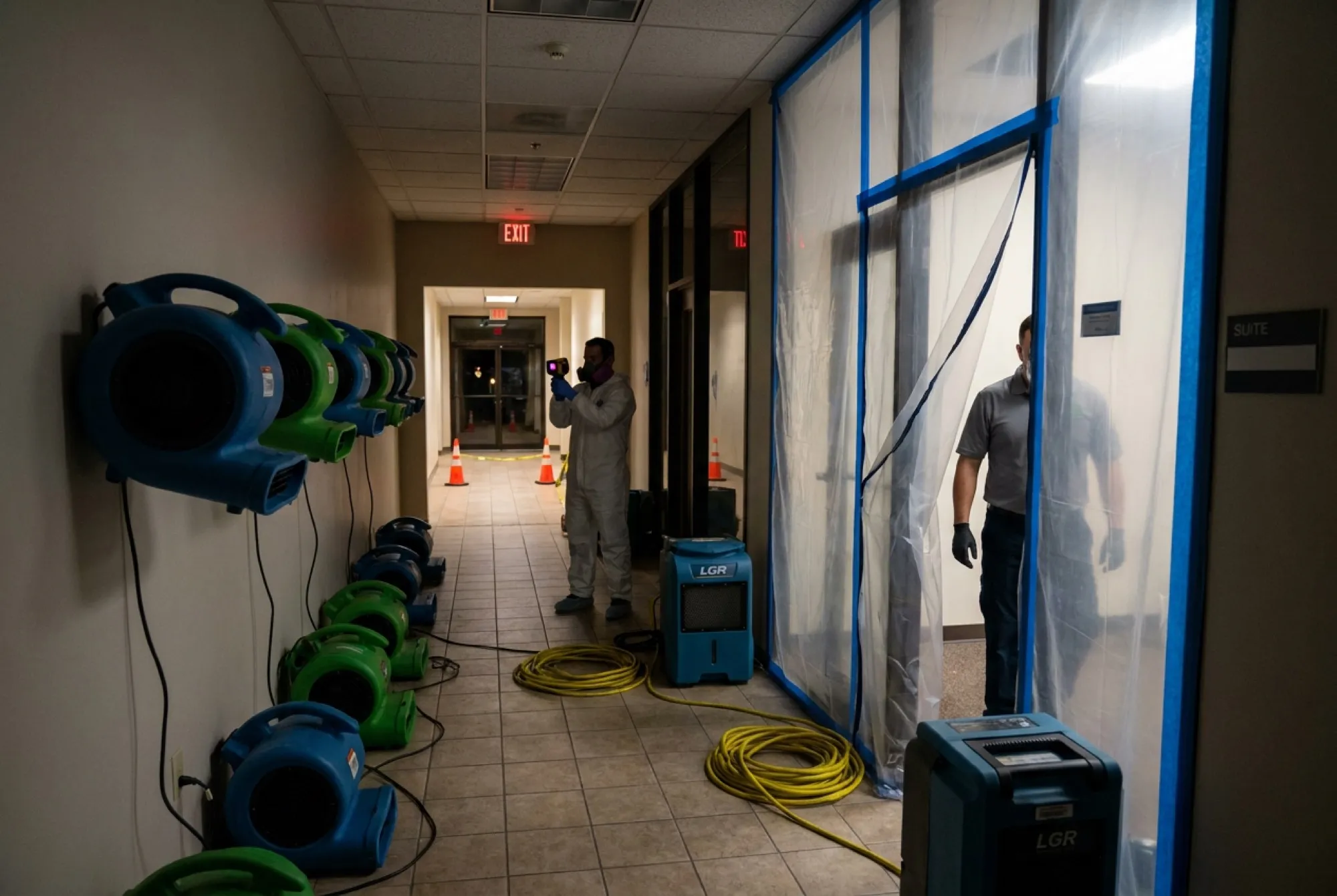
The first crew on-site does three things simultaneously: locates and stops the source, begins extraction, and establishes what's affected. On a commercial loss, the third part is bigger than it sounds. Water travels through chases, above ceilings, and along the underside of decking, and it turns up two suites away from where it started. We map with moisture meters and thermal imaging before assuming a boundary.
You get a scope and a plan the same day — what's wet, what's coming out, how long equipment runs, and what it means for occupancy. If the loss affects tenants, you get that in a form you can forward without rewriting it.
Working Around Your Operation
Commercial work is scheduling as much as it is restoration.
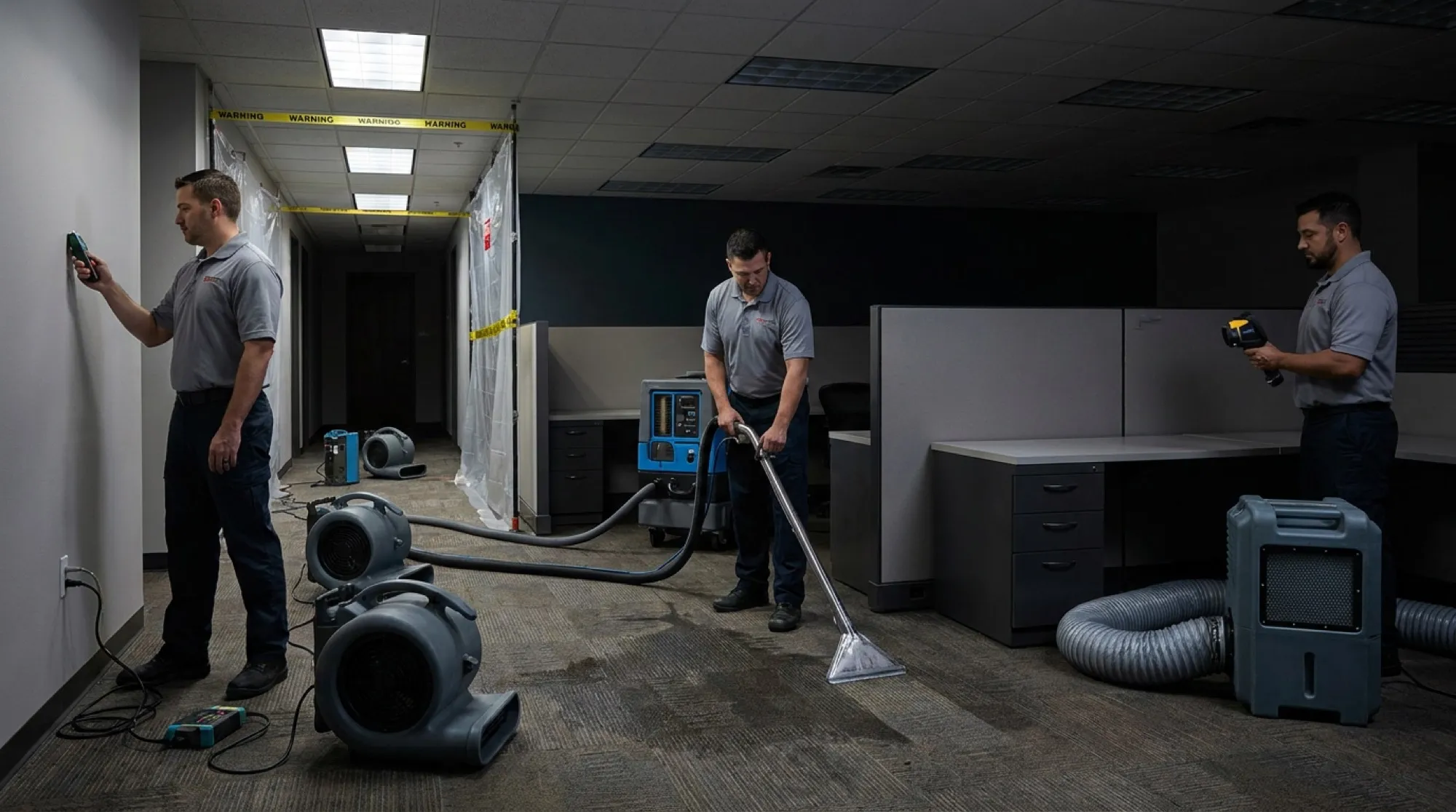
We run after-hours and overnight crews as standard, not as a premium favor. Containment goes up to keep dust and noise inside the work zone while the rest of the building operates. Equipment placement accounts for egress paths, ADA clearance, fire panel sensitivity, and the reality that people are walking past it at 8 a.m.
For occupied multifamily, we sequence unit by unit and coordinate access with residents through management rather than knocking on doors ourselves. For retail and restaurants, we work around service hours where the scope allows and prioritize the areas that reopen the doors fastest.
Property Types We Handle
Office suites and multi-tenant buildings. Retail centers and standalone storefronts. Restaurants and commercial kitchens — including the grease-related main line backups that turn into sewage cleanup jobs. Warehouses and light industrial. Multifamily and apartment communities. HOA common areas and clubhouses. Medical and dental offices. Schools, daycares, and churches. Hotels and short-term rental properties.
We also handle commercial mold remediation when a slow leak turns into an air quality complaint — and given how often the two arrive together, one team handling both matters.
Documentation and Billing
Commercial claims involve more people than residential ones — an adjuster, often a broker, sometimes ownership, occasionally a tenant's separate carrier and a third-party consultant. All of them need the same facts.
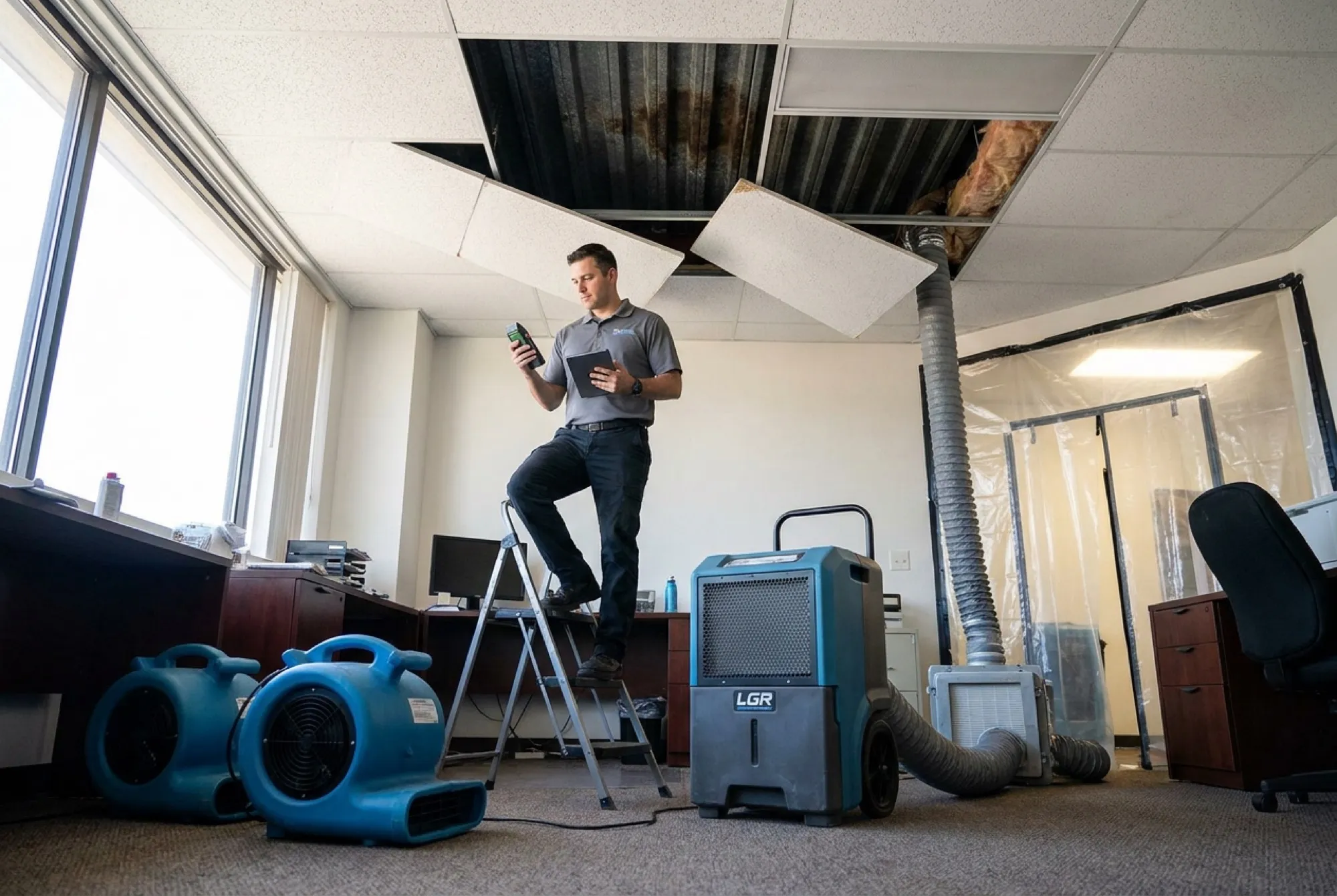
Every job produces a documentation package: moisture maps by area, daily readings through the drying cycle, photo documentation of conditions and work performed, equipment logs, and a scope written in the estimating format adjusters process. The estimate you receive is the estimate the carrier receives — one document, no second version.
We bill carriers directly and work with every major commercial line. For losses under deductible or where ownership prefers to pay direct, we invoice on standard commercial terms.
And because we hold the rebuild in-house, the repair scope is written by the people who did the mitigation — drywall, ceiling grid, flooring, casework, and paint, back to pre-loss condition without a second contractor negotiating a second scope. Same one-team model as our residential work, at building scale.
Common Questions
How fast can you respond to a commercial loss?
On-site within an hour, anywhere in the greater Phoenix Valley, 24/7. Off-hours calls are normal — most commercial losses are discovered at night or on a weekend.
Can you work overnight so we stay open?
Yes, and it's standard for occupied buildings. Night and weekend crews are how most of our commercial work gets done.
Do you carry the insurance and licensing our building requires?
Yes — licensed, bonded, and insured, AZ ROC 324471 and ROC 324468, IICRC certified. Certificates of insurance naming your entity as additional insured are available on request, usually same day.
Who pays when a loss crosses multiple tenants?
It depends on the lease structure and where the failure originated — building system versus tenant improvement. We document the origin and affected areas precisely, which is what lets the carriers and attorneys sort responsibility. We don't guess at liability, but we make sure the facts are clear.
Can you handle a large loss across multiple floors?
Yes. Equipment capacity scales to the job, and larger losses get a dedicated project manager as your single point of contact rather than a rotating crew lead.
What about our building's HVAC system?
If water reached ductwork or the air handler, it's part of the scope and we coordinate accordingly. Running the system through a wet building distributes moisture and, eventually, spores.
Do you provide documentation for our insurance and ownership?
Yes — moisture maps, daily logs, photo documentation, equipment records, and adjuster-format scopes. Written to be forwarded as-is.
Can you get us reopened before the rebuild is finished?
Often. We prioritize the areas that restore operations first and phase the remaining work around your schedule where the scope allows it.
Do you work with property management companies on an ongoing basis?
Yes — a number of Valley management companies use us as their standing water damage vendor across portfolios. Preferred-vendor arrangements, standing COIs, and portfolio-wide response are all straightforward to set up.