
Restaurant Water Damage in Phoenix
Published October 8, 2026 · Last reviewed October 8, 2026 · Water Fighters Restoration
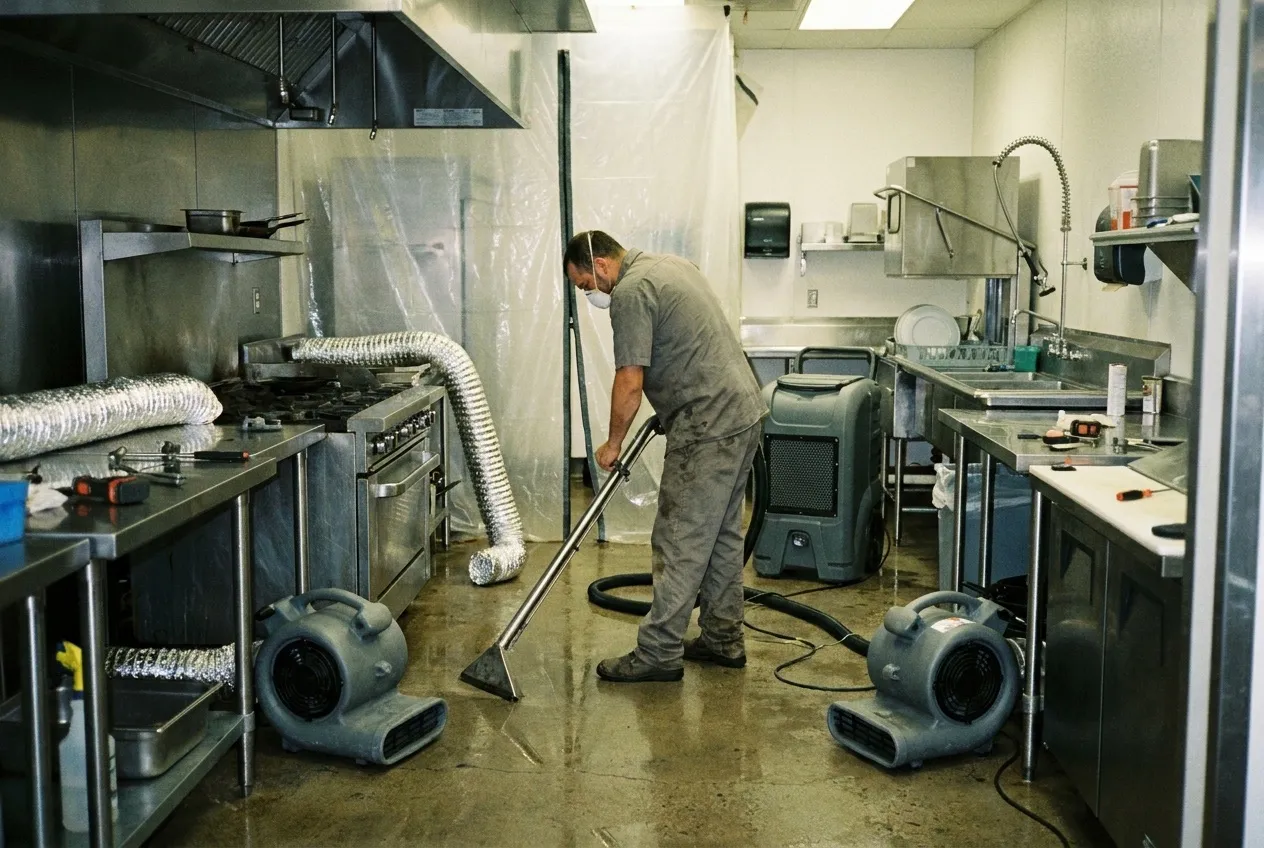
The supply line to the ice machine let go sometime after close. By the time the opening cook unlocks the back door, water has run under the cook line, along the cove base and up to the walk-in's threshold. The rubber floor mats have drifted a foot off the line.
In a restaurant, the water is only half the problem. The other half is a food permit, and in Maricopa County the code behind it treats a flood as an emergency that can require you to stop service.
What to do right now
- Stop the water at the valve serving the line. Leave the meter to your water provider.
- Keep staff off the wet floor and away from wet outlets and cords.
- If anything came up a floor sink, floor drain or grease line, it's Category 3. Keep people out of it. The commercial sewage cleanup page covers that work, grease interceptors included.
- The person in charge makes the operations call. A Maricopa County Environmental Services list puts it on the PIC "to take the appropriate actions by ceasing operations and contacting the Department for guidance if necessary."
- Call Water Fighters Restoration at (602) 884-5325. Open 24 hours, 7 days, and on-site within an hour.
The county's rules start before the cleanup does
Maricopa County adopted the FDA's 2017 Food Code effective October 6, 2021, "and no future editions or amendments." The county's Environmental Services Department is the regulatory authority, and Phoenix restaurants are inspected by Maricopa County Environmental Services. Food establishments on tribal land, or in the Pinal County parts of the service area, fall outside that code. That includes San Tan Valley, Gold Canyon, and the Pinal portions of Apache Junction and Queen Creek. There, call the agency that issued your permit.
The code's emergency list includes "a fire, flood, extended interruption of electrical or water service, SEWAGE backup" (8-404.11(A)). When one of those means an imminent health hazard may exist, the permit holder must stop operations and notify the county. Unaffected areas need not stop, and during an extended water or power interruption the county may agree to continued operations under an approved written plan (8-404.11(B)–(C)). If operations stop, the permit holder "shall obtain approval from the REGULATORY AUTHORITY before resuming operations" (8-404.12). The county approves reopening. A restoration contractor doesn't.
Food that touched the water is the operator's and the county's decision. The Food Code says unsafe or adulterated food "shall be discarded or reconditioned according to an APPROVED procedure" (3-701.11(A)).
Where water hides in a commercial kitchen
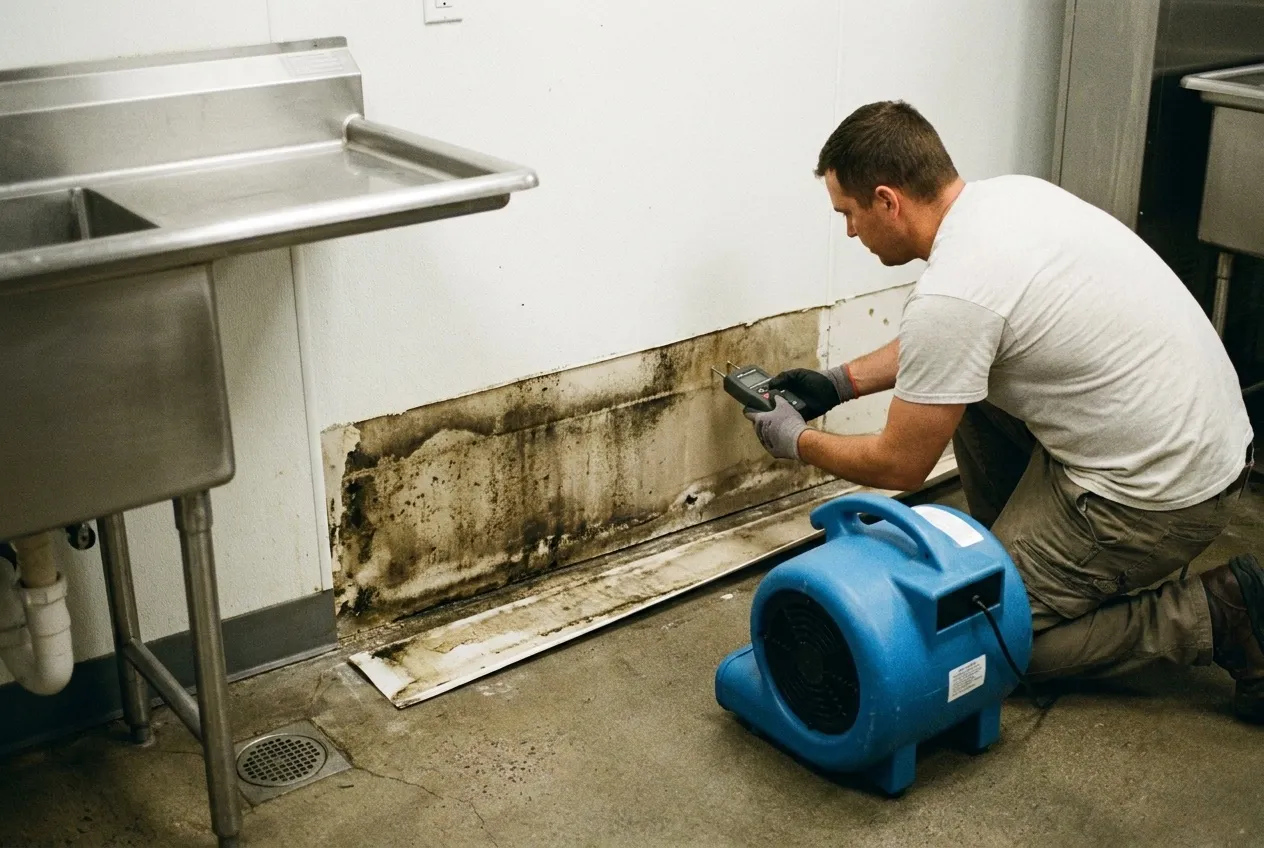
Kitchen water runs under cook-line and refrigeration equipment, behind FRP panels, which slow drying of the drywall underneath, under the walk-in's floor panels or curb, and into cove base joints. Moisture mapping covers those spots before the dining room. A slow leak found late behind FRP can become a commercial mold remediation job.
The category follows the source. An ice-machine or supply-line leak is Category 1 at the source, and water that ran across the floor and sat can become Category 2. Dish-machine discharge is Category 2. Anything that came up a floor sink, floor drain or grease line is Category 3.
Walk-ins and ice
Ice is food under the Food Code, and ice "for use as a FOOD or a cooling medium shall be made from DRINKING WATER" (3-202.16). The code also says "a direct connection may not exist between the SEWAGE system and a drain originating from EQUIPMENT in which FOOD, portable EQUIPMENT, or UTENSILS are placed" (5-402.11(A)).
Water under or around a walk-in cooler is out of sight, so it gets measured, not assumed.
The rebuild has its own rulebook
Maricopa County's construction guide calls itself "not all-inclusive and serves only as a guide," but it spells out the finishes the county looks for in a kitchen. Prep, warewashing and toilet-room walls must be "smooth, durable, nonabsorbent, easily cleanable." Walls behind cook lines and under hoods "must be of stainless steel or its equivalent," and the guide says "Do not install FRP behind cooking equipment or under hoods." Carpet "is not permitted in any area related to food preparation, food storage, food service" and several other areas. The guide also says "Generally, dining room finishes are not regulated."
The county code says "no major alteration or addition shall be made thereto until detailed plans and specifications… have been submitted to and approved by the Department." Its remodel definition excludes "the replacement of old equipment with new equipment of the same type." The county's plan review program decides what a given scope needs.
One team from drying to rebuild
One team does the mitigation and the rebuild, so the drying record and the repair scope come from one file. Estimates are free. The estimate you receive is the one the insurer receives, and Water Fighters bills insurance directly. The commercial water damage page covers scheduling around service hours. For a sprinkler that opened over the dining room, see fire sprinkler water damage. The Tolleson page covers drying a food-distribution warehouse. For the suite next door, see office and retail suite water damage.
Water Fighters Restoration is IICRC Certified 70192944 · AZ ROC 324471 · ROC 324468 · EPA Lead-Safe Certified Firm · Licensed, Bonded & Insured.
Common Questions
It was a supply line, not sewage. Do we still have to stop service and call the county?
Possibly, and that call belongs to the operator and the county. The stop-and-notify duty applies "if an IMMINENT HEALTH HAZARD may exist because of an emergency," and the code's list includes "flood" as well as "SEWAGE backup" (8-404.11(A)). A permit holder "need not discontinue operations in an area of an establishment that is unaffected by the IMMINENT HEALTH HAZARD" (8-404.11(B)). Maricopa County's list of reasons a permit may be suspended includes "Flood."
We shut the water off to stop the leak. Does that create a problem with our county food permit?
Stopping the leak comes first. Close the valve serving the line, and leave the meter to your water provider. After that, Maricopa County's suspension list matters. It includes "No water service is available" and food employees being unable to wash their hands. "Extended interruption (greater than one hour) of electrical service" is on the same list. Under 8-404.11(C), the county "may agree to continuing operations" during an extended water or power interruption if "A written emergency operating plan has been APPROVED." The plan also needs immediate corrective action and notice to the county when it takes effect.
The ice machine line leaked behind the cook line. What category of water is that?
At the supply line, it's clean water, Category 1. If it ran across the floor and sat, it can become Category 2. If it reached a floor sink that backed up, it's Category 3. Maricopa County's construction guide has an indirect-waste rule that names "ice machines" and "ice bins" among the fixtures that drain through an air gap to a floor sink or drain. When that floor sink backs up, what comes out of it is drain water.
Can we rebuild the kitchen with the same ceiling and wall materials we had before?
Not automatically. Maricopa County's construction guide says "Acoustical fissured/perforated ceiling tiles are not permitted in restrooms, kitchens, service (mop) sink areas, or high moisture-related areas." It requires "Vinyl-faced tiles or a smooth, painted drywall hard lid." It also says "All splash areas must be finished smoothly with durable and waterproof materials such as FRP or stainless steel." A "grandfather" clause "is not provided," and "All finishes require on-site approval." The county's plan review decides what a given scope needs.
Water got under the walk-in cooler. Does the box have to come apart?
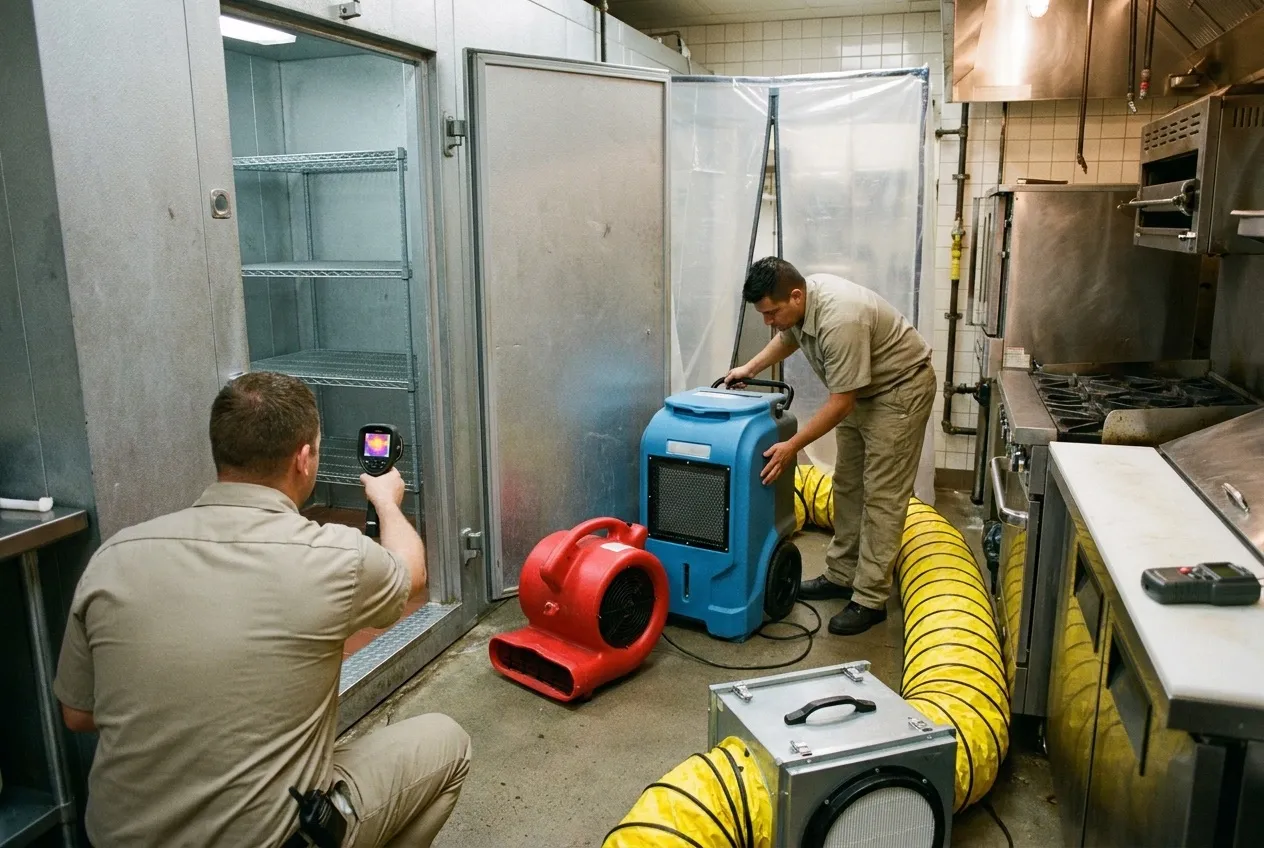
Not necessarily. Moisture gets measured under and around the box first, and the readings drive the decision. Maricopa County's construction guide says "Pumps may not be installed inside walk-in units," and that floor sinks or floor drains "must not be installed in walk-in units" without prior approval. Walk-in walls, ceilings and floor-to-wall junctures "must be made of metal and properly coved." The guide also says "Rubber/vinyl cove base is not permitted inside or outside walk-in cooler/freezer units," so whatever gets opened goes back to that standard.