Office & Retail Suite Water Damage in Phoenix
Published October 8, 2026 · Last reviewed October 8, 2026 · Water Fighters Restoration
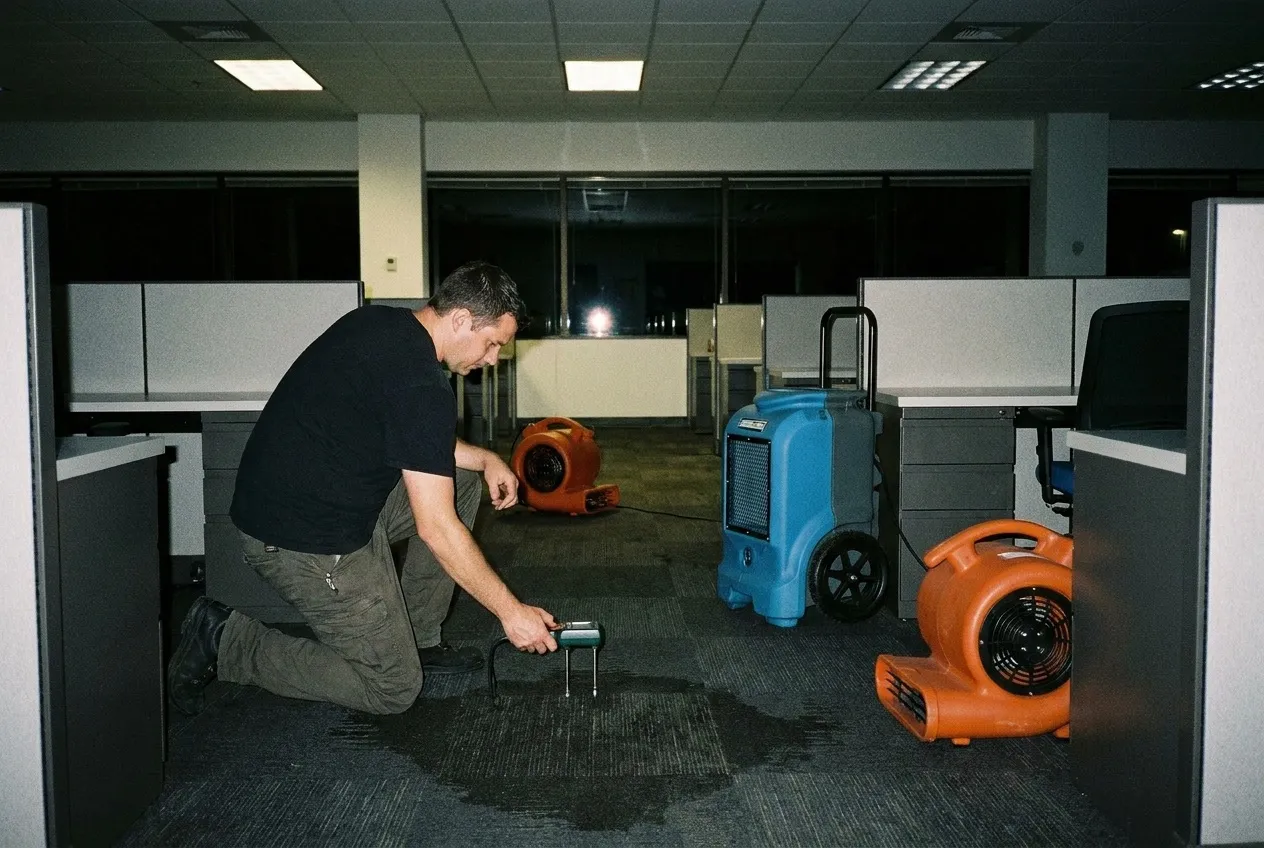
Monday morning, one ceiling panel over the copy room has a brown edge and a soft, bowed middle. The carpet tile under it is dry. Above the grid, water from a failed fitting has been spreading across the tops of the panels since Saturday, and the stain is the only part that reached the room.
An office or retail suite can hide water where a house can't: above a lay-in ceiling grid, under a raised access floor, and in the wiring those spaces carry.
What to do right now
- Close the valve serving the line, or call the building engineer who knows where it is. Leave the meter to your water provider.
- Keep people out from under sagging ceiling panels. Saturated panels can drop out of the grid.
- Don't switch wet electrical or network gear back on. A qualified person evaluates it first.
- If water came up a restroom or floor drain, or ran in across the ground from outside, treat it as Category 3. Keep people out of it.
- Call Water Fighters Restoration at (602) 884-5325. Open 24 hours, 7 days, and on-site within an hour.
Above the ceiling grid
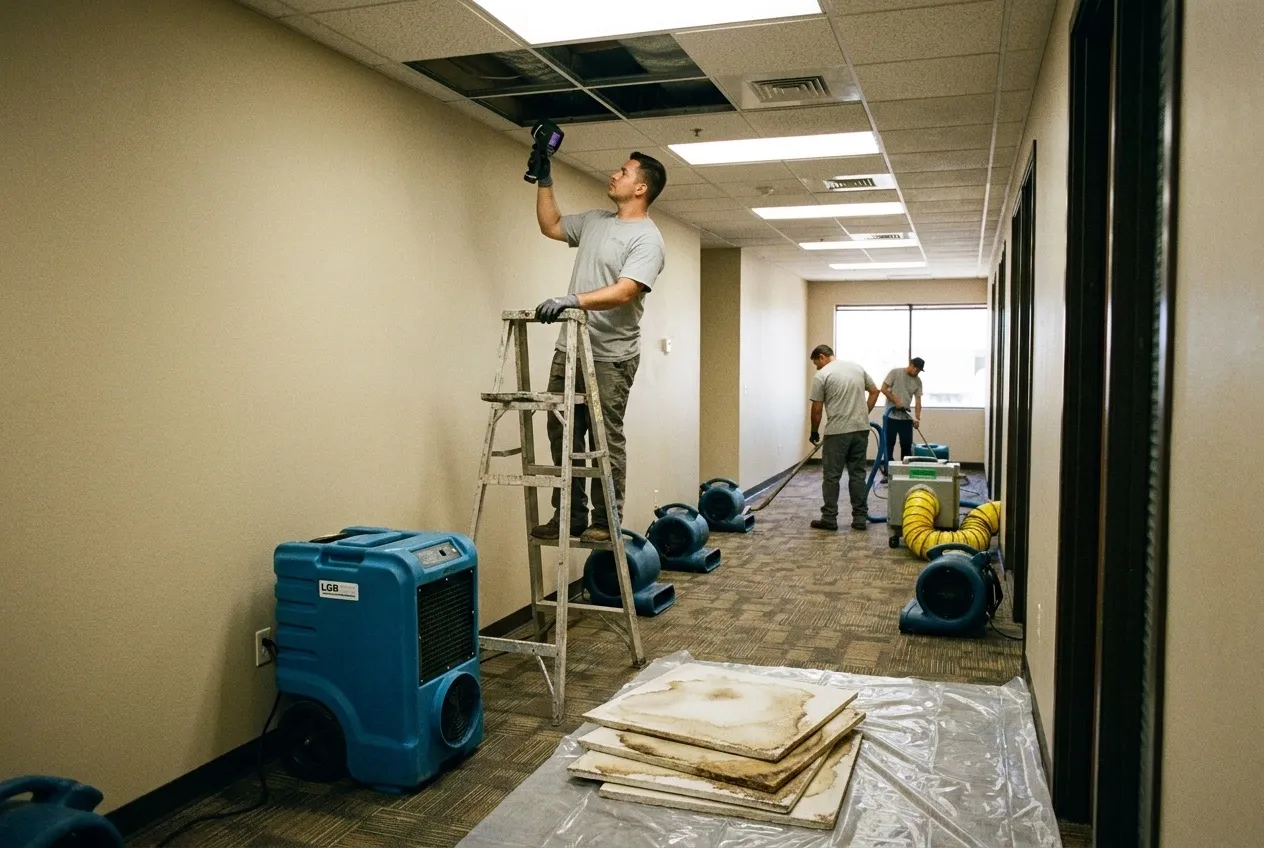
Many suites use a suspended grid with lay-in panels. The space above carries ductwork, cabling, light fixtures and sprinkler branch lines, and in many buildings it serves as the return-air path. Water from a roof, a rooftop unit's condensate line or the floor above spreads across the tops of the panels and the deck before a stain shows. So panels get lifted well beyond the visible stain, and moisture readings set the boundary.
The return-air path matters if the loss turns into mold. EPA's guide for commercial buildings says "Heavy mold growth on ceiling tiles may impact HVAC systems if the space above the ceiling is used as a return air plenum." The commercial mold remediation page covers the containment that follows. If a sprinkler head opened above the suite, the fire sprinkler water damage page covers that loss.
Under the raised floor
A raised access floor is a field of removable panels on pedestals over the structural slab. The cavity routes power and data cabling to floor boxes, and in some buildings it supplies conditioned air. Water that gets under the panels pools on the slab where nobody sees it.
Drying means lifting panels to extract and dry the slab and pedestals. EPA's clean-water table says to "Remove water with water extraction vacuum" from concrete, then "Accelerate drying process with dehumidifiers, fans, and/or heaters."
Wiring, breakers and low-voltage gear
NEMA's Evaluating Water-Damaged Electrical Equipment (GD 1-2019) says "Evaluation of electrical equipment should be conducted by qualified personnel." Its table marks "Replace equipment" for molded-case circuit breakers, low-voltage fuses, AFCIs and GFCIs, and "Wiring devices (switches, receptacles, dimmers, etc.)." The same goes for uninterruptible power supplies and wire or cable "listed for dry locations." Panelboards "may be reconditioned (contact the manufacturer)." Computers and servers are covered under contents restoration.
Furniture, records and retail stock
EPA's clean-water table says to dry carpet and backing "within 24 – 48 hours" with a water extraction vacuum, a dehumidifier and fans. It adds that "The subfloor under the carpet or other flooring material must also be cleaned and dried." The table's own footnote says "this is only a guideline."
For books and papers, EPA says "For non-valuable items, discard books and papers," and "Photocopy valuable/important items, discard originals." Its third option is "Freeze (in frost-free freezer or meat locker) or freeze-dry."
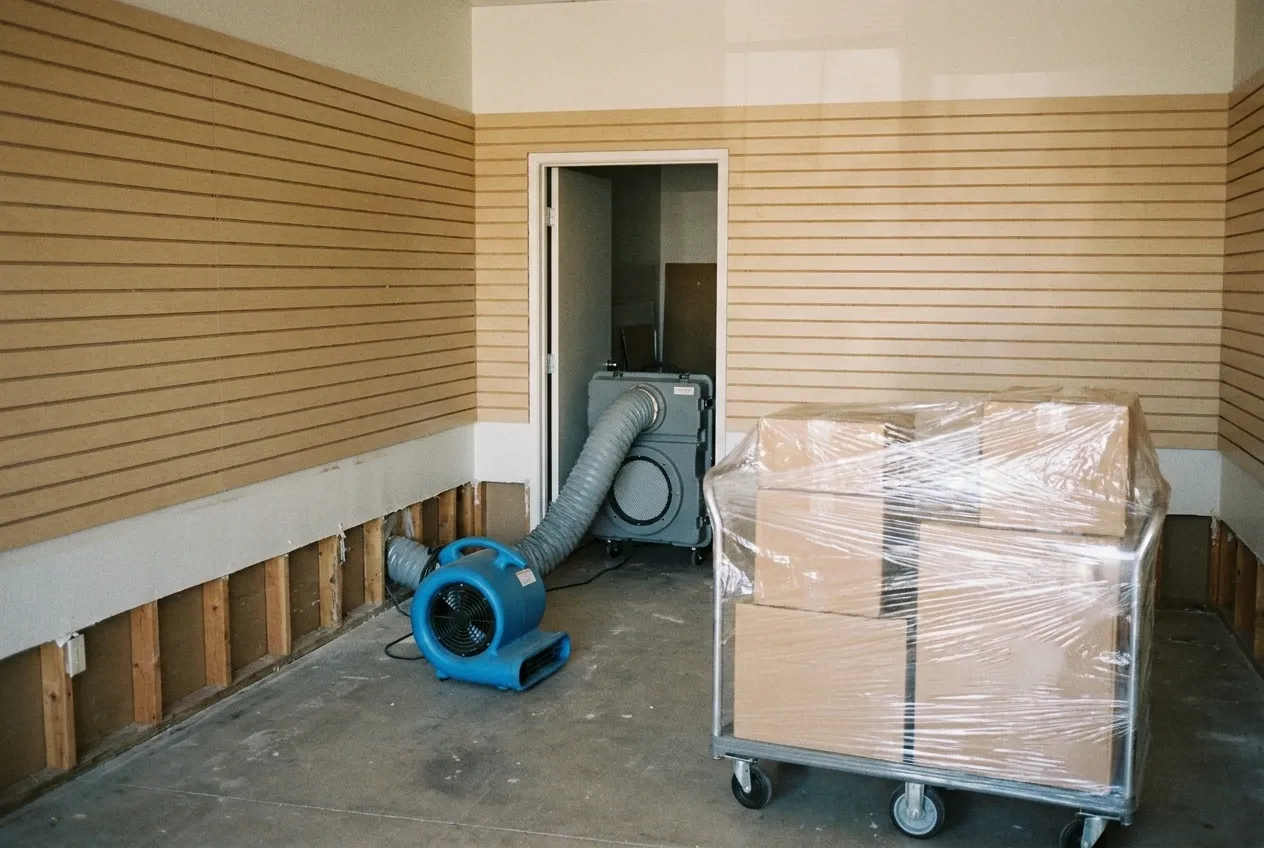
Retail suites add floor-level stock, fixtures and slatwall that sit right on the wet floor line. Stock on the floor gets moved and documented before extraction starts.
When the water isn't clean
The category follows the source. Clean supply water is Category 1 at the source, and clean water that sat is Category 2. Anything that backed up from a toilet, a restroom or floor drain, or a sewer is Category 3, and the commercial sewage cleanup page covers that work. Storm or runoff water that crossed the ground outside is handled as Category 3 too, and the monsoon flood damage page covers that side.
EPA's table says "Do not use fans before determining that the water is clean or sanitary." For water known or suspected to be contaminated with sewage, "Personal Protective Equipment and containment are required by the Occupational Safety and Health Administration (OSHA)."
The lease, and the Phoenix codes
In a suite, the lease controls who repairs and insures what. Allocation across several tenants is covered on the commercial water damage page.
In Phoenix, building work permitted since August 1, 2025 falls under the 2024 Phoenix Building Construction Code, based on the 2024 International Building Code. Other Valley cities adopt their own codes. Phoenix also enforces the 2024 International Fire Code with Phoenix amendments, effective February 17, 2026. The Deer Valley page covers business parks near the airport and our staffed location there.
One team from drying to rebuild
One team does the mitigation and the rebuild, so the drying record and the repair scope come from the same file. Estimates are free. The estimate you receive is the same one the insurer receives, and Water Fighters bills insurance directly. For a food-service tenant in the same center, see restaurant water damage.
Water Fighters Restoration is IICRC Certified 70192944 · AZ ROC 324471 · ROC 324468 · EPA Lead-Safe Certified Firm · Licensed, Bonded & Insured.
Common Questions
The ceiling tiles dried and look fine. Why replace them?
EPA's clean-water table says "Discard and replace" for ceiling tiles. It offers no dry-in-place option for them, unlike the one it gives drywall. EPA's commercial mold guide also lists "the top of ceiling tiles" among hidden surfaces where "It is possible that mold may be growing," which is the side nobody sees from the floor. A panel that got wet can also sag or stop sitting flat in the grid.
Water got under our raised floor and reached the floor boxes. Can we power back up once it's dry?
Not on looks alone. NEMA's guide says water-exposed electrical equipment "can be extremely hazardous if reenergized without performing a proper evaluation," and that evaluation "should be conducted by qualified personnel." A qualified person makes the call on power.
Does Arizona's Residential Landlord and Tenant Act apply to an office lease?
The act "shall apply to the rental of dwelling units" (A.R.S. 33-1304). It defines a dwelling unit as a structure or part of one "that is used as a home, residence, or sleeping place" (33-1310(4)). For a suite, the lease governs. This is a reading of the statute's scope, not legal advice.
The fire alarm went into trouble when the water hit. Does that change anything for the building?
It can, and the alarm contractor and the fire code official decide how much. A trouble signal doesn't by itself tell you the system is out of service. NEMA's guide says water-damaged components of signaling, protection and communication systems are replaced or returned "to the manufacturer for appropriate cleaning, recalibration, and testing." In Phoenix, the amended fire code addresses a required fire protection system that is out of service (901.7). Where the fire code official requires it, the code calls for evacuating the building and/or providing an approved fire watch until the system is back in service. A fire watch continues until the Phoenix Fire Department gives permission to end it (117.4). Outside Phoenix, ask your fire department.
Can fabric cubicle panels and office chairs be dried, or do they go?
It depends on the water and the time. EPA's clean-water table says upholstered furniture "May be difficult to completely dry within 48 hours." For a valuable piece, it says "you may wish to consult a restoration/water damage professional who specializes in furniture." If the water was Category 3, porous furnishings follow the removal approach on the commercial sewage cleanup page.