Apartment Water Damage in Phoenix
Published October 8, 2026 · Last reviewed October 8, 2026 · Water Fighters Restoration
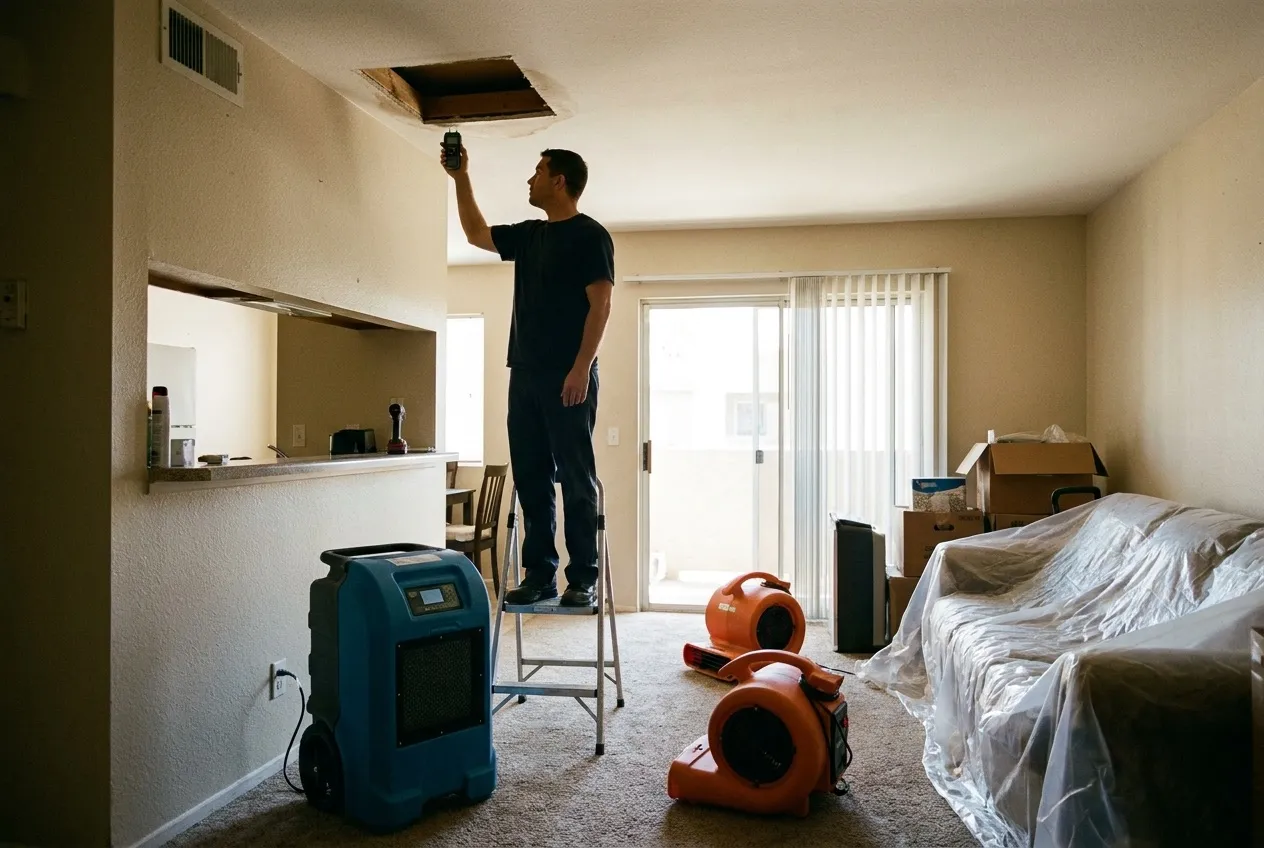
A ground-floor resident calls at 11 p.m. Water is dripping around the ceiling light, and the carpet under it squishes with every step. The unit above is dark, and its tenant is out of town.
In a multifamily building, water can travel well past the unit where it started. This page is for property managers and owners. It covers how water moves through a stack, what Arizona's landlord-tenant act says where the work touches it, and how to turn a unit without sealing moisture in. It is not legal advice; the lease and your counsel govern specifics.
What to do right now
- Stop the water at the closest valve serving the line, whether a unit valve, a riser valve or the building main. Leave the curb meter box to your water provider. The burst pipe guide covers where valves usually sit.
- Keep residents away from wet ceilings, light fixtures and outlets. A qualified person evaluates wet electrical equipment before it's turned back on.
- If water came up a tub, shower, toilet or floor drain, treat it as Category 3. Keep people out of it, and hold off on fans.
- Call Water Fighters Restoration at (602) 884-5325. Open 24 hours, 7 days, and on-site within an hour.
How water moves through a stack
Apartments sit above apartments by design. A supply failure upstairs commonly shows first as a ceiling stain, a wet light fixture or a wet wall in the unit below. It can reach more than one level before anyone finds the source. The ceiling water damage guide covers what that ceiling is telling you.
Drain water follows a different path. On a shared drain line, a backup usually comes out at the lowest connected fixture. The north Phoenix sewage page explains why that can be a ground-floor unit.
The category follows the source. Clean supply-line water is Category 1 at the source. Washer discharge, or clean water that sat, is Category 2. Anything that came up from a drain, a sewer line or a toilet backup is Category 3. The sewage cleanup page covers that work.
The act a manager works under
Arizona's Residential Landlord and Tenant Act "shall apply to the rental of dwelling units" (A.R.S. 33-1304). Section 33-1308 lists seven arrangements it doesn't cover. They include transient occupancy in a hotel or motel, a condo owner's own occupancy, and public housing under title 36, chapter 12 or federal law. Check before assuming the act reaches a given building.
The landlord shall "Make all repairs and do whatever is necessary to put and keep the premises in a fit and habitable condition" (33-1324(A)). The same section covers common areas, and keeping supplied plumbing and electrical systems "in good and safe working order and condition." The tenant shall "Promptly notify the landlord in writing" of conditions that need repair (33-1341(8)). The tenant also "shall not unreasonably withhold consent" to entry for "necessary or agreed repairs" (33-1343(A)).
Tenants have remedies of their own. They cover notice and cure (33-1361), minor defects repaired by a licensed contractor (33-1363), wrongful failure to supply water and essential services (33-1364), and fire or casualty (33-1366). The landlord-tenant guide covers them from the tenant's side.
Drying units with residents in them
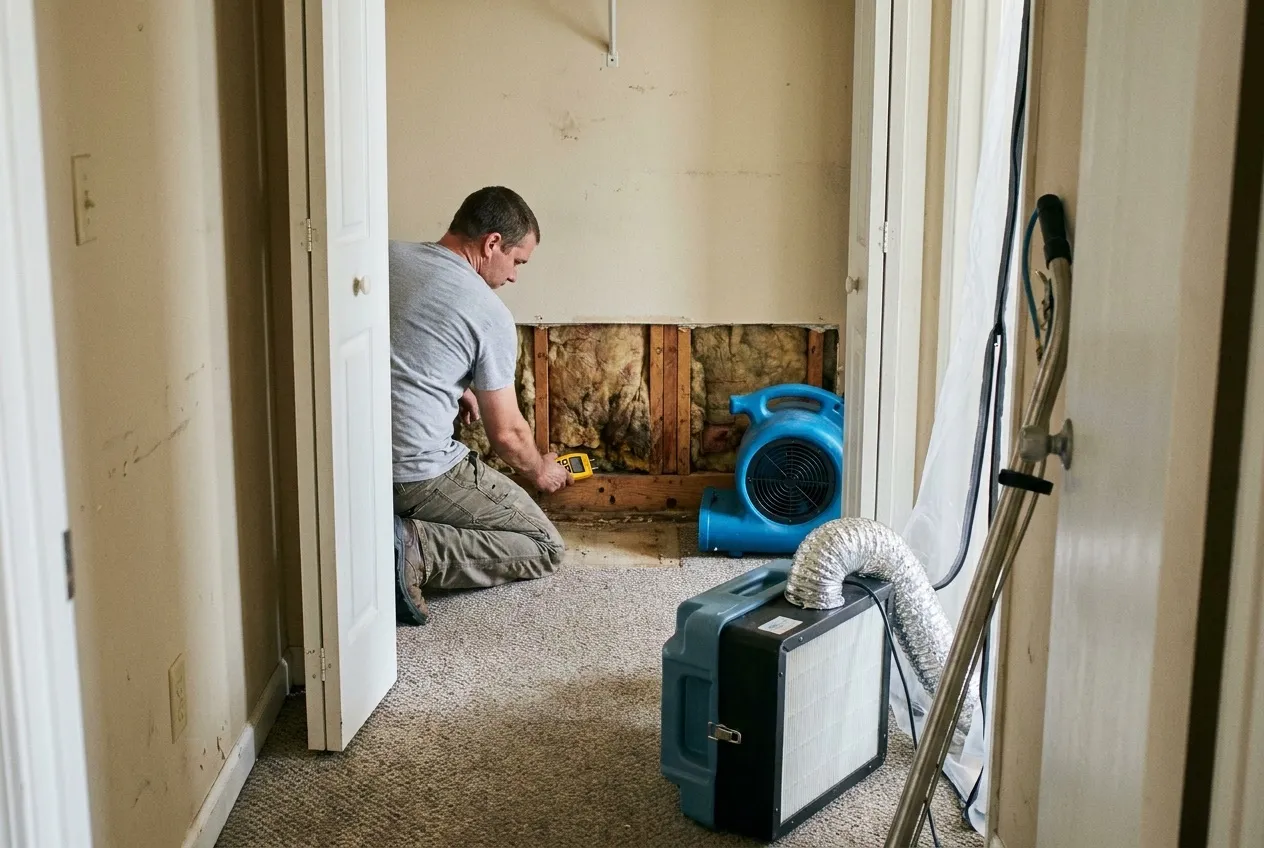
Drying an occupied building means repeat visits. Readings get taken in each affected unit until materials reach a dry standard, and equipment sits where residents can still reach the kitchen and bathroom. Water Fighters coordinates access with residents through management rather than knocking on doors.
EPA's clean-water table says to "Ventilate the wall cavity, if possible," and to dry carpet and backing "within 24 – 48 hours." Its own footnote calls that timing "only a guideline." For wet fixtures and outlets in the unit below, NEMA's guide says "Evaluation of electrical equipment should be conducted by qualified personnel." Its table lists wiring devices, GFCIs and AFCIs under "Replace equipment."
Walls and floor-ceiling assemblies between apartments are generally built as fire-resistance-rated separations. When one is opened for drying, the repair should restore the assembly as it was designed. In Phoenix, the adopted code is the 2024 Phoenix Building Construction Code, based on the 2024 International Building Code, effective August 1, 2025.
Turning the unit
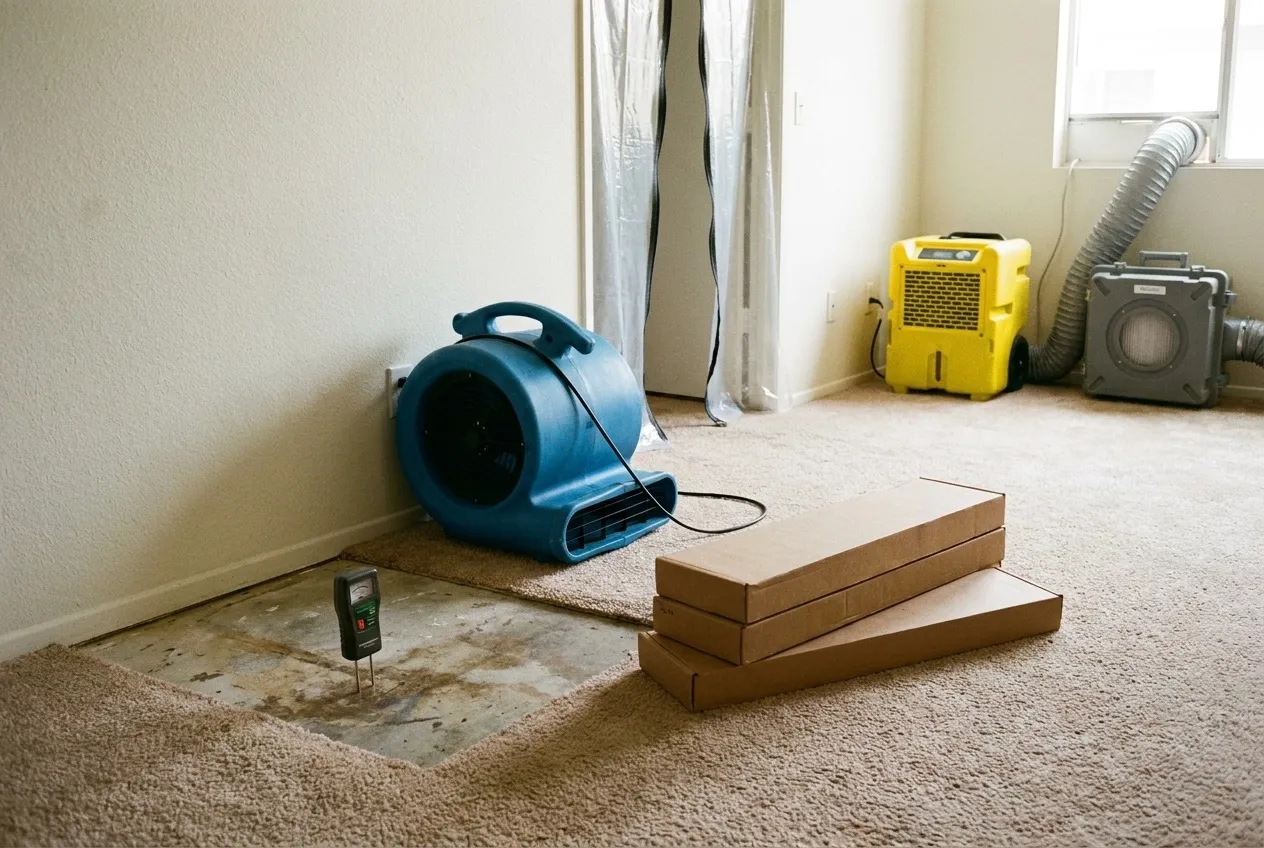
Turnover is where wet material gets hidden. Fresh paint over a damp wall and new plank over a damp slab both look finished on move-in day, with the moisture still behind them.
Records and the rebuild
A record that serves ownership, the carrier and a resident's own insurer holds moisture maps by area, daily readings, photos tied to locations, and equipment logs. Resident questions about belongings and temporary housing belong to the insurance claim guide.
One team does the mitigation and the rebuild, so the drying record and the repair scope come from one file. Estimates are free. The estimate ownership receives is the one the insurer receives, and Water Fighters bills insurance directly. The commercial water damage page covers multifamily within commercial response. The Tempe page covers the landlord workflow in Tempe. For a rented condo, the association side is in HOA and condo water damage.
Water Fighters Restoration is IICRC Certified 70192944 · AZ ROC 324471 · ROC 324468 · EPA Lead-Safe Certified Firm · Licensed, Bonded & Insured.
Common Questions
A leak is coming from a unit whose tenant isn't home. What does Arizona's landlord-tenant act say about entering?
The act says "The landlord may enter the dwelling unit without consent of the tenant in case of emergency" (33-1343(C)). Otherwise, "Except in case of emergency or if it is impracticable to do so," the landlord gives "at least two days' notice" and enters "only at reasonable times" (33-1343(D)). Whether a given leak counts as an emergency is a call for ownership and its counsel, not for a restoration contractor.
What does the act say about notice before follow-up drying visits in occupied units?
Under 33-1343(B), a tenant's repair request "constitutes permission from the tenant for the landlord to enter the dwelling unit pursuant to subsection D of this section." That permission is "for the sole purpose of acting on the service or maintenance request," and the tenant waives separate access notice. Subsection D otherwise calls for at least two days' notice, except in an emergency or where impracticable. How that applies to repeat drying visits is for the lease and your counsel.
What does Arizona's landlord-tenant act say about shutting off water to occupied units for a repair?
Two sections sit side by side. A landlord "shall not terminate utility services" provided under the rental agreement, running water among them. The exception is "as necessary to make needed repairs or as provided in section 33-1368" (33-1364(C)). The landlord's duty list also says to "Supply running water and reasonable amounts of hot water at all times," with stated exceptions (33-1324(A)(6)). This page draws no conclusion about how long a repair shutoff may last.
Can we paint and lay new flooring so the unit turns on schedule?
Not over material that still reads wet. EPA's clean-water table says wallboard "May be dried in place if there is no obvious swelling and the seams are intact." If not, it says "remove, discard, and replace." It adds that "The subfloor under the carpet or other flooring material must also be cleaned and dried." Paint and new flooring seal moisture in rather than remove it. Readings at a dry standard, not the calendar, are the signal to rebuild.
Water came up through a tub drain in a ground-floor unit. Can maintenance set fans tonight?
EPA's answer is direct: "Do not use fans before determining that the water is clean or sanitary." Water that came up a drain is Category 3. For water known or suspected to be contaminated with sewage, EPA notes that "Personal Protective Equipment and containment are required by the Occupational Safety and Health Administration (OSHA)." Keep staff and residents out of the room, and leave the cleanup to a crew equipped for it.