
The Phoenix Water Damage Insurance Claim, Start to Finish
Published August 7, 2026 · Last reviewed August 21, 2026 · Water Fighters Restoration
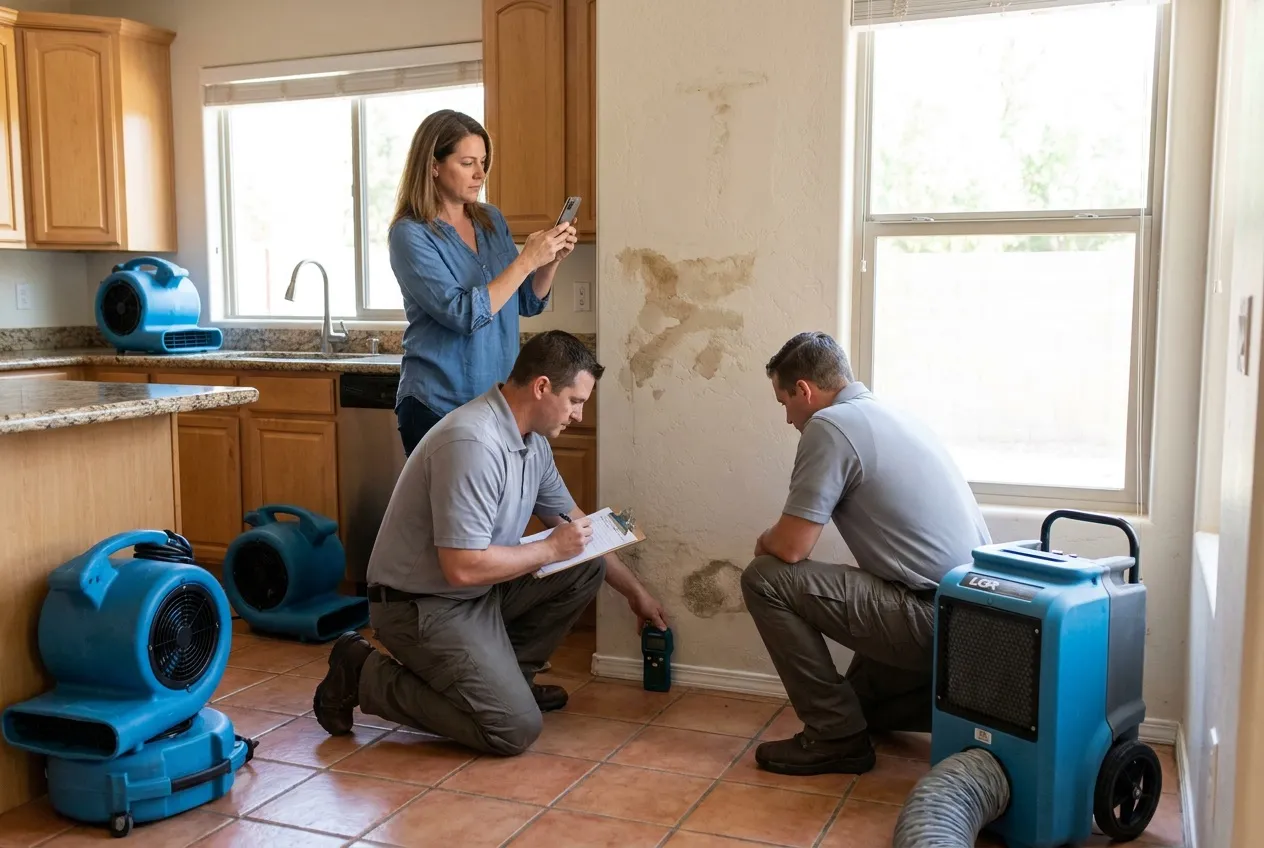
Most people file their first water damage claim standing in a wet hallway, learning the vocabulary in real time. This page is the claim in order — what to do first, what you're signing, how the money actually moves, and where claims go sideways. One honest disclosure up front: we're restoration contractors, not insurance agents or attorneys. Your policy's exact terms win every tie, and your agent is the right reader of them. What follows is how the process works on the hundreds of claims we document every year.
What should I photograph before anyone starts drying my house?
Everything, before anything moves: the source, the standing water with something for scale, every affected room from its doorway, close-ups of wet baseboards and climbing walls, the underside of cabinets, and your belongings where they sat. Wide shot first, then close, every room. Two minutes of photos outranks an hour of explaining later.
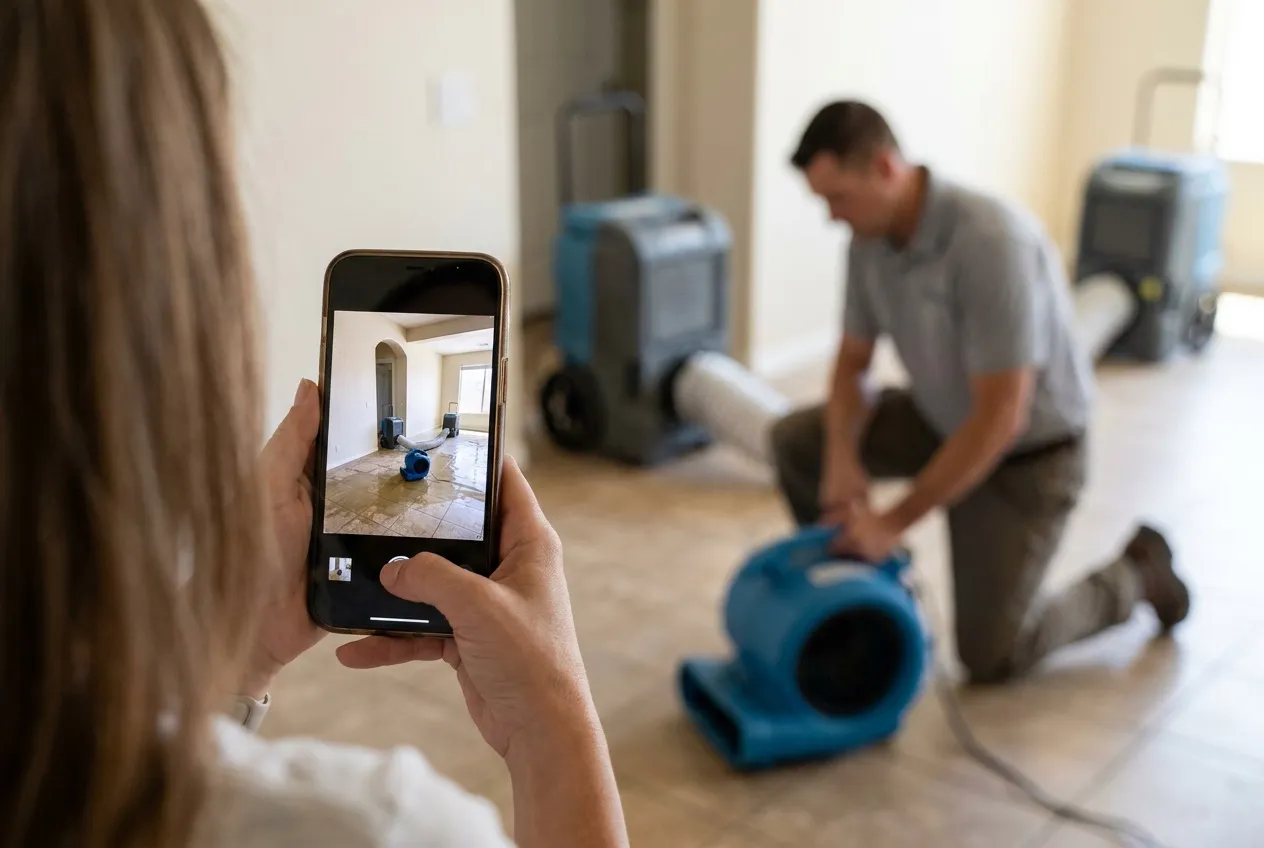
Yes — a professional crew documents too; our moisture maps, photo logs, and daily readings become the working file your adjuster processes. Shoot anyway. Your photos capture the first hour before mitigation changes the scene, they're timestamped by your phone, and they're yours no matter who does the work. Add three specifics most people miss: the water meter or the failed component itself (the cause-of-loss shot), a video walking the water's path from source to farthest wet point, and the serial tags on damaged appliances. Store everything off the phone the same night.
Then stop photographing and start mitigating — your policy requires prompt action, and the pictures exist precisely so that acting fast costs you nothing at claim time.
What am I signing when a restoration company hands me a work authorization?
Two things, usually: permission to perform a defined scope of emergency work on your property, and a direction-of-pay clause telling your insurer it can pay the contractor directly. Read both parts. It is not a blank check, and it should never obligate you to use that company for the rebuild.
The scope-of-consent section should name what's authorized — extraction, drying, demolition as readings require — not "any and all services." The direction-of-pay section is administrative convenience, not surrendered control: the claim is still yours, and you can still question line items. What a legitimate authorization does not contain: a penalty for choosing another contractor for repairs, an assignment of your entire claim, or open-ended pricing with no scope attached. If a form does, ask for it plainer or sign nothing past the emergency scope. In Arizona you choose your contractor at every stage — an authorization for tonight's extraction is not a commitment for next month's drywall.
Ask for a copy before the crew leaves. A company that hesitates to hand you your own paperwork has answered a different question.
How long do I have to file a water damage claim?
Report it promptly — days, not weeks. Every policy carries a prompt-notice condition, and while Arizona doesn't set one universal deadline, your policy sets two that matter: the notice requirement in its Conditions section, and a contractual deadline for legal action, commonly shortened to one or two years. Read yours tonight.
Late notice isn't automatically fatal — carriers generally have to show the delay actually hurt their ability to investigate, which lawyers call prejudice — but you never want to be the test case. The practical rule: report as soon as you know you have a loss, even before you know its full size. Reporting is free; you can always close a claim that turns out smaller than your deductible. What quietly runs out the clock is the "wait and see if it dries" month, which damages the claim twice — once on notice, once on the mitigation duty. If you've discovered old damage from an event months back, report it now and let the dated evidence do the arguing.
The deadline that surprises people is the suit-limitation clause, because it's shorter than any statute they've heard of. Find it in your policy's Conditions — it's the one date worth writing down.
How long does a water damage insurance claim take?
The money moves in stages, not in one check. Adjuster contact typically comes within days of reporting. The emergency mitigation invoice is often paid separately and early. The main payment usually arrives as an actual-cash-value check after the scope is agreed, with the held-back depreciation released after repairs finish. Simple claims close in weeks; negotiated ones run months.
What sets the pace is scope agreement, not paperwork speed. A claim where the contractor's estimate arrives in the format adjusters process, with photos and moisture logs behind every line, gets reviewed and agreed fast. A claim where scope is asserted without evidence gets a slower, line-by-line negotiation — and every revision cycle adds weeks. The other pace-setter is you: signed authorizations returned promptly, the contents inventory finished, and receipts submitted keep your file at the top of the stack. Where claims genuinely stall — cause-of-loss disputes, duration questions — the file either settles it or it doesn't, which is why the documentation sections above exist.
If a claim sits silent past your carrier's stated response windows, call your adjuster's supervisor, then your agent. Polite persistence, in writing, moves files.
What is recoverable depreciation and how do I get the second check?
Your carrier prices the loss at replacement cost, then subtracts depreciation for age and wear, and pays the remainder first — that's the actual-cash-value check. The depreciation is "recoverable" if your policy is replacement-cost: finish the repairs, submit proof, and the held-back amount arrives as the second check.
The proof is usually the contractor's final invoice showing the work completed at the scoped items, sometimes with photos, occasionally with an inspection. Two traps to step around. First, the second check only covers what actually got repaired or replaced — pocket the ACV money and skip the repairs, and the depreciation stays with the carrier. Second, deadlines: policies commonly give a limited window after the loss to complete repairs and claim the holdback, so a rebuild that drifts can quietly forfeit money. If your policy is actual-cash-value-only (some older or budget policies are), there is no second check — worth knowing before repair decisions, not after.
Our final invoice is written to be that proof — line-itemed against the agreed scope — so the release request is a formality, not a project.
What is a supplement and who submits it to my insurance?
A supplement is a documented request to add scope to an open claim — damage that wasn't visible when the original estimate was agreed, discovered once walls opened or materials came up. The contractor typically writes and submits it, in the same estimating format as the original scope, with photos and readings attached.
Supplements are normal, not suspicious: nobody can meter the inside of a sealed wall, and an estimate agreed on day two can't see what demolition reveals on day five. What makes one move smoothly is the same thing that moves everything in a claim — evidence attached at submission, priced in the carrier's own format, tied to the original cause of loss. What makes carriers push back: supplements that arrive at the end as a surprise total instead of during the work as discoveries happen. Our practice is to document, price, and submit the day the condition is found, and to tell you before we tell the adjuster — a surprise line item on your final invoice being the thing that should never exist.
One boundary worth knowing: supplements live on open claims. If your claim has already closed and new damage surfaces, that's a different process — the reopening question in the FAQ below covers it.
How can you tell if water damage is new or old?
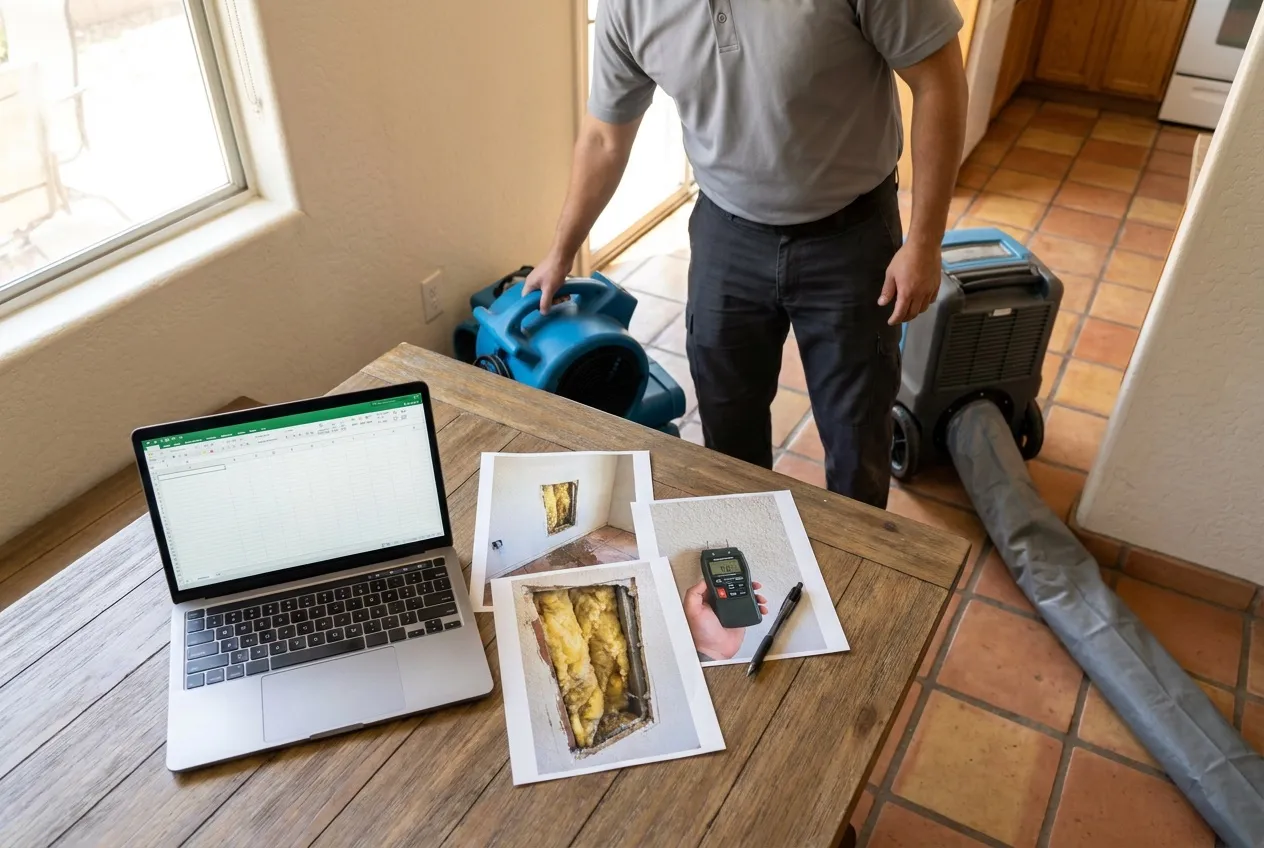
Mostly by edges and texture. Fresh damage has a damp, active edge and darkens toward the source; old damage leaves set brown rings with dry, defined borders. New drywall damage is soft and swollen; old damage goes brittle and flaky. And visible mold means at least days — colonization needs 24 to 48 hours to start.
Other tells the trades read: mineral halos and efflorescence mean repeated wet-dry cycles, not one event; stacked rings mean multiple soakings; a stain that's bone-dry under a meter is history, while one reading wet is live. Age matters to a claim because coverage follows suddenness — carriers pay for the burst, not for the seep that ran unnoticed for a season, and the new-versus-old read is where that conversation starts. Which is exactly why dated evidence outranks anyone's opinion: a moisture log that shows readings on specific days, photos with timestamps, and a repair record establish when damage happened in a way a visual guess never will.
If you've just found a stain and don't know its age, don't paint over it and don't guess at the adjuster — get it metered and photographed first, and let the file carry the argument.
Do I need a public adjuster for my water damage claim?
Usually not for a routine, well-documented residential claim — the fee comes out of your settlement, and a claim with clean evidence and an agreed scope has little for a representative to add. Where one earns the cost: large or complex losses, cause-of-loss disputes, or a claim that has genuinely stalled or been denied.
A public adjuster is licensed by the state to represent you — not the carrier — and works for a percentage of what the claim pays. That fee structure is the whole decision: on a straightforward claim it buys little; on a large, complex fire-and-water loss with contested scope, professional representation can pay for itself. What a public adjuster is not: a substitute for documentation. They argue from the same file everyone else does, which means the moisture logs, photos, and dated scope still decide the outcome — with or without representation. Our lane in that arrangement doesn't change: we document, we scope, we bill the carrier directly, and we hand the same file to whoever is reading it.
If you're considering one, verify the license with the Arizona Department of Insurance and get the fee agreement in writing before signing — the same sixty-second diligence you'd give any contractor.
Common Questions
Do you work with my mortgage company on the insurance check?
Yes, and on larger structural claims you'll need someone to — carriers commonly name your lender on the check under the policy's mortgagee clause, which means the bank endorses it before anyone gets paid. Lenders typically hold the funds and release them in draws as repairs progress, sometimes with their own inspections.
The process is bureaucratic but navigable: the lender's loss-draft department has a checklist — the adjuster's summary, the contractor's license and W-9, lien waivers, sometimes a signed contract — and repairs move as fast as the paperwork does. We supply our side of that stack the same week it's requested, because a rebuild waiting on a loss-draft department is the most preventable delay in this business. Start the lender conversation the week the claim opens, not the week the check arrives.
Will my insurance pay for a hotel while my house is being dried out?
If the home is genuinely uninhabitable from a covered loss, usually yes — that's Additional Living Expense coverage, and it pays the increase in your costs: lodging, the meals-out difference, even pet boarding. It doesn't pay for leaving a livable house that's merely loud with drying equipment.
The habitability line is the whole question, and it's factual, not preference: no working bathroom, contaminated water in living space, or no safe power reads as uninhabitable; three air movers in the den doesn't. Keep every receipt from the first night, get the adjuster's ALE confirmation before booking a month anywhere, and know the coverage has its own limit on your declarations page. Most clean-water residential dry-outs don't displace the household — and when one does, the confirmation-then-receipts sequence is what makes reimbursement boring.
Can I reopen a closed water damage claim?
Sometimes. If related damage surfaces after closure — hidden moisture behind a wall, mold traced to the original loss — you can ask the carrier to reopen, and with evidence tying the new damage to the covered event, they often will. The clock that governs it is your policy's legal-action deadline, so don't sit on the discovery.
The evidence bar is the same as everywhere in a claim: dated photos, readings, and a professional's written connection between what was found and what happened. What reopening is not for: scope you knew about and didn't pursue, or new unrelated losses (those are new claims). And if your claim is still open, additions run through the supplement process covered above — a distinction worth keeping straight, because supplements are routine and reopenings are negotiations.
Who pays for a hotel if an apartment is uninhabitable after a leak in Arizona?
Three different pockets, depending on what you carry and what happened. Your renter's policy's loss-of-use coverage is the direct answer — it pays your lodging when a covered loss makes the unit unlivable. The landlord's insurance covers the building, not your hotel. And Arizona's landlord-tenant law gives tenants separate options when a unit becomes uninhabitable.
In practice: if you carry renter's insurance, call your own carrier first — that's the fastest path to a paid room. If you don't, the conversation is with your landlord about the unit's condition and your options under the state's landlord-tenant framework, which can include rent abatement or termination in genuine habitability failures — a conversation worth having in writing, and with an attorney if it hardens. Either way, photograph the unit's condition the first day; every version of this runs on the same evidence.