
Monsoon Flood Damage in Phoenix
Published August 4, 2026 · Last reviewed October 8, 2026 · Water Fighters Restoration
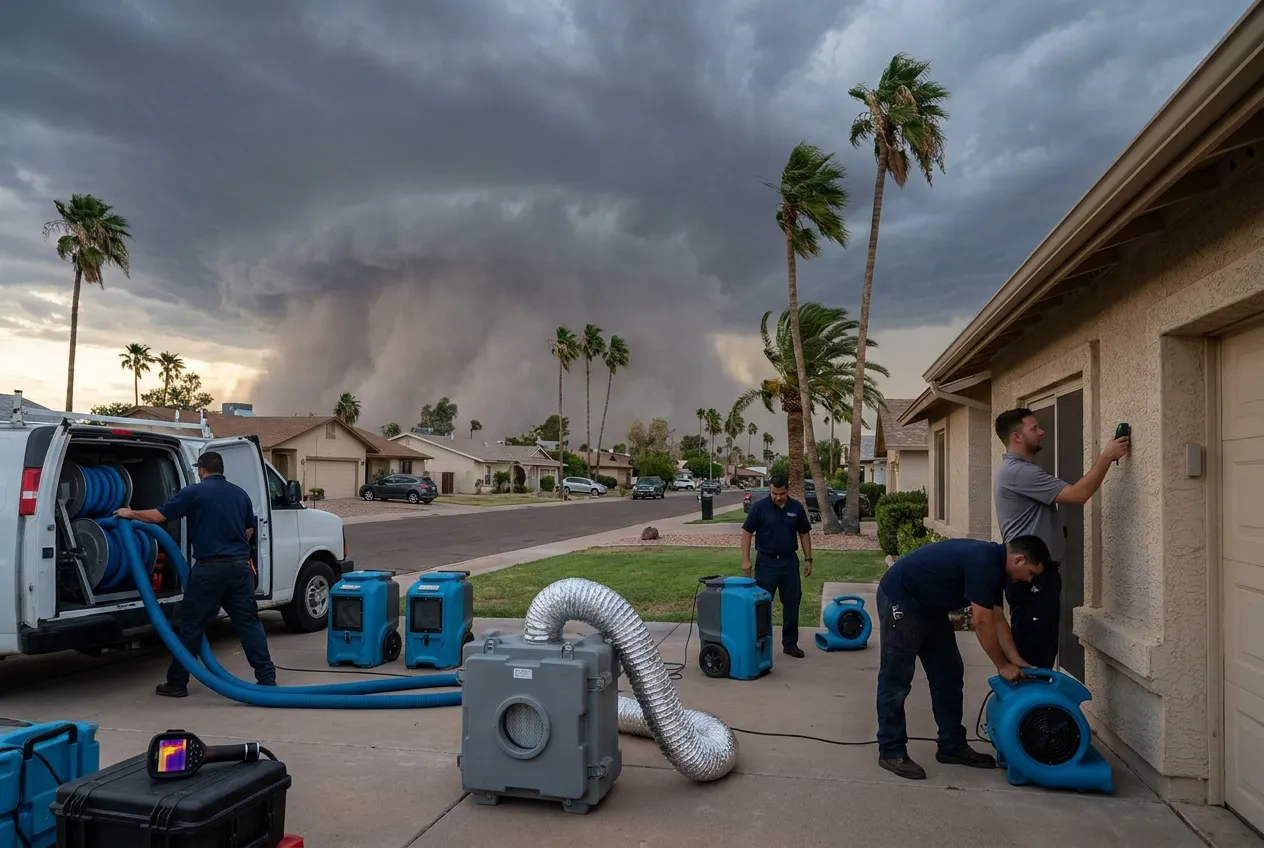
Every Phoenix summer runs the same three-act storm: the dust wall, the outflow winds, then rain falling faster than the desert can drink it. The city's drainage is engineered for most of it. Your house's last hundred feet — the scuppers, seals, and thresholds — are engineered by whoever maintained them last, and that's where monsoon losses are decided.
Anatomy of a Monsoon Loss
The sequence matters because each act sets up the next. The haboob arrives first and packs dust into every drain, scupper, and door track — the same dust that becomes dam-building sludge twenty minutes later. The wind arrives second, working shingles, lifting patio covers, and driving debris into the roof drainage it's about to need. Then the rain: an inch or more in under an hour is routine for a strong cell, and flat commercial-style roofs, tile roof penetrations, and low thresholds all get tested at once. Most homes pass. The ones that don't usually fail at a single point — one blocked scupper ponding a roof section, one west-facing door whose sweep gave up two summers ago, one garage sitting an inch below the street's brimming gutter.
Where It Gets In
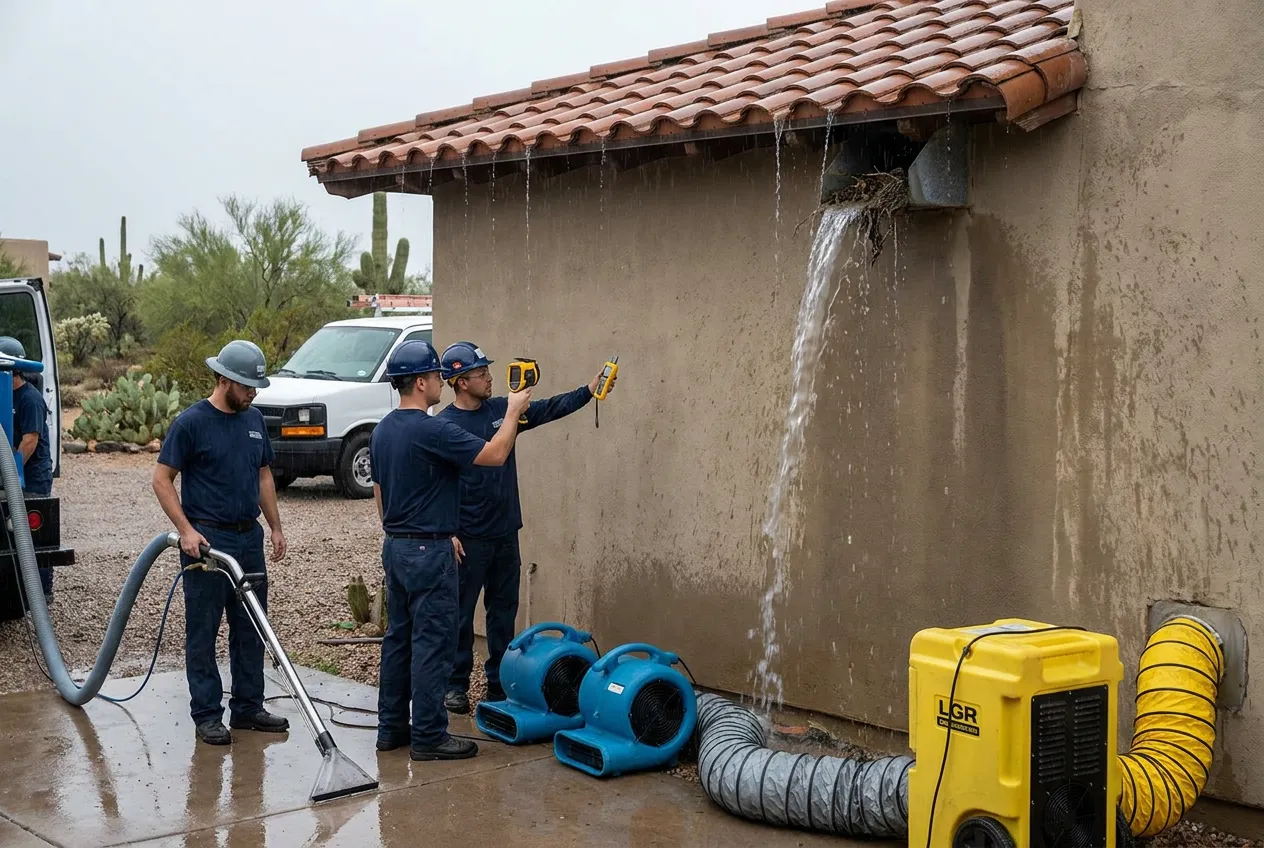
The entry points repeat across thousands of calls: flat-roof and parapet scuppers, tile roof penetrations around vents and skylights, west-facing windows and doors taking rain horizontally, garage thresholds meeting street flow, weep screeds at ponding grade, and — in the older irrigated neighborhoods — lots whose berms send runoff toward the slab instead of the street. Interior AC systems join the party indirectly: a condensate line already half-clogged by June chooses the humid storm week to back up through a ceiling, and the homeowner reasonably blames the roof. Half of monsoon diagnosis is separating storm water from the failure the storm merely exposed.
The June Checklist
An hour in June prevents most August calls. Clear every scupper, roof drain, and gutter — physically, not visually from the ground. Walk the lot's runoff path and make sure water leaving your roof has somewhere to go that isn't a doorway. Test door sweeps and thresholds with a hose if you're serious. Trim what overhangs the roof. Check that the grade beside the slab still slopes away — settled backfill quietly reverses it over the years. And if your neighborhood has flood-irrigated lots or sits beside a wash corridor, walk those edges too; the handbook's monsoon chapter carries the full version of this list.
Why Storm Water Is Different
Storm water that runs in across the yard, the street, or the desert is handled as Category 3 — grossly contaminated — no matter how clear it looks, because it carries all of them. Rain that comes through the roof gets its category on site: it is handled as Category 3 when the inspection finds it picked up contamination from the roof, the attic, or the walls, and any water gets worse the longer it sits. That classification changes the job on arrival: contaminated-water protocols, faster material calls (soaked pad and swollen MDF come out rather than gamble), antimicrobial treatment on what stays, and drying verified by readings on a compressed clock, because storm losses arrive warm and wet in a season built for mold. It also changes the claim: wind-driven rain through a storm-created opening is typically covered; rising water from outside is the separate flood-policy conversation. We document the entry point and mechanism precisely on every storm call, because that distinction is the whole coverage question — and the storm's date is our ally in the adjuster's queue.
Common Questions
A storm is hitting tonight and water is starting to come in. What do I do this minute?
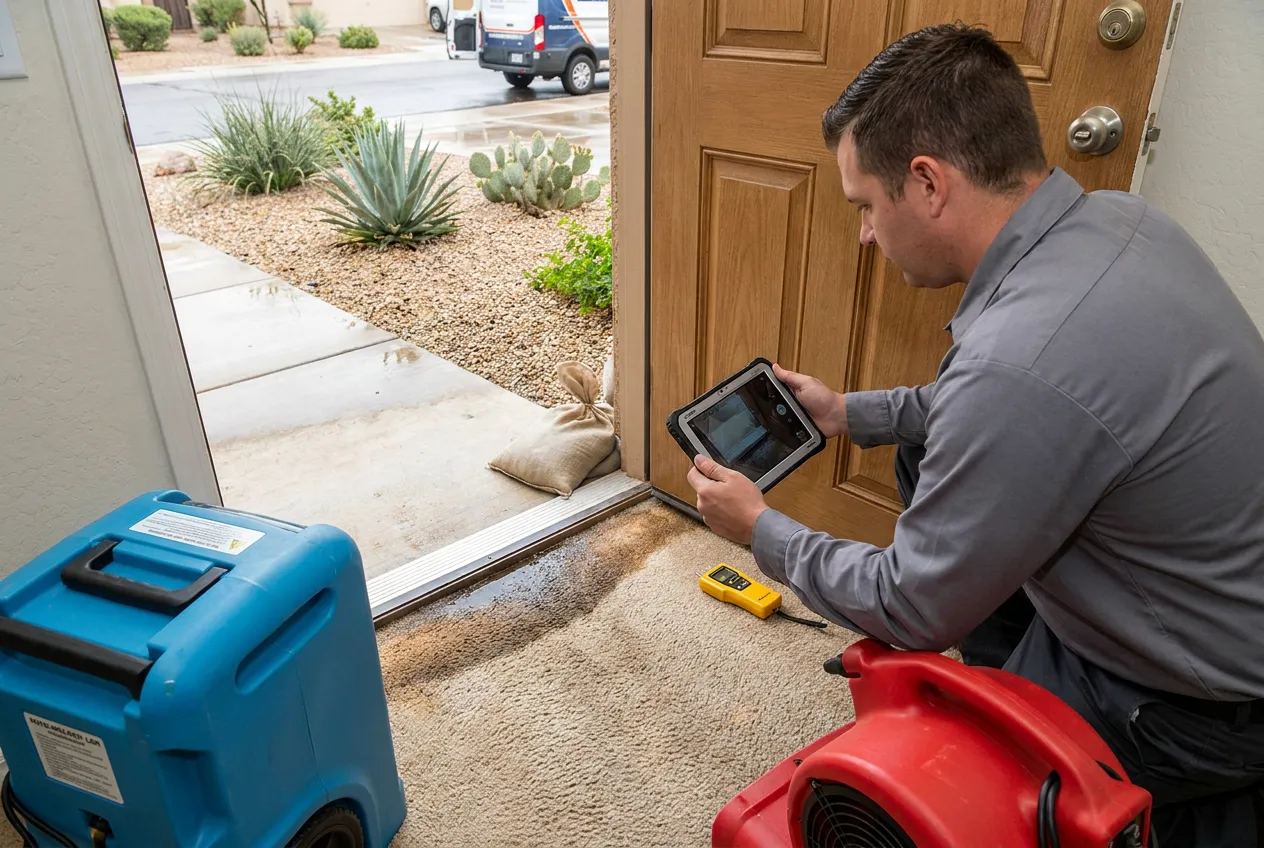
Move what's movable, towel-dam the threshold, and call — don't wait for the storm to pass. Crews run all night during monsoon events, and the difference between water stopped at the entry room and water in four rooms is measured in minutes.
The ceiling stained during a storm. Roof leak or something else?
Coin flip in July — storms expose AC condensate backups and old flashing failures as often as they cause new openings. We trace the moisture path before anyone sells you a roof, because drying the ceiling twice for a misdiagnosed source is the expensive version.
Is monsoon water really contaminated if it came straight off my own roof?
Often, but not automatically. The IICRC's 2026 position is that rain coming in from above isn't automatically Category 3 — it becomes Category 3 when it's grossly contaminated. Roof surfaces carry months of dust, droppings, and debris, and water that ran through an attic and a wall cavity picks up more, so the category gets set on site from what the water touched and how long it sat. When it did pick up contamination, Category 3 handling isn't caution theater — it's why storm losses don't become health problems.
Will insurance cover monsoon damage?
Usually yes for wind-driven rain entering through a storm-created or storm-exposed opening; rising outside water needs separate flood coverage. The entry mechanism decides it, which is exactly what our documentation establishes — and why the cost guide's insurance section is worth ten minutes before August.
Can you really get here during a major storm night?
Monsoon nights are what we staff for. If a Valley-wide event ever genuinely threatens the response window, you get a call with a real time and interim instructions — not a voicemail box.
Should I tarp my roof after a monsoon leak?
Yes. Your insurance policy expects reasonable steps to stop further damage, and tarping a storm-opened roof is the textbook example. That does not mean you on a wet tile roof at night — that trip ends in emergency rooms. Contain the water inside, and have the tarp placed at first safe light or by a crew tonight.
The mitigation duty is real: a documented opening left uncovered through two more storms invites a carrier to argue the later damage was preventable. Photograph the opening and the interior damage first, then cover it. And respect what a Phoenix roof is after a storm — wet concrete tile is slick, broken tiles hide underfoot, and walking it in the dark cracks more of them. A monsoon microburst can drop an inch of rain in twenty minutes; the tarp's job is making sure the next cell hits plastic instead of insulation.
The tarp stops the next gallon. The gallons already in the ceiling cavity are the actual job — saturated insulation out, framing dried to verified readings, on the same 24-to-48-hour clock every wet material runs. An overnight storm crew does both in one visit: tarp up top, extraction below.
When is monsoon season in Phoenix?
June 15 through September 30 — the National Weather Service's fixed dates for the North American monsoon in Arizona. The storms themselves cluster from early July through late August, when Gulf of California moisture surges north and afternoon heat builds the cells that arrive as dust, wind, and then rain.
The dates became fixed in 2008; before that, the season officially started only after three straight days of high dew point, which made for good trivia and bad planning. If you're reading this in May or early June, the June checklist on this page is the whole assignment.