
Contents Restoration & Pack-Out in Phoenix
Published August 21, 2026 · Last reviewed August 21, 2026 · Water Fighters Restoration
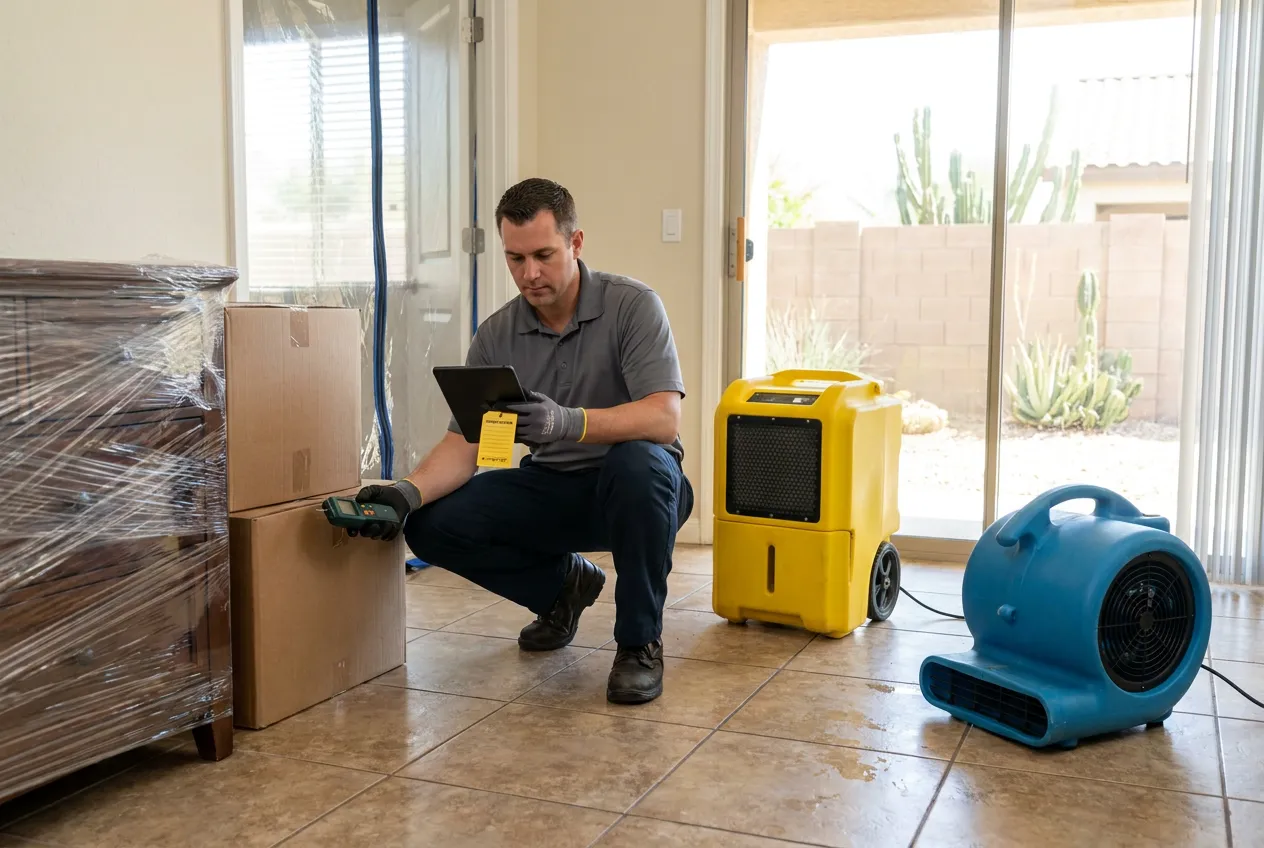
Most of what gets written about restoration is about buildings — drywall, framing, moisture readings. The question homeowners actually ask first is usually about a box. What happens to my things, where do they go, and how do I know I will get them back.
The Question Nobody Asks Out Loud
There is a difference between the structure and the contents of a home, and in a serious loss they get handled as two connected jobs. The structure has to be dried, and drying a room full of furniture is slower, less effective, and worse for the furniture. So the contents come out — that is the pack-out — and they get cleaned, stored, and returned once the room is finished.
The part people are anxious about is control. You are being asked, in a bad week, to let strangers put your possessions in boxes and take them somewhere. The answer to that anxiety is documentation, and it is the same answer to almost everything else in this business: everything is inventoried, everything is photographed, and every item is trackable at any point in the process.
Nothing leaves the house unrecorded. If you want the list, you get the list.
How a Pack-Out Works
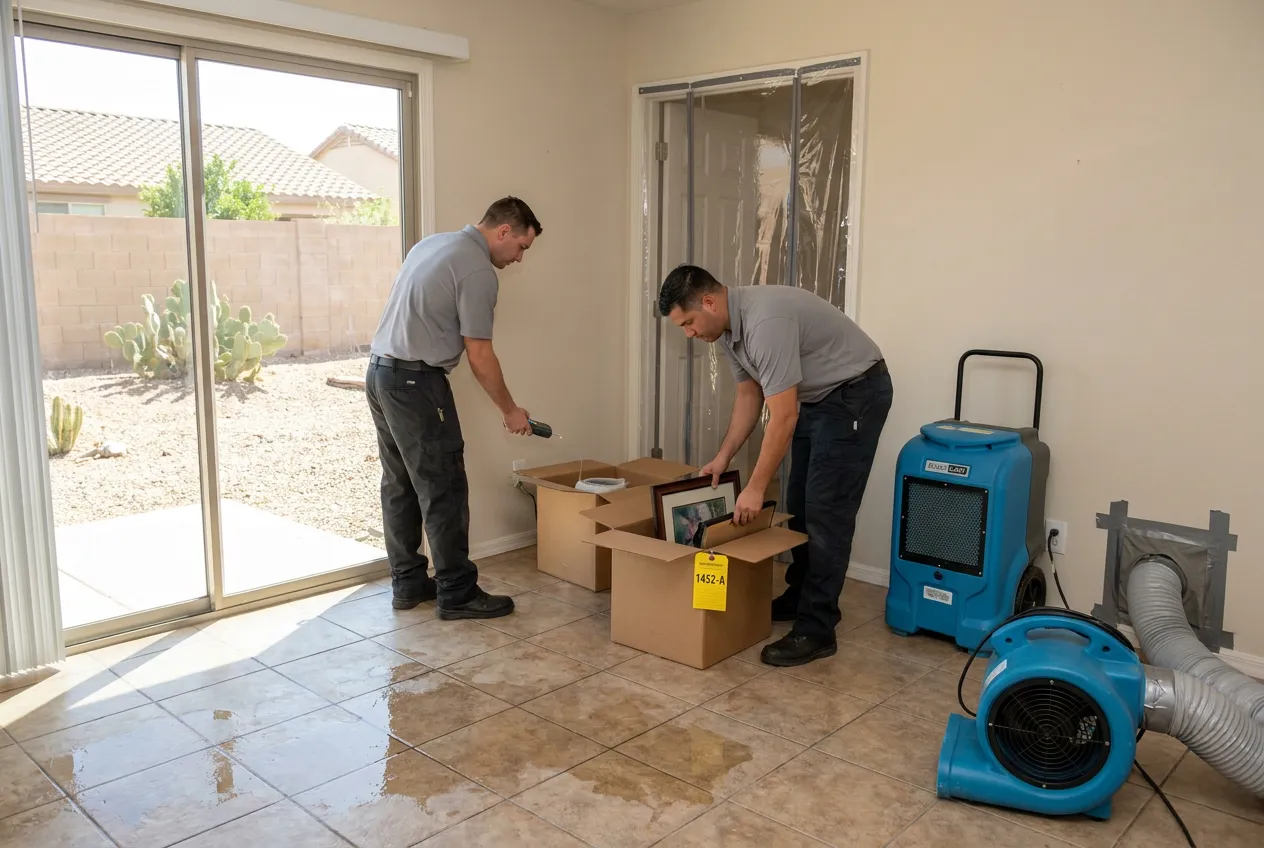
Inventory first. Before anything is boxed, items are photographed and logged with condition noted. That record is what protects you and it is what an adjuster will want. Rooms are worked one at a time so the record stays organized by where things came from.
Sort by what the item needs. Not everything gets the same treatment. Some items are cleaned on site and stay. Some need specialized cleaning off site. Some are unsalvageable and get documented for the claim rather than cleaned. That sorting decision is made against the water category and the material, not by eye.
Pack and transport. Standard cartons for most household goods, custom crating for artwork, mirrors, and anything fragile or oddly shaped. Furniture gets wrapped and padded. The truck manifest matches the inventory.
Clean and store. Depending on the item, that can mean ultrasonic cleaning for hard goods, textile cleaning for soft goods, deodorization for smoke exposure, or controlled drying for paper and books. Storage is climate-controlled — a relevant detail in a Phoenix summer, where a hot unit will finish what the water started.
Pack back. When the structure is done, the contents come home and go back where they were, room by room, against the same inventory.
What Can and Cannot Be Saved
The honest version is that the water category decides more than the material does.
Clean-water losses give the most room. Furniture, textiles, and most household goods are salvageable if they are treated quickly, because the problem is moisture rather than contamination. Speed matters enormously — the same sofa is a cleaning job on day one and a disposal on day four.
Category 3 losses — sewage, storm water, anything grossly contaminated — narrow it sharply. Porous items that absorbed contaminated water generally cannot be made safe: upholstered furniture, mattresses, pillows, and most textiles that took it directly. Hard goods and non-porous items usually clean up fine. That line is not negotiable and we would rather say so on the first day than let someone hope for six weeks about a couch.
Smoke and soot exposure is its own category, with its own cleaning methods, and odor is often the deciding factor rather than visible damage.
Sentimental items get treated differently in one specific way: when something cannot be restored to function, it can often still be stabilized or partially recovered, and it is worth asking rather than assuming. Nobody gets to tell you what a thing is worth to you.
Documents, Photographs, and Electronics
Three categories deserve their own paragraph because the wrong first move destroys them.
Paper and photographs. Do not try to separate wet photographs or documents, and do not lay them out in the Arizona sun to dry. Wet paper tears and wet emulsion lifts. The correct move is to keep them wet and cold — bag them and freeze them if you can — which stops deterioration and buys time for controlled drying later. That is counterintuitive and it is the single most useful thing on this page.
Electronics. Do not power anything on to see if it works. Water and residue inside a device do more damage energized than they do sitting there, and a device that could have been cleaned becomes scrap the moment someone tests it. Leave it off and let it be assessed.
Anything with a motor or a compressor. Appliances that took water get evaluated rather than plugged in, for the same reason and with the added electrical hazard.
The Insurance Side
Contents are usually covered under a separate part of a homeowner policy from the structure, with their own limit, and that has a practical consequence: the contents inventory is not paperwork, it is the basis of that part of your claim.
This is where the two sides of the file meet. Our inventory documents what existed, what condition it was in, and what happened to it. Your own photographs of the room before anything moved are worth keeping too — they capture the scene as it was. Between the two, an adjuster has what they need to process the contents portion without a negotiation about what was in the room.
Items that cannot be restored get documented as losses with the same care as items that can, because an unsalvageable item still has to be substantiated. The claim guide covers how the money moves and where contents sit in that sequence.
Common Questions
Do all my things have to leave the house?
No. A pack-out happens when the structure needs to be dried or rebuilt in a way that having contents in the room prevents. Smaller losses often mean moving items to an unaffected room instead, which is simpler for everybody.
How do I know where my things are?
The inventory. Every item is photographed and logged before it is packed, and the manifest follows it to storage and back. You can ask for the list at any point.
My photo albums got wet. What do I do right now?
Do not try to peel pages apart and do not dry them in the sun. Bag them and put them in a freezer if you can. Freezing halts the damage and preserves the option of controlled drying, which is the difference between recovering an album and losing it.
Can our computer be saved?
Possibly, if nobody turns it on. Powering up a wet device is what turns a cleaning job into a total loss. Set it aside, leave it off, and let it be evaluated — and if the data matters more than the hardware, say so early.
Is the storage air conditioned?
Yes. In Phoenix that is not a detail to skip — a hot storage unit will finish what the water started, particularly with wood furniture, leather, and anything with adhesive in it.