
HOA & Condo Water Damage in Phoenix
Published October 8, 2026 · Last reviewed October 8, 2026 · Water Fighters Restoration
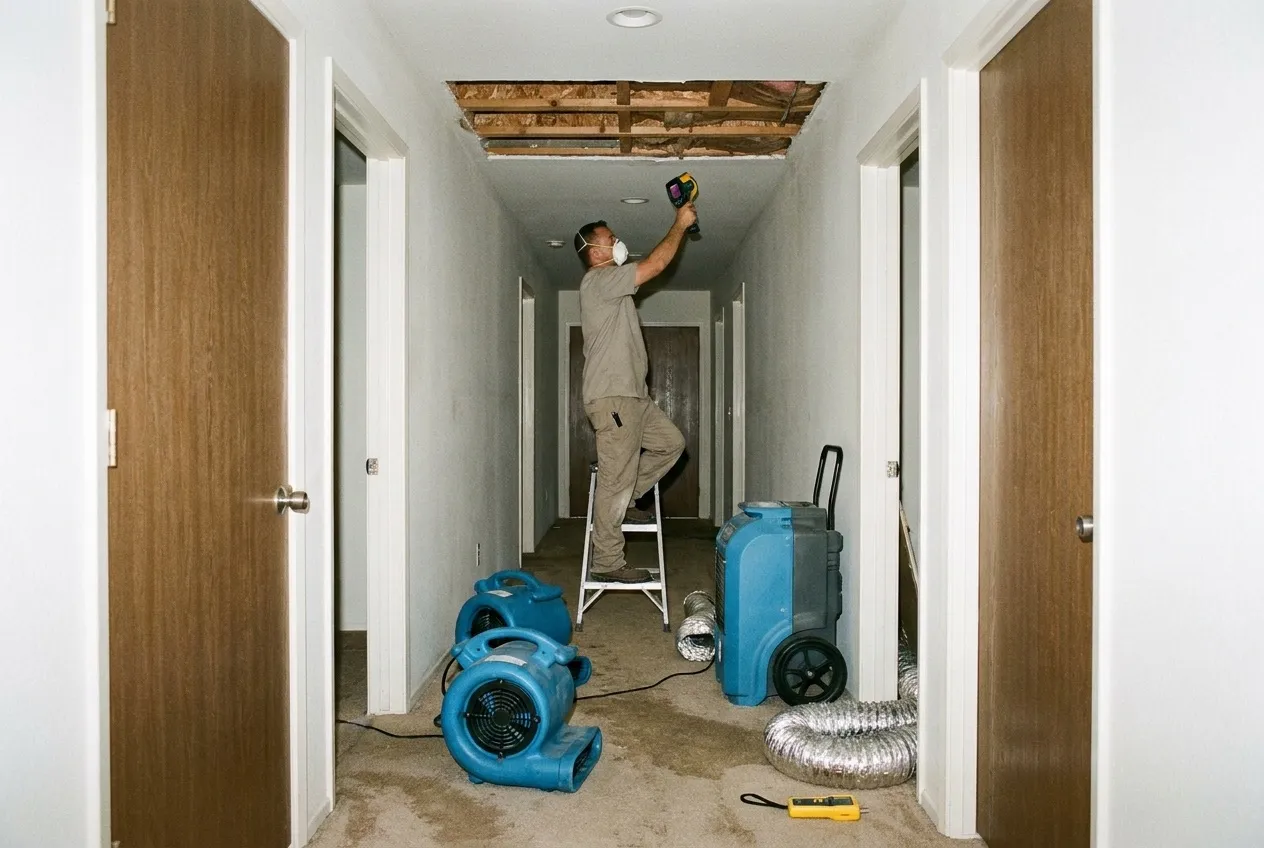
A supply line fails inside a second-floor condo. Downstairs, a brown ring spreads across the ceiling, and water drips from the edge of a light fixture onto the carpet. Two owners and one association now share the same wet ceiling.
Arizona answers part of the "who handles what" question in statute, and the answer depends on whether your community is a condominium or a planned community. Nothing here is legal advice; your declaration governs the details, and your own counsel can apply it to your building.
What to do right now
- Stop the water. Close the valve where the line enters your unit. For a shared line, call the association's emergency contact. Leave the curb meter box to your water provider.
- Keep people out from under the wet ceiling and away from wet light fixtures.
- Photograph the source and everything the water reached.
- Call Water Fighters Restoration at (602) 884-5325. Open 24 hours, 7 days, and on-site within an hour.
Two statutes, two rulebooks
Arizona's Condominium Act "applies to all condominiums created within this state without regard to the date the condominium was created" (A.R.S. 33-1201). It sets unit boundaries, default upkeep, required insurance and the order for reporting a loss.
The Planned Communities Act covers many townhome and patio-home HOAs. It has no section that splits maintenance between the association and owners, grants access through a lot or home, or requires insurance. In a planned community, the CC&Rs carry that load.
The drying itself is ordinary mitigation. What changes is the bookkeeping, because every wet material sits on one side of a line the statute or the declaration draws.
Who maintains what in a condo
Section 33-1247(A) sets the default: "the association is responsible for maintenance, repair and replacement of the common elements and each unit owner is responsible for maintenance, repair and replacement of the unit." That sentence opens with three exceptions: "Except to the extent provided by the declaration, subsection C of this section or section 33-1253, subsection B." The last one points to the insurance section, 33-1253(B). Access to a neighbor's unit is covered on the north Phoenix extraction page.
"Except as provided by the declaration," the same section also covers features outside the unit. Balconies, patios, entryways, and exterior doors and windows "designed to serve a single unit, but located outside the unit's boundaries," are limited common elements "allocated exclusively to that unit" (33-1212(4)). "Unless otherwise provided for in the declaration," the common expense of repairing one "shall be equally assessed against the units to which the limited common element is assigned" (33-1255(C)).
What the master policy covers
A condo association "shall maintain, to the extent reasonably available," property insurance. It covers "the common elements and, if required by the condominium documents, the units" (33-1253(A)).
The policy "need not include improvements and betterments installed by unit owners or the personal property of unit owners" (33-1253(B)). An owner's HO-6 policy is generally written to fit with it around the declaration's split, and the Central Phoenix page covers where the boundary falls.
The statute makes each owner an insured for the owner's interest in the common elements, the unit if the documents require it, or association membership (33-1253(D)). The insurer "waives its right to subrogation under the policy against any unit owner or members of the unit owner's household." If an owner has other insurance on the same property, "the association's policy provides primary insurance."
The association's prompt-repair duty covers "Any portion of the condominium for which insurance is required under this section" (33-1253(I)). Units fall inside it only if the condominium documents require them to be insured. The insurance claim guide covers the claim record.
Drying a building with shared walls
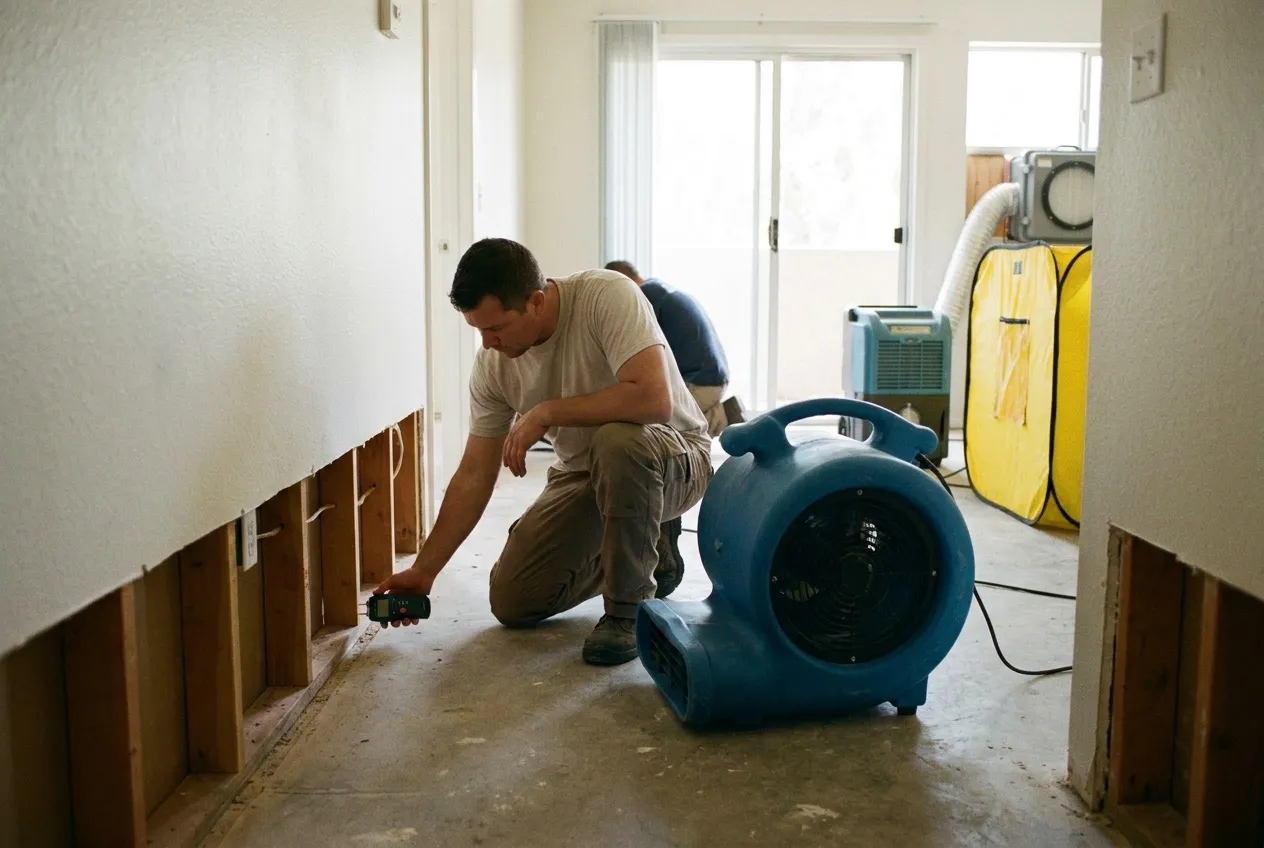
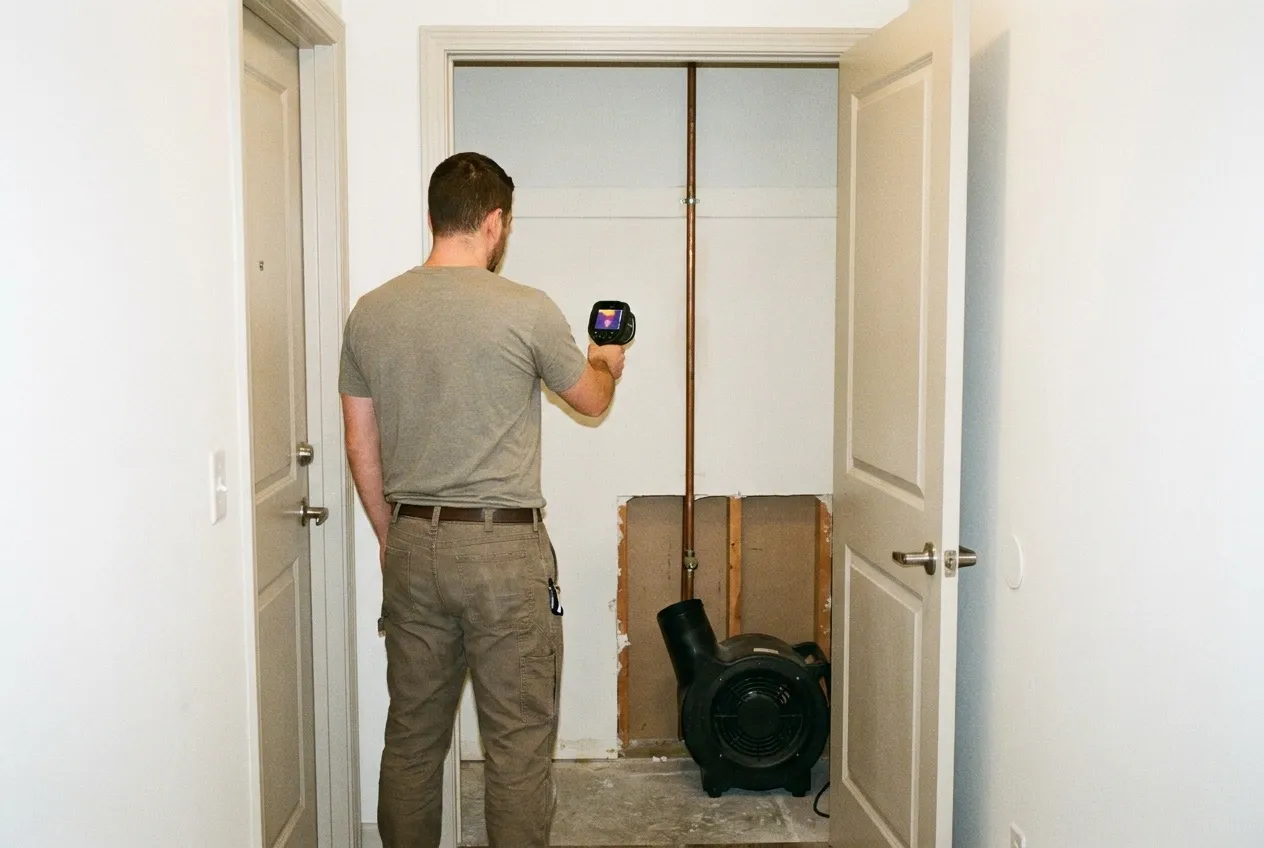
A failed line upstairs often shows first on the ceiling in the unit below, which the ceiling water damage guide covers. Mapping follows the water down and sideways with moisture meters and a thermal camera: the unit below, the shared wall, the corridor. Anything that came up a shared drain is Category 3, and the north Phoenix sewage page covers how the statute treats a shared conduit.
Good records name each wet material and where it sits: unit finish, common element, or limited common element. Readings and photos tied to those labels let owners, the board and the carriers work from the same facts.
What a board can do on a bad night
Subject to its declaration, a condo association may "Make contracts and incur liabilities" (33-1242(A)). It also "has a duty to act reasonably in the exercise of its discretionary powers" (33-1242(E)), as planned-community associations do under 33-1821. For board meetings held after declarant control ends, both statutes also excuse notice when an emergency requires action before notice can be given.
One team from drying to rebuild
Subject to the declaration, an owner "Shall not change the appearance of the common elements, or the exterior appearance of a unit" without the association's written permission (33-1221(A)). That matters if a repair would change how a door, window or other exterior surface looks.
One team does the mitigation and the rebuild, so the drying record and the repair scope come from one file. The water damage restoration page shows that process end to end, and the water damage repair page covers finished surfaces. Estimates are free. The estimate you receive is the one the insurer receives, and Water Fighters bills insurance directly. For a condo that's rented out, see apartment water damage.
Water Fighters Restoration is IICRC Certified 70192944 · AZ ROC 324471 · ROC 324468 · EPA Lead-Safe Certified Firm · Licensed, Bonded & Insured.
Common Questions
Where does a condo unit end inside a wall: at the paint, the drywall or the studs?
"Except as provided by the declaration," the statute puts the finished surface of a boundary wall in the unit and the rest of that wall in the common elements. The unit's share includes "wallboard, plasterboard, plaster, paneling, tiles, wallpaper, paint, finished flooring" and other finish materials (33-1212(1)). Interior partitions inside a unit belong to the unit, framing included (33-1212(3)). Upkeep and insurance are separate questions, covered on the north Phoenix extraction page and the Central Phoenix page.
Do I have to tell the association before I file on the master policy?
The statute says that before reporting under the master policy, a unit owner "shall report the loss to the association and give the association ten business days" to decide in writing (33-1253(E)). A decision not to report a claim must give the reason. Each owner also "has the right to report a loss under the association's property insurance policy" (33-1253(D)). Mitigation doesn't wait for either; the water keeps moving while the ten days run.
Can our board approve emergency work at 2 a.m. without posting a meeting notice?
The statute says notice "is not required if emergency circumstances require action by the board before notice can be given" (33-1248(D)–(E) for condos; 33-1804(D)–(E) for planned communities). That rule applies to board meetings held after declarant control ends. At an emergency meeting, the board "may act only on emergency matters," and the minutes "shall state the reason necessitating the emergency meeting." Those minutes are approved at the next regularly scheduled board meeting. The section excuses notice; it does not list emergencies among the grounds for closing a meeting.
We're in a townhome HOA, not a condo. Does the condo statute decide who fixes what?
Not if your community is a planned community. The planned-community definition "does not include … A condominium that is governed by chapter 9 of this title" (33-1802). The Planned Communities Act has no section on upkeep, access or insurance, so the CC&Rs decide. Many townhome communities are planned communities, and the recorded declaration says which yours is.
Can an owner see the association's file on the water loss?
The statute says records "shall be made reasonably available for examination by any member or any person designated by the member in writing as the member's representative" (33-1258; 33-1805). The association "shall have ten business days to fulfill a request for examination." Some records may be withheld, such as privileged attorney communications, "Pending litigation," and personal, health or financial records of individual members and employees. A file kept by building component from day one is easier to read when that request comes.