
Water Damage Restoration in Central Phoenix, AZ
Published September 2, 2026 · Last reviewed October 8, 2026 · Water Fighters Restoration
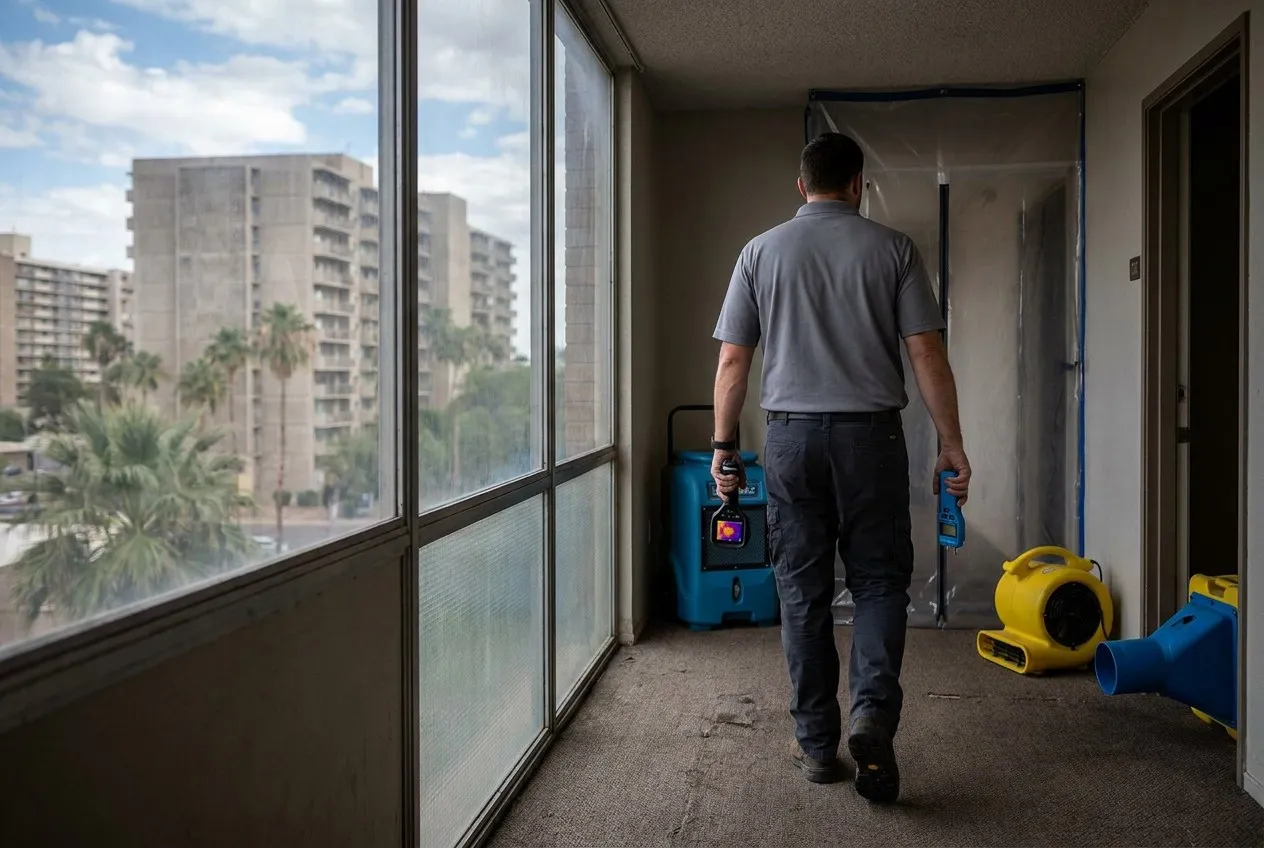
Central Phoenix puts three different water-damage clocks within a few blocks. A 1920s house may sit across Central Avenue from a 1960s tower. A newer shared-wall building may stand beside both.
The corridor runs roughly from McDowell to Camelback within the Encanto urban village. The eight-square-mile village holds 21 of Phoenix's 36 residential historic districts.
That density changes source tracing. A wet ceiling may begin in another unit, a common riser, or a roof assembly. In an older house, the same stain may come from galvanized supply, cast-iron drainage, or a later remodel.
The Encanto restoration page covers the garden-suburb district west of Central. The Coronado restoration page covers the streetcar-era housing east of the corridor.
Three plumbing clocks share one corridor
The first clock belongs to the 1920s through 1940s districts. Unrenovated houses may have supply and drain systems at or beyond their normal service lives. Remodels often leave a mix of old and newer materials behind finished walls.
The second clock belongs to the early residential towers. Phoenix Towers opened in 1957 as Arizona's first residential high-rise. Executive Towers followed in the early 1960s, and Regency on Central opened in 1964.
Risers and drain stacks in buildings of that age can serve many units in one vertical line. A failure on an upper floor may travel downward through wall chases. The first visible damage can appear several floors below the source.
The third clock began with transit-oriented development. Light rail opened along Central in 2008 after zoning changes encouraged denser housing. Newer lofts, condominiums, and post-2015 apartments still carry shared-wall and stacked-unit risk.
How a stacked-building leak is traced
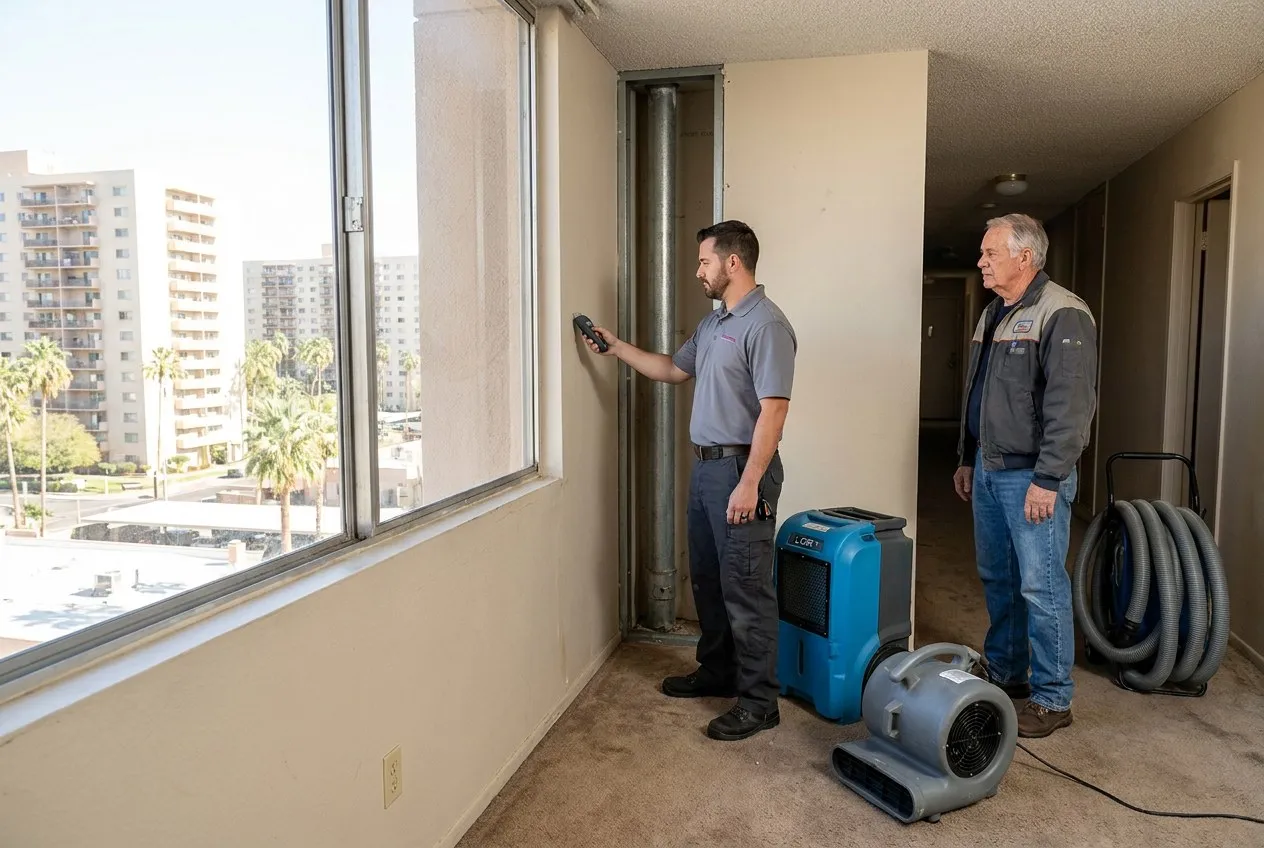
A high-rise leak is traced by following the water path, not by opening the first wet ceiling.
- Confirm whether water is still moving. The building's authorized contact identifies the proper shutoff and any affected common system.
- Compare units above, below, and beside the stain. Water can move vertically through a chase, then spread sideways at a floor assembly.
- Map moisture on each affected level. Readings separate visible staining from material that is still holding water.
- Match the pattern to the plumbing route. Supply lines, drains, condensate paths, and roof entry leave different moisture shapes.
- Document private and common areas separately. That record supports building management, unit owners, and their carriers.
Wastewater from a failed drain stack is Category 3. Clean supply water is assessed separately.
A source two floors above can leave only a narrow wet stripe at first. The musty paper smell in a closed hallway often arrives later.
Water Fighters Restoration is Open 24 hours, 7 days. Crews stage as one licensed team, Valley-wide, with the promise on-site within an hour.
Streets serve as drains during major rain
No live wash crosses the Central Avenue corridor. Its storm story is paved drainage, underpasses, and streets carrying water toward storm drains.
September 8, 2014 remains Phoenix's wettest calendar day on record. About 3.29 to 3.30 inches fell as remnants of Hurricane Norbert crossed the city. Central Phoenix saw flooded underpasses and streets working as temporary channels.
Cave Creek flooded west-central Phoenix in 1921 and left mud at the State Capitol. Cave Creek Dam and later Cave Buttes Dam cut that historic route from the grid.
That is history, not a present wash claim for this corridor. Today, outside water arrives through street ponding, roof openings, door thresholds, or below-grade access. Water that crossed pavement or soil is handled as Category 3 and requires contaminated-water controls, and roof water gets its category on site.
The storm damage service explains the response to exterior entry. The burst-pipe guide covers the pressurized indoor source that often produces a different scope.
Building access and policy lines matter early
A tower loss needs more than a unit key. Management may coordinate the engineer, common shutoff, service access, loading area, and elevator. Each property confirms its own rules.
The insurance line also needs early attention. A condominium association's master policy and an owner's HO-6 policy may divide responsibility by building component. The declaration, bylaws, endorsements, and adjuster decisions control that boundary.
Documentation should show the source area, affected common elements, unit finishes, and emergency work. The Phoenix insurance claim guide explains how to organize the record without promising coverage.
Mixed-use properties add another layer. Park Central began as Phoenix's first mall in 1957 and was redeveloped from 2017 into a mixed-use campus. Commercial occupancy, residential areas, and shared mechanical systems can require separate work zones. The commercial water damage page covers that operating-building approach.
Mitigation and rebuild stay connected
Once the source is controlled, technicians extract standing water and map the affected assembly. Selective openings may be needed around a chase, ceiling, cabinet, or historic wall finish. Air movement and dehumidification are adjusted to the materials that remain.
Historic plaster does not dry like modern drywall. A concrete tower deck does not behave like a wood-framed ceiling. The plan should match the assembly instead of treating every wet wall as the same wall.
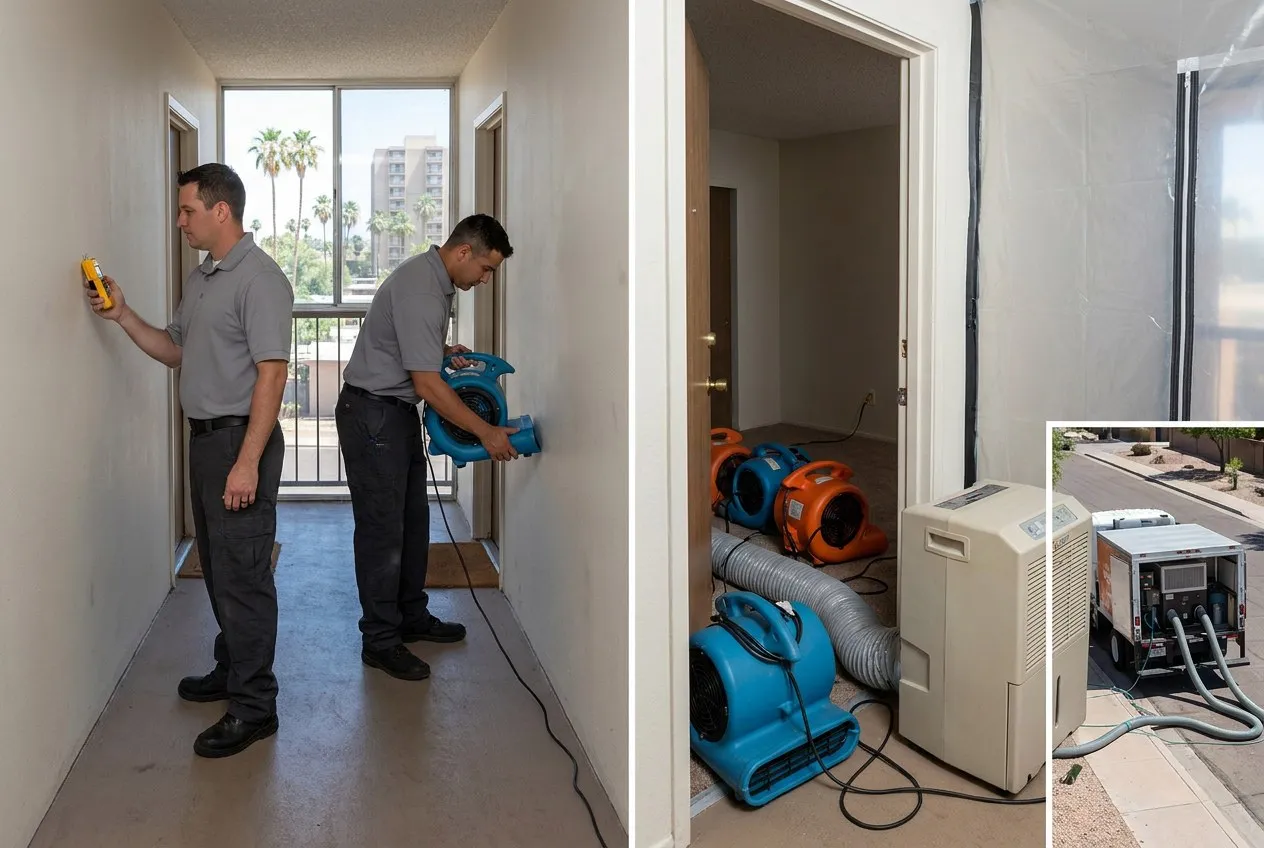
One team does mitigation and rebuild. That keeps emergency removal, drying records, and finish repairs connected through one scope.
Water Fighters Restoration is IICRC Certified 70192944 · AZ ROC 324471 · ROC 324468 · EPA Lead-Safe Certified Firm · Licensed, Bonded & Insured.
Common Questions
How can a leak appear two floors below its actual source?
Water can follow a shared chase before crossing a floor assembly. Technicians compare several levels rather than assuming the stain marks the source, as explained in the water damage process.
Where does a condominium master policy end and an HO-6 policy begin?
The boundary depends on the association documents and both policies. Emergency records should separate common components from unit finishes, then the carriers can apply the actual terms through the insurance claim process.
Who can shut off water in a Central Phoenix tower?
The building's authorized contact controls a common-system shutoff. A unit valve may be accessible to the resident, but technicians coordinate with management before changing a shared building system.
Is water from a municipal main break handled differently from an indoor pipe leak?
Yes, because the source, entry route, and responsibility record differ. Water crossing soil or pavement is handled as Category 3, as covered in the storm damage response.
How does drying equipment reach an upper floor without disrupting the building?
Equipment is sized for the affected unit and moved through the access route approved by management. The plan may include loading coordination, elevator timing, floor protection, and clear egress around the work area.