
Water Damage Restoration in Coronado, Phoenix
Published September 2, 2026 · Last reviewed September 2, 2026 · Water Fighters Restoration
Coronado was Phoenix's first planned, mass-produced subdivision. Its houses were built for working families, then altered by generations of owners. That history is visible in additions, patched openings, mixed pipe, and rooms that no longer match the original plan.
The designated Coronado Historic District runs roughly from 7th to 14th Streets. Greater Coronado reaches farther and includes three historic districts: Coronado, Country Club Park, and Brentwood.
The street number matters here. Coronado is east of Central on Streets. Encanto is west of Central on Avenues. The Central Phoenix page covers the high-rise corridor between their different water stories.
Phoenix's first planned subdivision still shows its build sequence
Development began after a 1908 subdivision petition. About 600 buildings date from 1920 through 1930. Craftsman and Spanish Colonial homes dominate the west side, while later English Cottage and Tudor examples appear farther east.
About 40 percent of the housing was built by 1940. Another 56 percent followed from 1940 through 1959. The Works Progress Administration paved streets and sidewalks from 1938 through 1942.
The Brill Line trolley ran on 10th Street from 1913 through 1946. It explains the streetcar-suburb pattern, not a current transit system.
Unrenovated early homes may have galvanized supply branches and cast-iron drains. The 1940s and 1950s ranch sections trend toward early copper. Later remodels can place copper, PEX, plastic drain, and old metal within one route.
How technicians read a layered remodel
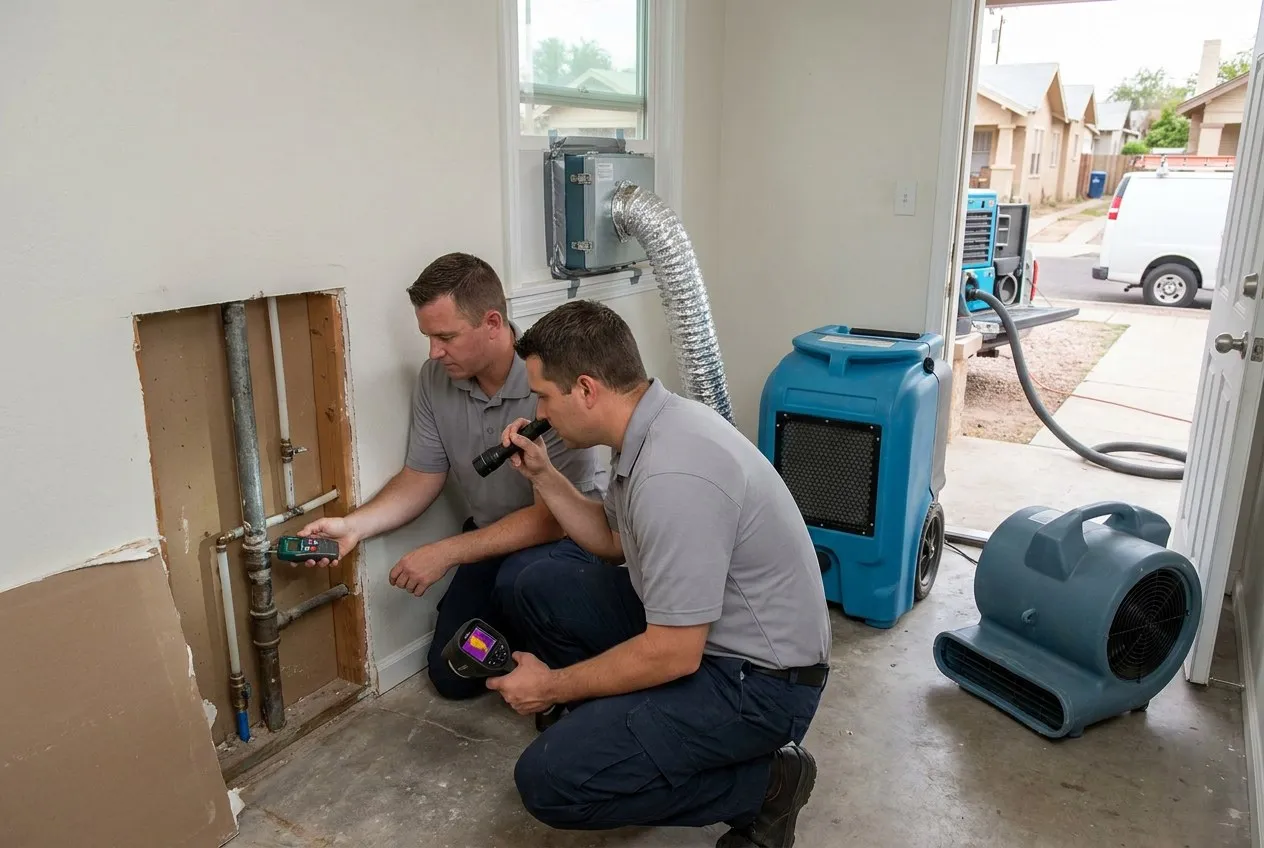
A source trace starts by treating the house as a sequence of changes.
- Find the oldest visible assembly. Original walls, floor framing, and drain routes establish the starting layout.
- Identify additions and moved fixtures. A bathroom or laundry may no longer sit over its first drain path.
- Compare pipe transitions. Leaks often develop at fittings where materials or repair eras meet.
- Map moisture across both layouts. Water may follow an old opening even after the room changed.
- Confirm the source before removal. A painted patch can hide damage, but it does not prove where the current water began.
A flipped bungalow can look uniform from the room. Behind the wall, the repair dates may be forty years apart.
Water Fighters Restoration is Open 24 hours, 7 days. Crews stage as one licensed team, Valley-wide, with the promise on-site within an hour.
Water below the floor still affects the house
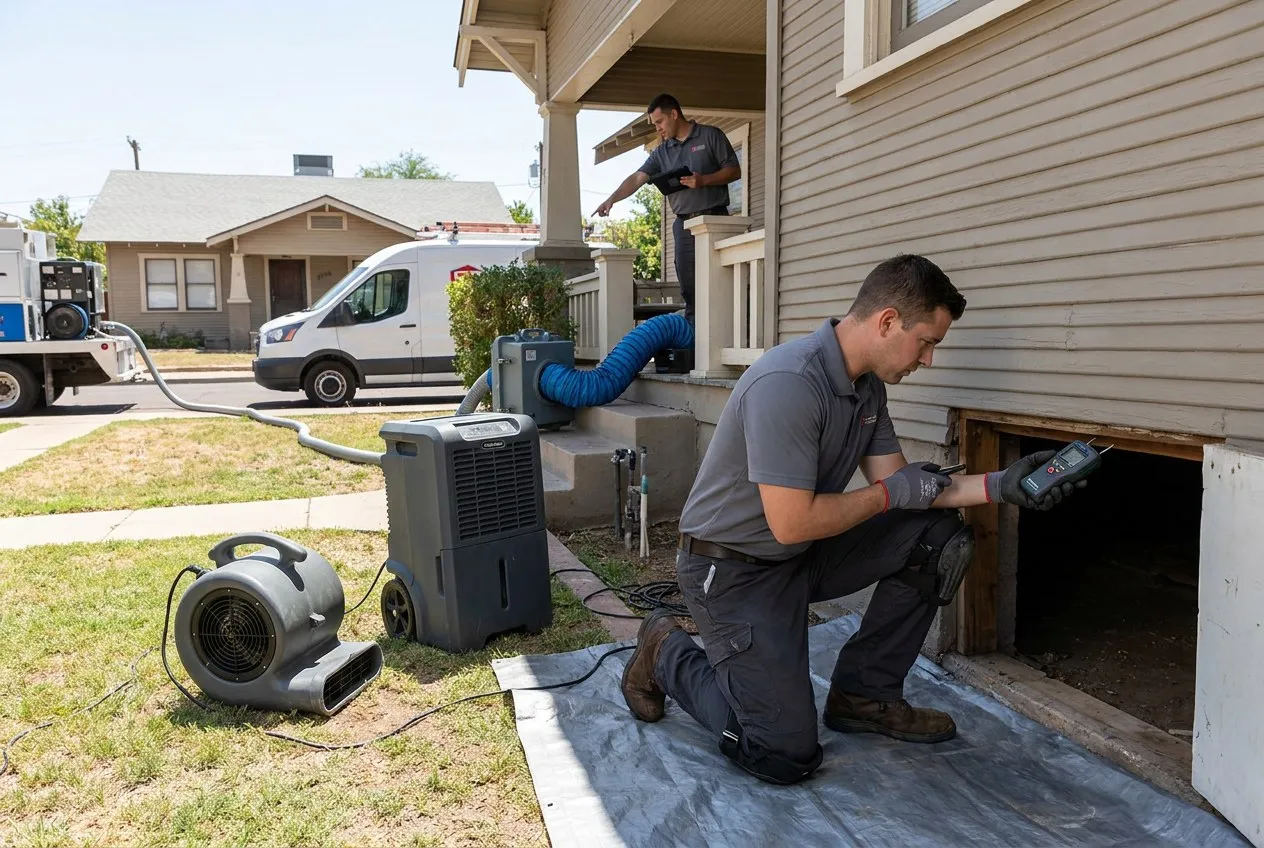
Some Coronado homes use pier-and-beam construction. A pipe leak or storm entry can leave water in the crawl space while the rooms above remain dry to the touch.
That water can wet joists, subfloor, insulation, ducts, and soil. It can also raise humidity beneath wood flooring. A closed skirt or narrow access point may slow inspection and equipment placement.
The response begins with safe access and source control. Technicians then remove standing water where reachable, inspect structural wood, and place drying equipment for the underfloor assembly. Readings above and below the floor show whether moisture crossed into the room.
The earthy smell through a floor register is often the first indoor clue.
Storm water follows the city grid, not a named wash
No named wash defines Coronado's flood story. The neighborhood relies on urban streets and storm drainage during heavy rain.
September 8, 2014 is the shared Phoenix benchmark. About 3.30 inches fell in roughly seven hours. Water entered low yards, side passages, roofs, and openings where drainage could not keep up.
An irrigation canal once ran along Oak Street at the neighborhood's early edge. That is a historical fact, not a current waterway or flood-irrigation system.
Any storm water entering from outside is Category 3. Professional cleanup controls access, removes contaminated water and affected porous material when needed, cleans retained surfaces, and verifies drying.
The ceiling water damage guide covers roof and upper-room stains, including older texture cautions. The burst-pipe guide covers pressurized supply failures.
Sewer laterals and finish repair need one record
A house from the 1920s may still connect through an old clay sewer lateral, though each property must be inspected. Roots, offsets, breaks, and failed joints can contribute to a backup.
Anything from a sewer or drain backup is Category 3. The sewage cleanup service explains containment, removal, cleaning, and drying. Whether a lateral is patched, lined, or replaced belongs to the qualified sewer professional after camera inspection and condition assessment.
Historic wood windows, original trim, and older plaster deserve item-by-item decisions after storm entry. Solid wood may be cleanable and dryable when it remains sound. Swollen composite material and delaminated finishes behave differently.
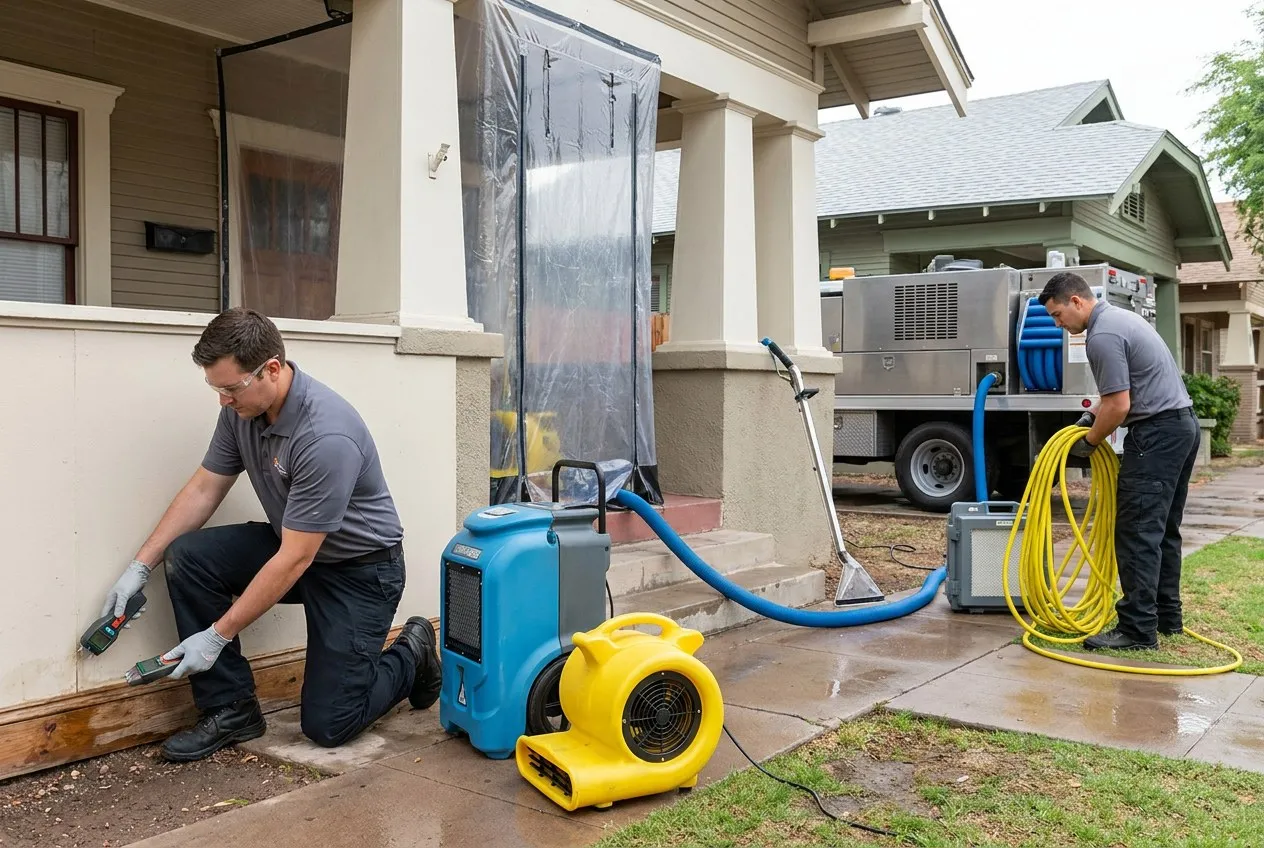
One team does mitigation and rebuild. The same record can follow controlled removal, drying, carpentry, plaster or drywall repair, and finish work.
Water Fighters Restoration is IICRC Certified 70192944 · AZ ROC 324471 · ROC 324468 · EPA Lead-Safe Certified Firm · Licensed, Bonded & Insured.
Common Questions
Does water under a pier-and-beam floor matter when the rooms stay dry?
Yes. Water can affect joists, subfloor, insulation, ducts, and crawl-space humidity before the finished floor feels wet. The distance traveled is confirmed through readings above and below the assembly.
What does a painted-over stain mean in a recently flipped bungalow?
It proves only that discoloration was covered. Moisture readings, source testing, and inspection of nearby repairs are needed to tell an inactive mark from a current leak.
Should a 1920s clay sewer lateral be patched, lined, or replaced after a backup?
That decision follows a professional camera inspection and condition assessment. The restoration scope handles the Category 3 interior loss, while the sewer trade determines the appropriate lateral repair through the sewage cleanup process.
Can hundred-year-old wood windows be saved after storm intrusion?
Sometimes. Solid wood that remains stable may be cleaned and dried, while failed joints, delamination, or trapped contamination can require controlled repair or replacement.
Can a neighbor's roofline send enough water into a shared side yard to damage my wall?
Yes, concentrated roof runoff can overload a narrow side yard during heavy rain. Once it crosses the ground and enters, it is Category 3. Document the exterior route and interior moisture through the storm damage response.