
Water Damage Restoration in Sunnyslope
Published August 21, 2026 · Last reviewed August 21, 2026 · Water Fighters Restoration
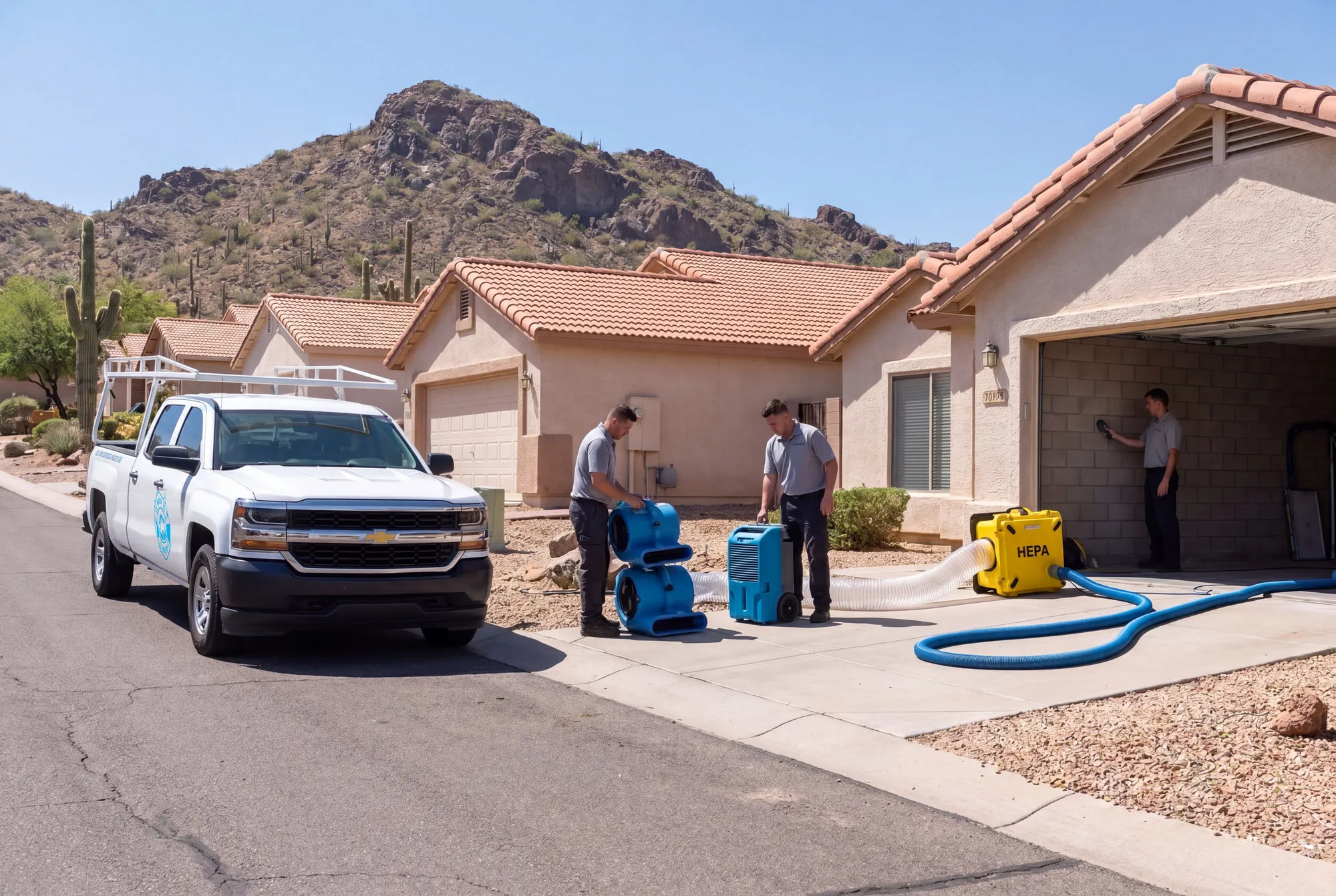
Sunnyslope sits north of downtown Phoenix against North Mountain and Shaw Butte, on ground that actually slopes — which is unusual in a valley this flat, and it changes how water behaves both inside and outside a house. It is also one of the older parts of the city, with housing that spans nearly a century on the same streets.
A Neighborhood on a Grade
Most Phoenix neighborhoods are flat enough that a leak spreads in a circle. On a grade, it does not. Water inside a Sunnyslope home moves downhill through the structure, which means the room where a pipe failed is often not the room with the worst damage.
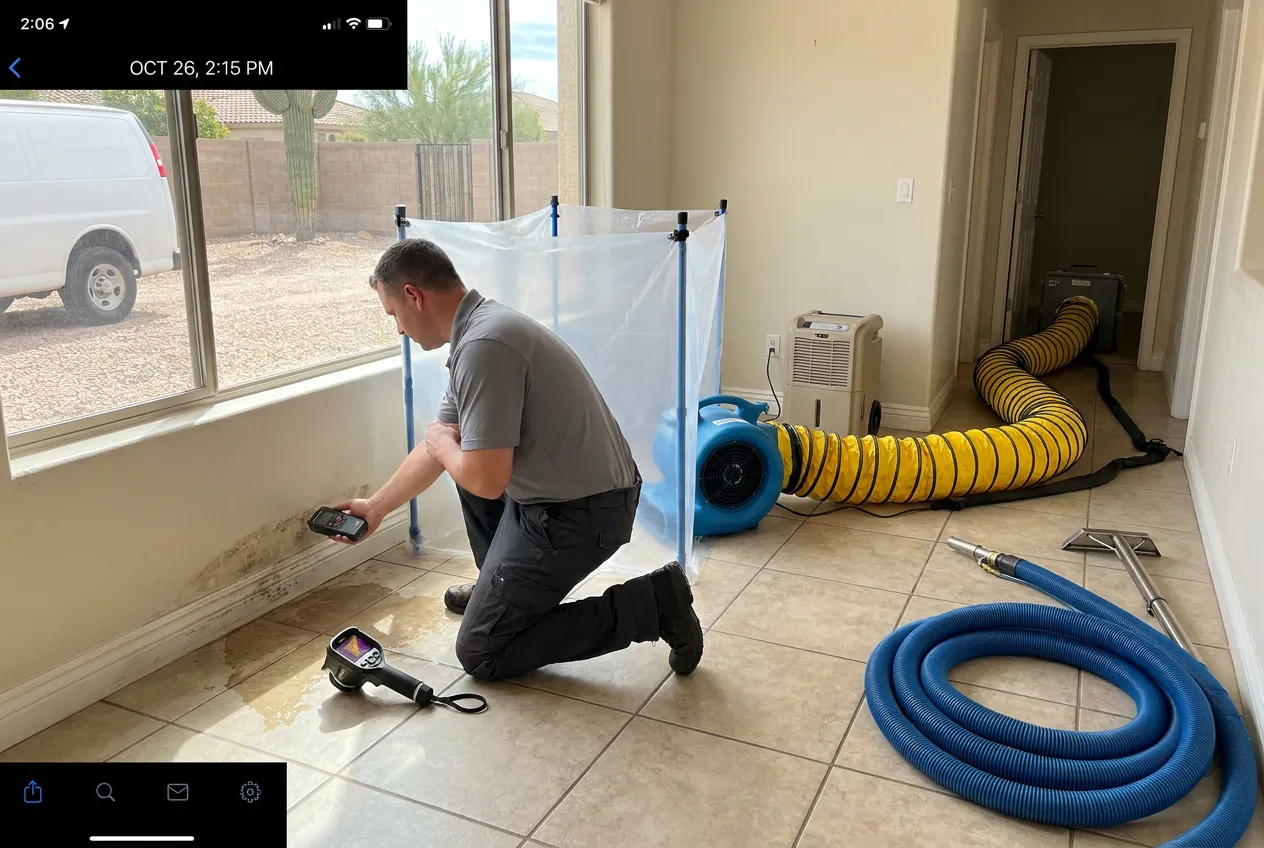
That has a practical consequence for how a job gets scoped. A homeowner points at the bathroom where they found water; the meter finds it two rooms downslope, under a floor covering that still looks dry. Skipping that step is how a house gets "dried" and then grows mold in the room nobody checked. The drying standard exists to make that a measurement rather than a guess.
Outside, the same rule applies at a larger scale. Runoff off the mountain crosses these neighborhoods on its way to the flat. Each lot either sheds it or catches it, depending on grading, walls, and what the last owner did to the yard.
A Century of Housing Stock
Sunnyslope started as a place people came for dry air and their health, and the earliest cottages date to the 1920s and 30s. The bigger build came after the war. Then came decades of renovation, replacement, and infill, which means a single block can hold a 1930s bungalow, a 1958 ranch, and a house finished last year.
So there is no single answer to "what fails here." An original-era home has the corrosion story. Galvanized supply lines close up and eventually leak inside walls. Cast iron drains erode along the bottom until sewage leaves the pipe under the slab. A postwar ranch has some of that plus whatever was changed along the way. New infill has the component story — modern materials with builder-grade parts that will matter in fifteen years.
The trickiest houses are the renovated ones, because a remodel replaces what it can see. New fixtures on old lines is the standard finding. The transition point is worth attention — where new copper or PEX meets original galvanized. Joining dissimilar metals without the right fitting corrodes faster than either metal alone.
What the Mountain Sends Down
During monsoon season, North Mountain and Shaw Butte shed water fast. Desert slopes do not absorb much, especially after a dry stretch bakes the surface. A hard cell turns into sheet flow within minutes. It reaches the top of the neighborhood before the storm has finished.
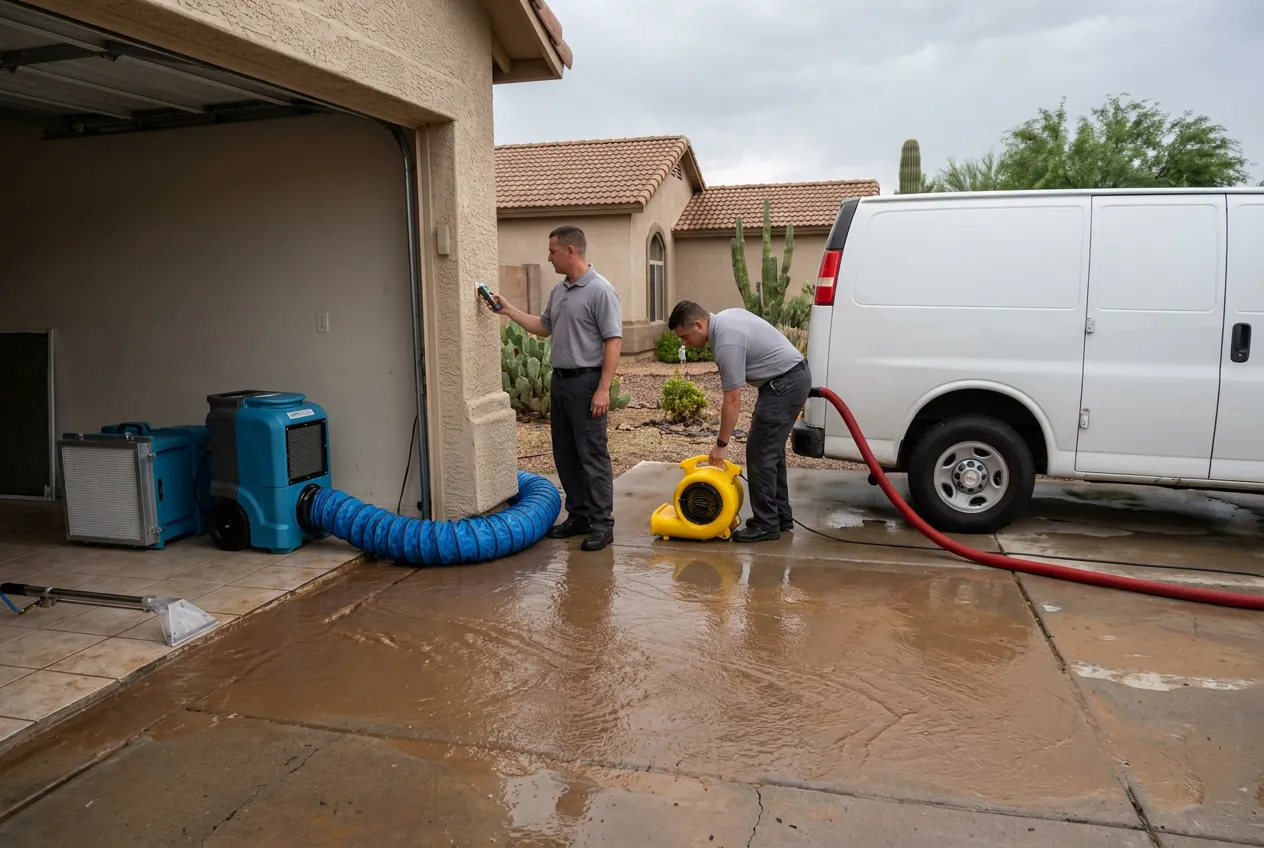
Houses on the uphill side take it directly. The failure points are mostly the ones you would expect: garage thresholds, side yards that funnel between a house and a block wall, patios that were graded correctly once and have settled since. The one people miss is the retaining wall. Drainage behind a wall silts up over the years. A wall that used to relieve pressure stops relieving it, and the yard above turns into a basin.
Whatever gets in from outside is contaminated from the first minute. It has crossed soil, pavement, and whatever the street was carrying. It gets treated as Category 3 no matter how clean it looked coming down the driveway. The monsoon guide has the prep list worth working through before June.
Common Questions
The leak was in the bathroom but the hallway carpet is the wet part. How?
Grade. On a slope, water inside a structure travels downhill through the subfloor and along framing, so the worst damage often shows up below the source rather than beside it. That is why the meter maps the whole path rather than the obvious room.
Our house is from 1936 and has been remodeled twice. What's actually behind the walls?
Usually a mix. Remodels replace fixtures and the lines right behind them; original runs inside walls and under the slab commonly stay. Finding the transition points is part of any real assessment.
Every big storm puts water in the garage. Is that fixable?
Usually, and it is rarely a plumbing fix. It is grading, thresholds, and drainage — where water arrives, where it is meant to go, and what has settled or silted up since the house was built.
What does a retaining wall have to do with water in the house?
The drainage behind it. Walls are built with a way to relieve water pressure from the uphill side. When that silts up over twenty years, the ground above holds water it was never meant to hold, and it finds another way out.
Is the water that comes off the mountain actually dirty? It looks clean.
It has crossed soil, roadway, and whatever was on both. Storm water indoors is handled as contaminated regardless of appearance, which changes what can be dried and what has to be removed.