
Burst Pipe & Slab Leak Water Damage in North Phoenix
Published October 8, 2026 · Last reviewed October 8, 2026 · Water Fighters Restoration
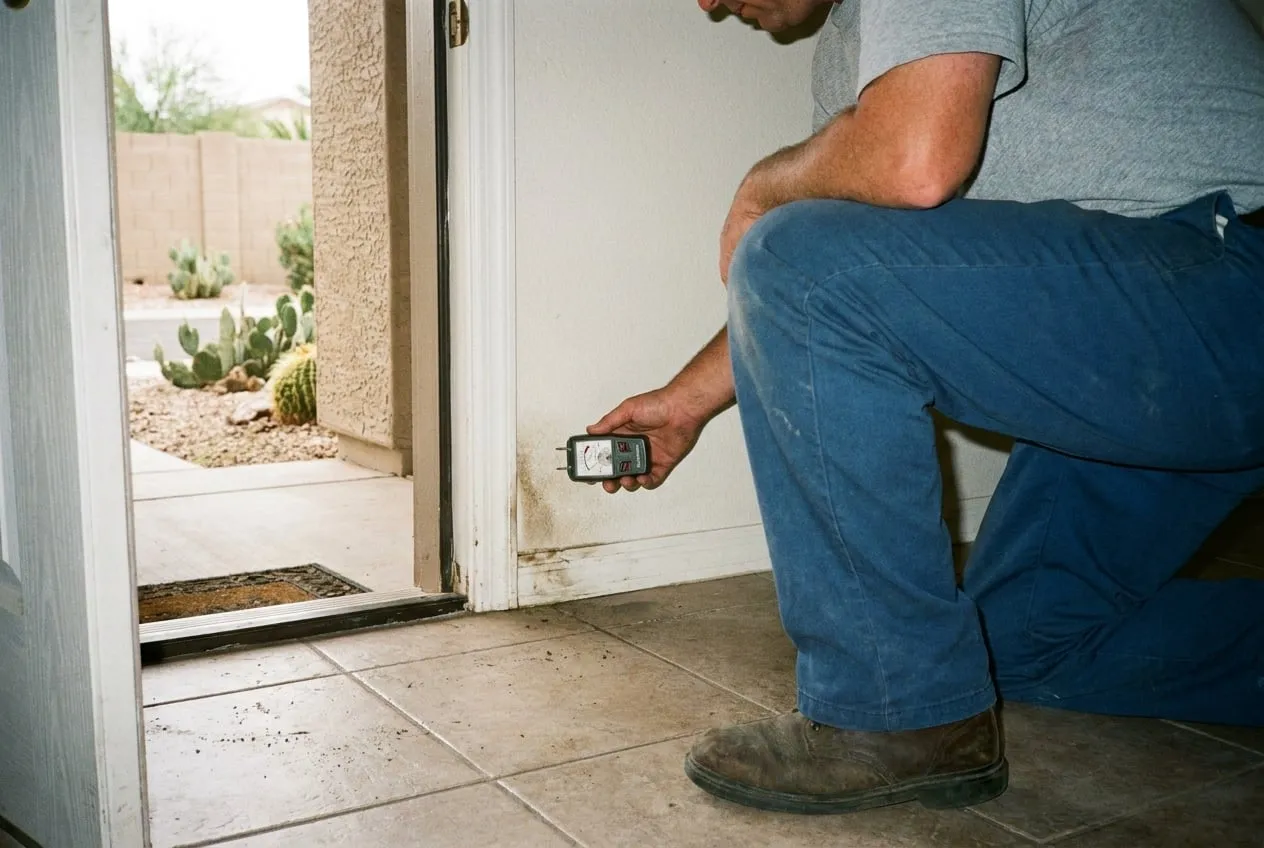
Water is running across the hallway tile from a wall you can't see into. Or a strip of front yard between the meter box and the house stays dark and soft while the gravel around it bakes. Something failed on your side of the meter, and the water is ahead of you.
Two trades split this job. A plumber finds and fixes the pipe, and Water Fighters Restoration dries the house and rebuilds what the water ruined.
What to do right now
- Close the house valve where the line enters the home. The burst-pipe guide covers where it usually sits and the provider's emergency line.
- Leave the curb meter box to the water provider. The city tells customers not to shut water off at the meter. If your valve can't be found or won't close, the city sends a technician.
- Stay out of rooms where water has reached outlets, cords, or the panel.
- Call a plumber for the pipe and us for the water. Water Fighters Restoration is Open 24 hours, 7 days, at (602) 884-5325, and on-site within an hour.
Your side of the meter, in order
In north Phoenix around Deer Valley and the I-17 corridor, from roughly Bell Road north through Norterra and Stetson Valley, the water meter is the line. Past the meter, in the city's words, "any leaks or breaks that occur on private property (the customer's side) are the responsibility of the property owner." The private path runs like this:
- The meter. City property. The city repairs leaks on its street side.
- The yard line. The buried pipe from the meter to the house. It is yours, and a plumber repairs it.
- The pressure regulator. The city says it requires one on the customer's side and makes it the owner's responsibility.
- The runs inside. Supply lines under the slab, up the walls, and across the attic.
A failure anywhere past the meter is the owner's to repair. The water it puts into the house is ours to dry.
The yard line is easy to forget, since nobody sees it after the trench is filled. A 2000 insurer loss-control bulletin noted that a polybutylene yard line could run between the meter and the house even where copper entered the wall. A house built while poly was being made didn't necessarily get it, and what is buried in a given yard is a plumber's question. A yard-line leak can push water through soil before it gets inside, so its category depends on what it picked up on the way, not on the clean pipe it came from.
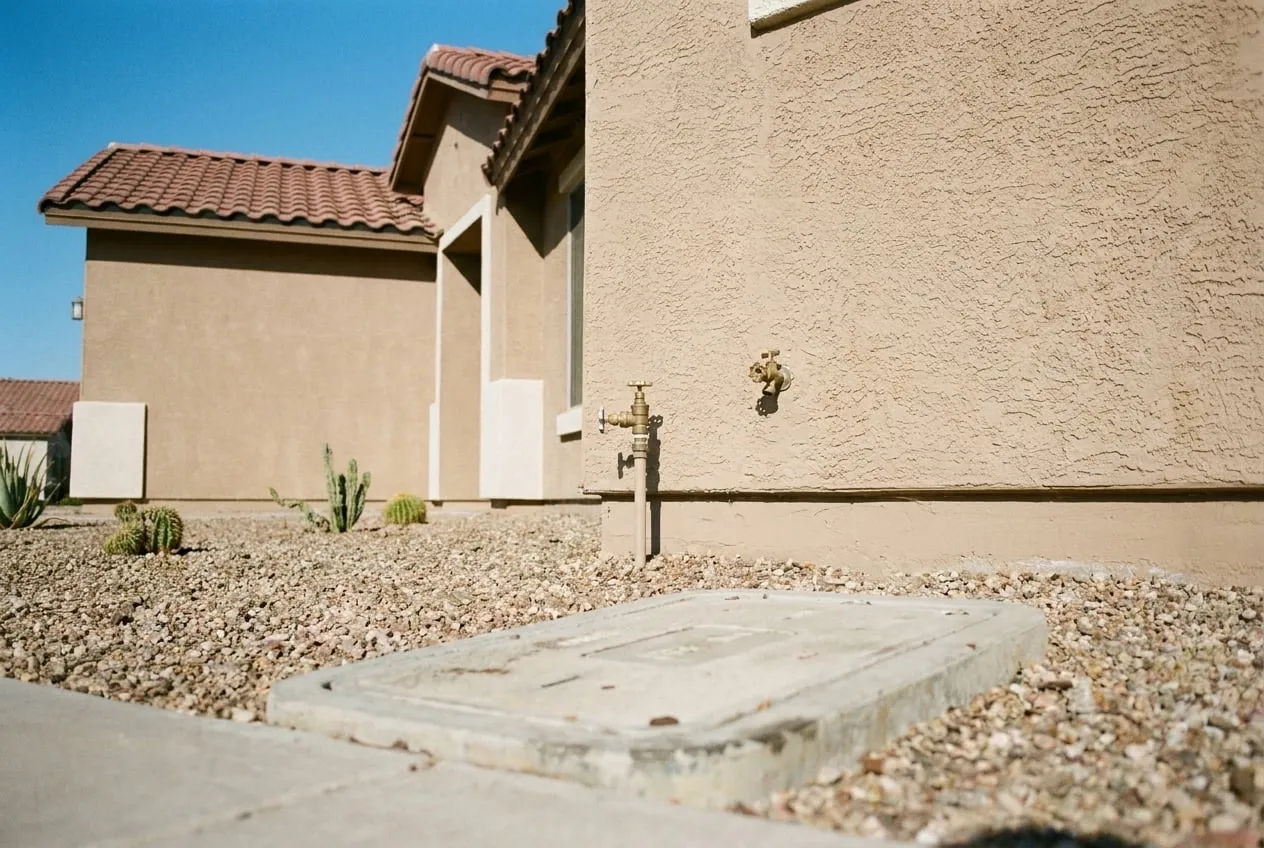
What works on the path: age, heat, and the odd freeze night
The pipe on that path is as old as the house, or its last repair. In 85027, which runs from about Bell and Union Hills to Pinnacle Peak, 62% of units were built from 1980 to 1999. In 85083 two-thirds date from 2000 to 2009, and in 85085 about 91% were built in 2000 or later. Material is a house-by-house answer. The Desert Ridge page covers what fails in a 2000s house, and the North Phoenix page covers the copper story south of Bell.
Heat is the steady load. The Deer Valley airport station averages 87 days a year at 100°F or above, and it hit 117°F on June 19, 2016 and again on June 20, 2017. The city says "our extreme temperatures in both the summer and, occasionally, winter put a toll on exposed plumbing." It calls exposed plastic pipe such as PVC more susceptible. In a house, that means the run in the attic, on the roof, or along a garage wall.
Cold is rarer. For a Freeze Warning night, the city's list is short. Keep garage doors closed where supply lines run through the garage, open sink cabinets, insulate attic and roof pipes, and drain hose bibs. The airport station's colder readings are in the questions below.
What we do once the plumber has the pipe
Our lane is the water. We don't locate leaks, repair pipe, repipe, install or adjust regulators, or touch meters. We coordinate with your plumber so the access opening and the drying plan fit together.
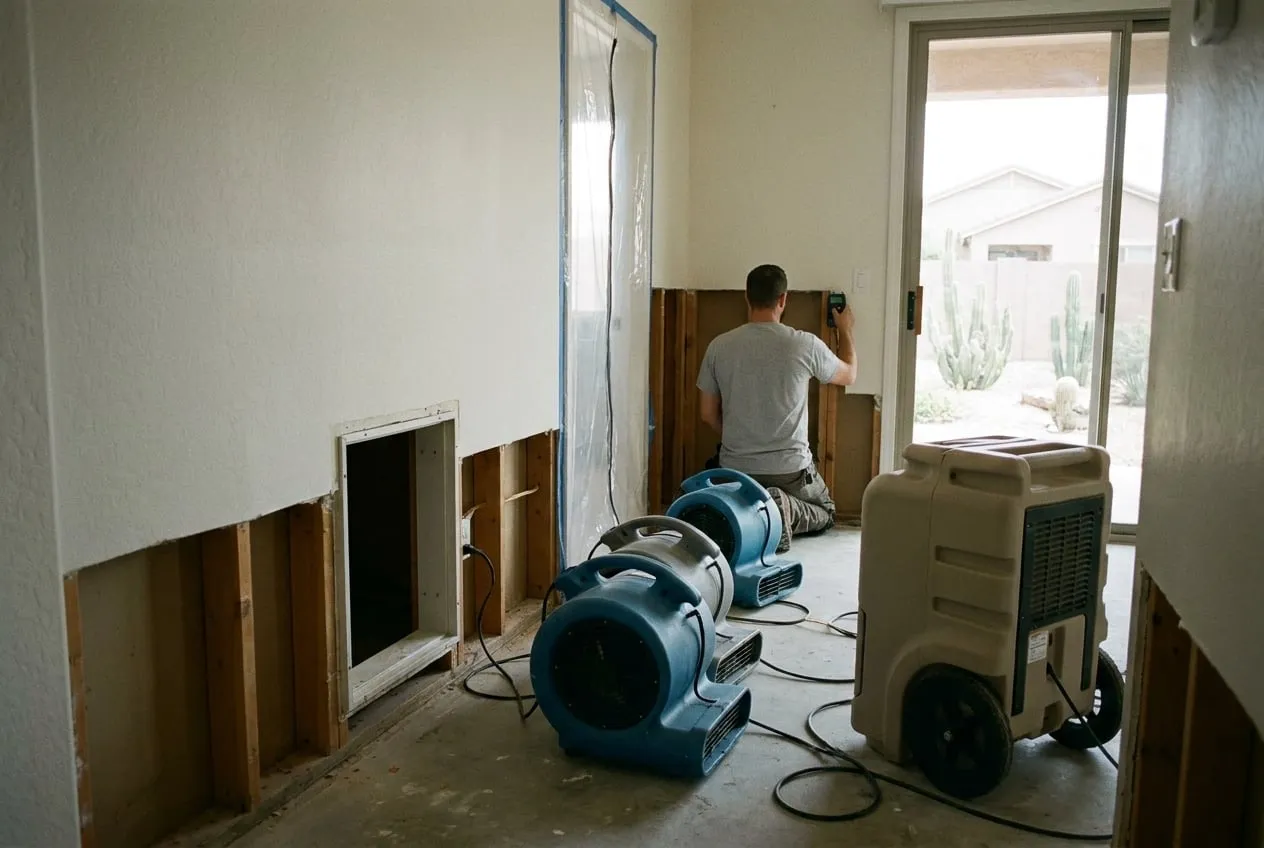
Mapping starts at the failure and works outward to base plates, toe kicks, carpet pad, and the ceiling under an attic run. The north Phoenix extraction page covers the first hours on tile and pad. Drying runs against moisture readings, not the calendar, and the full slab leak page covers how a slab loss dries.
Then the same team rebuilds the drywall, baseboard, flooring, and the plumber's access opening. That is the one-team restoration model, with no handoff. Water Fighters runs a staffed Phoenix location in Deer Valley.
Water Fighters Restoration is IICRC Certified 70192944 · AZ ROC 324471 · ROC 324468 · EPA Lead-Safe Certified Firm · Licensed, Bonded & Insured.
Common Questions
Why does the Deer Valley airport station read several degrees colder than Sky Harbor on freeze nights?
Elevation is part of it: the station sits at about 1,487 feet, against about 1,113 feet at Sky Harbor. On Jan. 14, 2007, its all-time low, it read 22°F to Sky Harbor's 29°F, and on Feb. 3, 2011 the pair was 24°F and 30°F. Elevation isn't the whole explanation, and an airport sensor is not your attic. Since September 1998 the station has logged roughly 60 nights at or below 32°F, about two a year, against Sky Harbor's 17. Nothing at 28°F or colder has shown up since January 2013. Where elevation is the main freeze story, see the Anthem page.
Who owns the pipe between the water meter and my house?
You do. The city owns the meter and repairs its street side, while the buried yard line belongs to the property owner and is a plumber's repair. When that line leaks toward the house and water gets inside, the drying and rebuild are our part. The insurance coverage guide covers sudden versus gradual for yard-line and slab leaks.
Phoenix calls 40 to 100 psi acceptable. Why does the city still want a regulator on my side of the meter?
Because the city says it requires one, on the owner's side of the line. Its guidance calls 40 to 100 psi "an acceptable pressure range" and says it "requires that customers install a pressure regulator (also known as a pressure reducing valve)." Private regulators are the owner's responsibility, so don't assume yours is there or working. A plumber tests and services it; we don't adjust regulators.
Does Phoenix's hard water cause pinhole leaks in copper?
No Phoenix-specific study has been found that shows it. The city's 2025 report lists hardness of 172 to 302 ppm, or 10 to 17.6 grains per gallon, and says hard water "can cause some types of scaling in pipes and water heaters." Pinhole research points to a different mix. NSF-funded work at Virginia Tech linked copper pitting to higher chlorine, aluminum, and pH and lower natural organic matter, and it centered on Washington, DC. The report gives one hardness range citywide, including the CAP water treated at Union Hills, one of the plants serving the north side.
Does the soil under north Phoenix slabs move enough to stress pipes?
Federal soil maps don't single this area out. NRCS ratings put the ground here at about 48% low and 49% moderate for shrink-swell. About 2% rates high, in small pockets such as one near 35th Avenue between Bell and Union Hills. Around Norterra, a cemented hardpan often sits within inches of the surface, about 6 to 9 inches down at sampled points. A soil map can't speak to any one pipe, so a suspected slab leak still gets located by a plumber.