
Water Damage Restoration in Desert Hills, AZ
Published September 2, 2026 · Last reviewed September 2, 2026 · Water Fighters Restoration
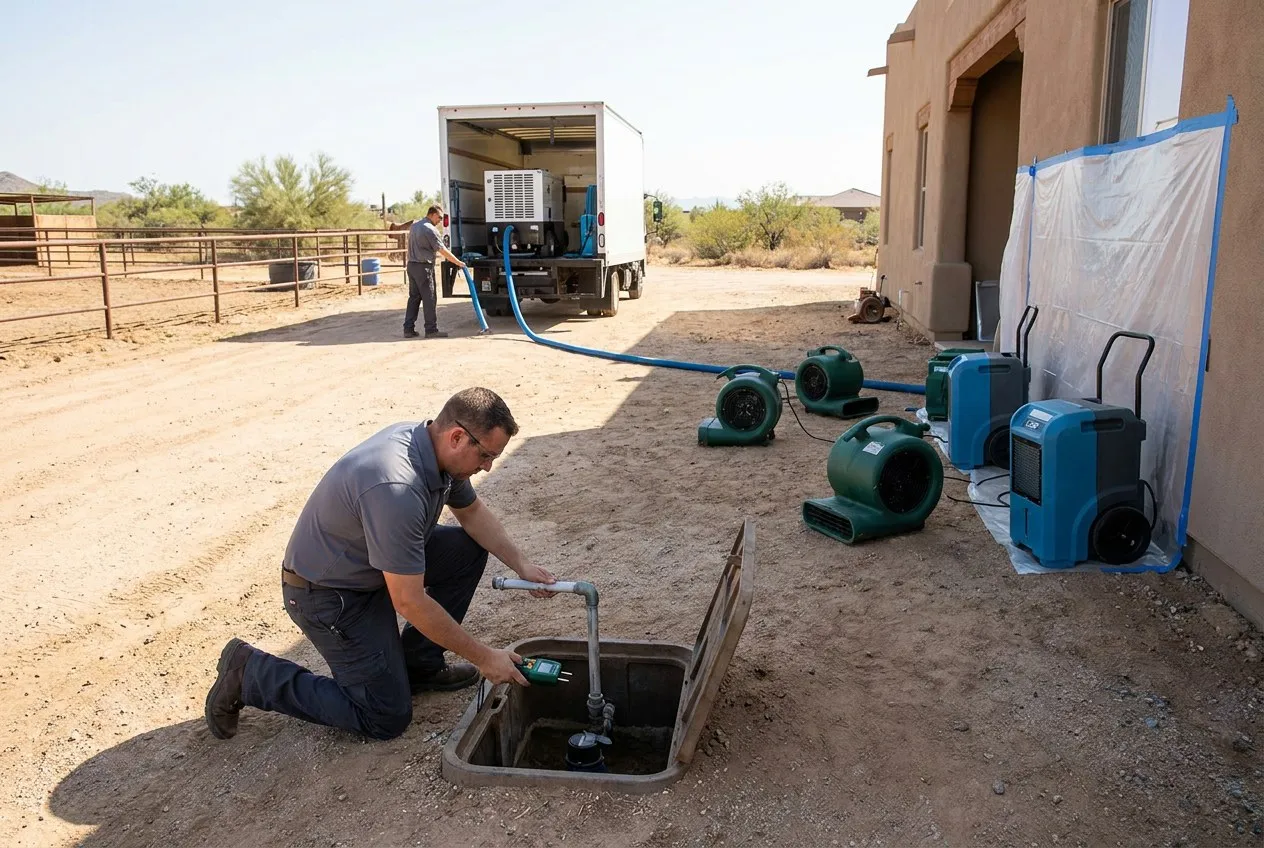
Desert Hills is acre-lot country with two water realities. About 1,820 connections receive piped water from the Town of Cave Creek's Desert Hills Water System. Properties outside that service area rely on wells or hauled water.
Desert Hills is unincorporated Maricopa County, not part of Cave Creek and not its own census-designated place. It is the southern New River CDP area, with roughly 3,000 residents.
One home may have a system meter. The next may share a well, use a tank, or receive trucked water from the Anthem filling station.
The New River restoration page covers the larger northern community's seasonal wash and 2014 flood record. The Cave Creek restoration page covers the incorporated town that owns the Desert Hills system without governing this area.
The water map is split, not vague
The Desert Hills Water System had 1,820 active connections at the end of 2024. Three wells are supplemented with Cave Creek's treated CAP water as the aquifer declines.
Outside that footprint, properties share New River's declining-well conditions. State-based reporting found more than 1,200 permits and monitored declines of 23 to 179 feet.
Some properties store hauled water filled in Anthem; EPCOR pipes nothing into Desert Hills.
No citywide sewer exists. Septic systems are the wastewater pattern across the area.
Four questions identify the property system
- Is there an active Desert Hills Water System meter? Confirm the provider rather than relying on the mailing address.
- Does the property use a private or shared well? Identify the pressure tank, controls, and any written shared arrangement.
- Is water delivered to an on-site tank? Trace the tank, booster pump, and long line toward the house.
- Where is the septic system? Keep wastewater routes separate from supply and storm water.
Not every Desert Hills home has piped water, and not every home depends on a well.
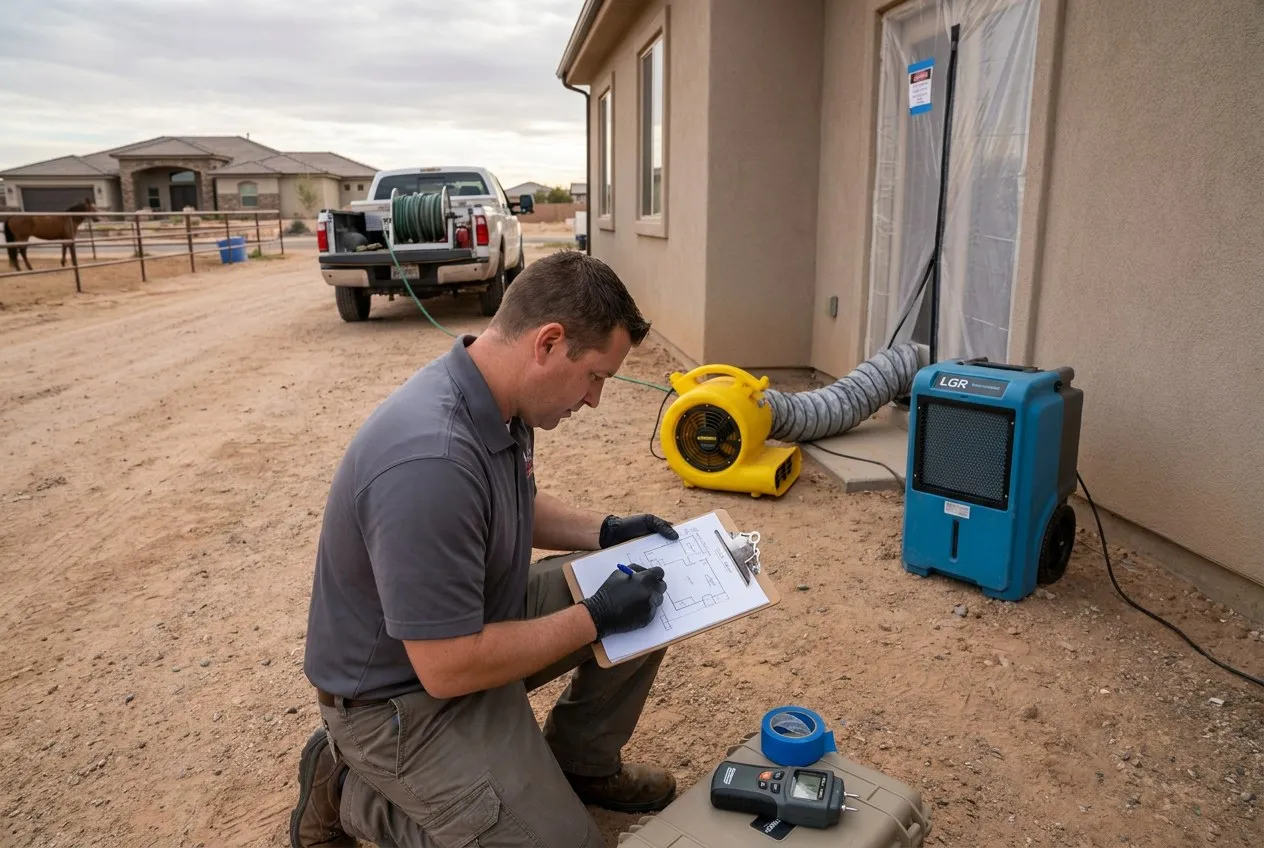
Water Fighters Restoration is Open 24 hours, 7 days. Crews stage as one licensed team, Valley-wide, with the promise on-site within an hour.
Shared wells and long runs need component-by-component records
A shared well can serve several properties through common and private equipment. A pump, tank, fitting, or buried-line failure still needs immediate building assessment.
Technicians document the failed component, private route, affected structure, and source-control work. Ownership and payment responsibility depend on agreements and legal rights, so the restoration record should not guess at them.
Long runs to shops, horse areas, or detached buildings can release water far from the main house. Pressure loss and wet soil may appear before any interior stain.
The Anthem restoration page provides the nearby contrast: a planned community with piped EPCOR service and a stronger freeze story.
Desert Hills sits on a drainage divide
Small drainages move west toward Skunk Creek and east toward Cave Creek. Desert Hills Wash has a gauge near Joy Ranch Road, but no large watercourse defines the area.
The August 2014 storm affected the corridor, with major Cave Creek and Skunk Creek flows. That is context, not proof of flooded Desert Hills homes.
On flat acre lots, sheet flow can still enter a house without a named wash. Fill, horse pads, driveways, shops, and small berms change where rain moves.
Water crossing the ground before entry is Category 3. The sewage cleanup page covers the separate Category 3 response required for septic or drain backups.
Custom housing removes the tract shortcut
The 1955 Sam Joy Ranch land subdivision did not create a 1950s housing stock. Homes are mainly 1990s and 2000s custom construction.
There is no tract-wide pipe pattern to assume. One house may use copper, another PEX, and another a mixed private system. Inspection starts with the build and equipment.
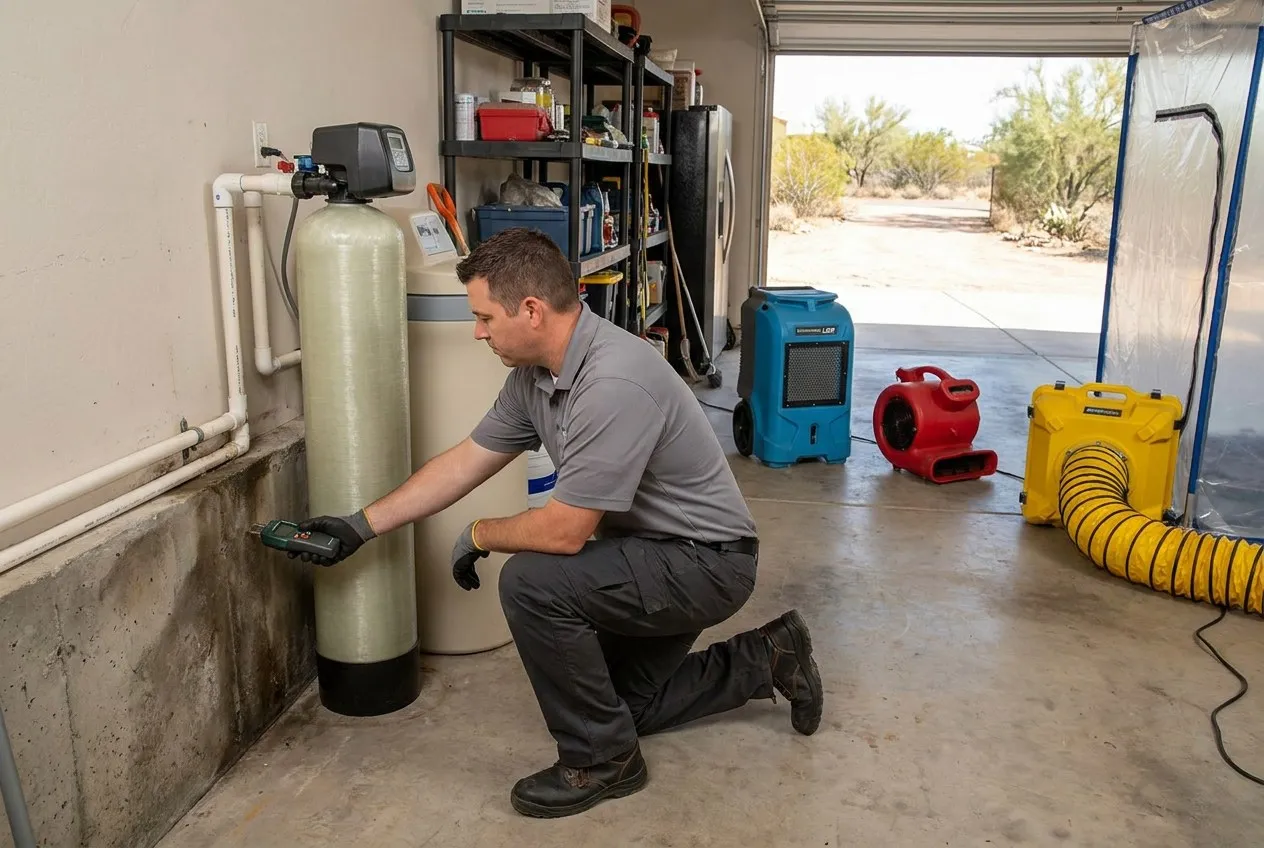
Softeners, reverse-osmosis units, filters, and boosters add fittings and drain routes. A tube can wet a garage wall or slab edge for hours.
Drip irrigation placed along a foundation can also keep one stem-wall area damp. The slab leak guide explains how interior supply losses are separated from exterior moisture.
Occasional freezes mainly expose wells, hose bibbs, backflow devices, and outdoor fittings.
One team does mitigation and rebuild, keeping custom access, drying, and finish repair within one record.
Water Fighters Restoration is IICRC Certified 70192944 · AZ ROC 324471 · ROC 324468 · EPA Lead-Safe Certified Firm · Licensed, Bonded & Insured.
Common Questions
Who is responsible when a shared well serving three Desert Hills properties fails?
Responsibility depends on the shared-well agreement, component ownership, and applicable legal rights. Restoration documents the failed equipment and building damage, but it does not replace legal advice about cost allocation.
How can sheet flow enter a house on flat land with no nearby wash?
Small elevation changes can send rain toward a driveway, addition, or low wall opening. Soil marks, debris, and readings reconstruct the route after water disappears, following the monsoon flood guide.
How often is a softener or reverse-osmosis system the actual leak source?
No reliable local percentage exists for this area. These systems add tubes, fittings, valves, and drain connections, so each component is checked during a slab moisture assessment.
How is water-damage risk assessed when every Desert Hills house is custom?
The inspection uses the property's plumbing, grade, foundation, roof, and private-water equipment. There is no tract pattern strong enough to replace a site-specific moisture map.
Can drip irrigation along the foundation slowly damage a stem wall?
Yes, repeated wetting can keep soil and the wall edge damp. Water crossing that soil indoors is Category 3; timing and readings separate it from a concealed slab leak.