Emergency Water Extraction in North Phoenix
Published October 8, 2026 · Last reviewed October 8, 2026 · Water Fighters Restoration
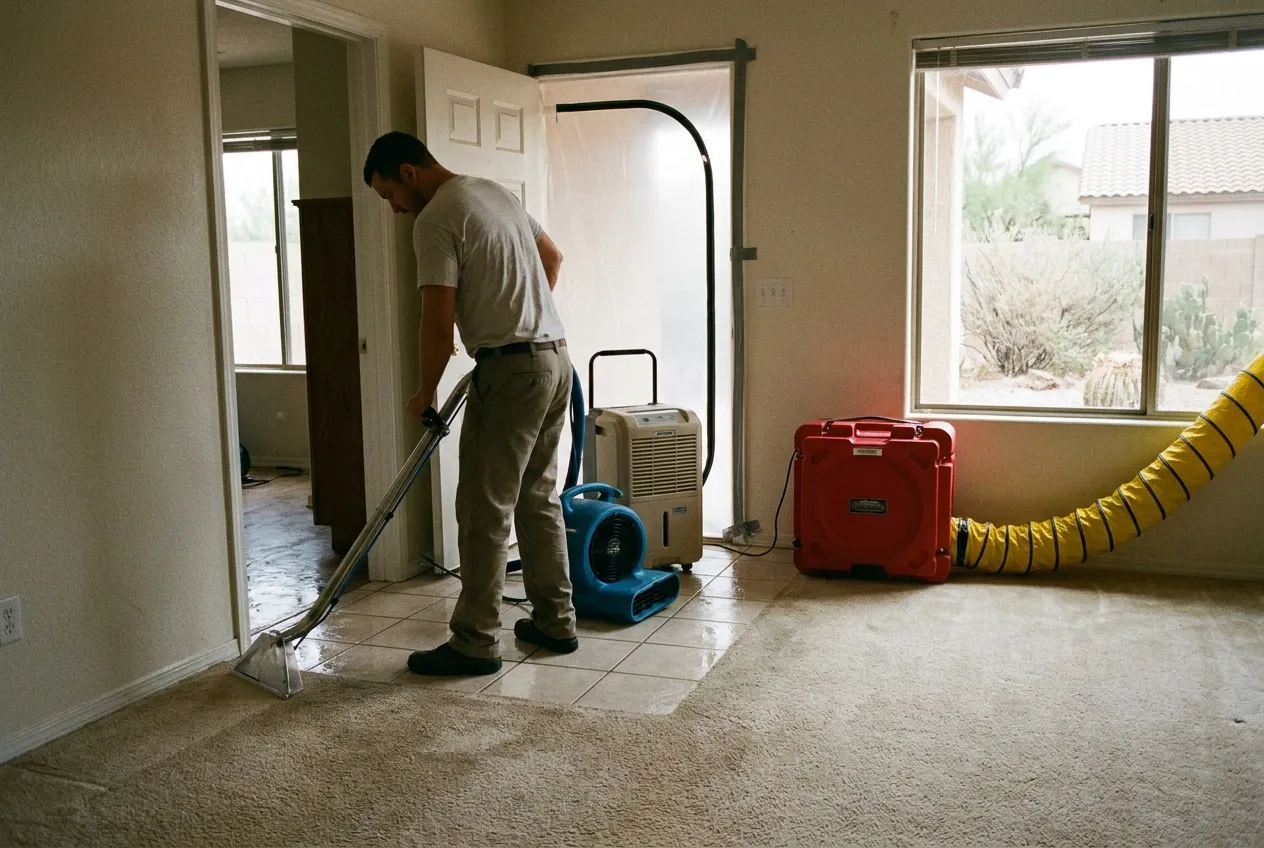
Water is on the tile and moving toward the bedroom carpet. Or it is coming through the ceiling from the unit upstairs, or out from under the wall you share with the townhome next door. The kind of building you live in decides where that water goes next, and where extraction has to follow it.
This page covers the first hours of extraction in north Phoenix around Deer Valley and the I-17 corridor, from roughly Bell Road north through Norterra and Stetson Valley. Water Fighters Restoration has a staffed location in Deer Valley, and the Deer Valley page covers that side of the story.
What to do right now
- Close the house valve. The City of Phoenix tells customers to close "the valve near the location where it enters your home." Leave the curb meter box to the City.
- If the house valve won't close, call the City. The City of Phoenix 24/7 water and sewer emergency line is 602-261-8000. The City turns service off at the meter.
- Keep people and pets out of outside water and drain water. Storm water that came in at a door, and anything that came up a drain, is Category 3.
- Call Water Fighters Restoration at (602) 884-5325. Tell us the building type: house, townhome, or condo. Open 24 hours, 7 days, on-site within an hour.
The City's shutoff split
In the City of Phoenix, the homeowner closes the house valve and the City handles the meter. The City's guidance says it in capital letters: "DO NOT ATTEMPT TO TURN OFF THE WATER AT THE METER YOURSELF." The meter box and meter are city property.
The City lists 602-261-8000 for water or sewer emergencies "such as a main break or overflow." That is the City's line. Ours is (602) 884-5325. The burst-pipe guide covers where house valves usually sit.
Where the water hides, by building
North Phoenix around Deer Valley is not one housing story. ZIP 85027, the Deer Valley core, has a median build year of 1988, and about a third of its units went up in the 1980s. For extraction, the building type matters more than the year.
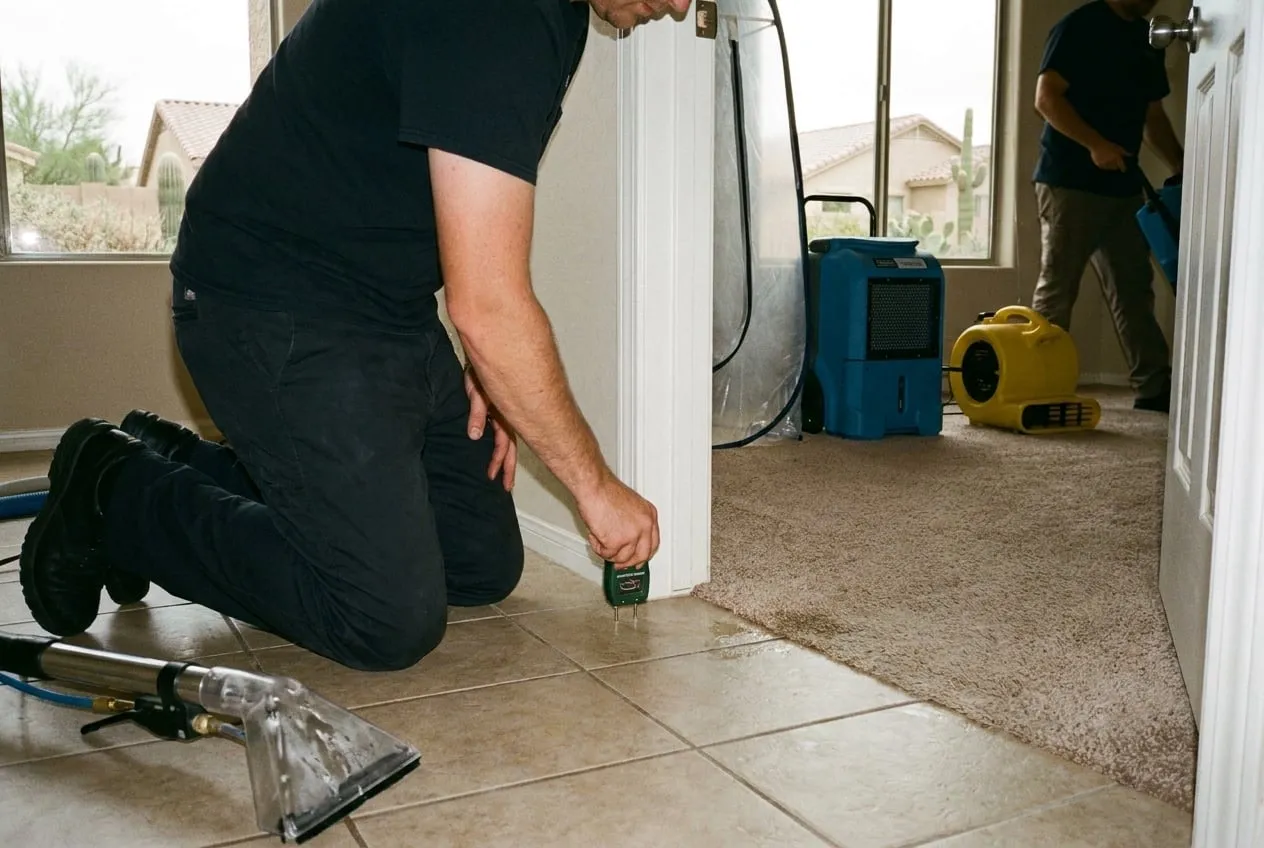
Tile over slab. Valley tract homes from the 1990s on often have tile over the slab in the main rooms. Water on tile runs to the walls, under the baseboards, and into the bottom of the drywall and the wood plate it sits on. In Stetson Valley (85083), 67% of homes date from 2000 to 2009, and 95% are single-family detached.
Carpet pad at the edge. The same homes often carry carpet in the bedrooms. Where tile meets carpet, the pad pulls water in and holds what the surface hides. The carpet can feel nearly dry on top while the edge gives a little under your heel.
Manufactured-home floors. 85027 includes manufactured-home communities, and roughly 1 in 11 of its units is a mobile or manufactured home. Minnesota Department of Labor and Industry floodwater guidance says the decking is "typically structural particle board and is adversely affected by water." That out-of-state guidance describes what professionals check: where the floor was submerged, the bottom board comes off for inspection, and belly insulation that floodwater reached gets replaced.
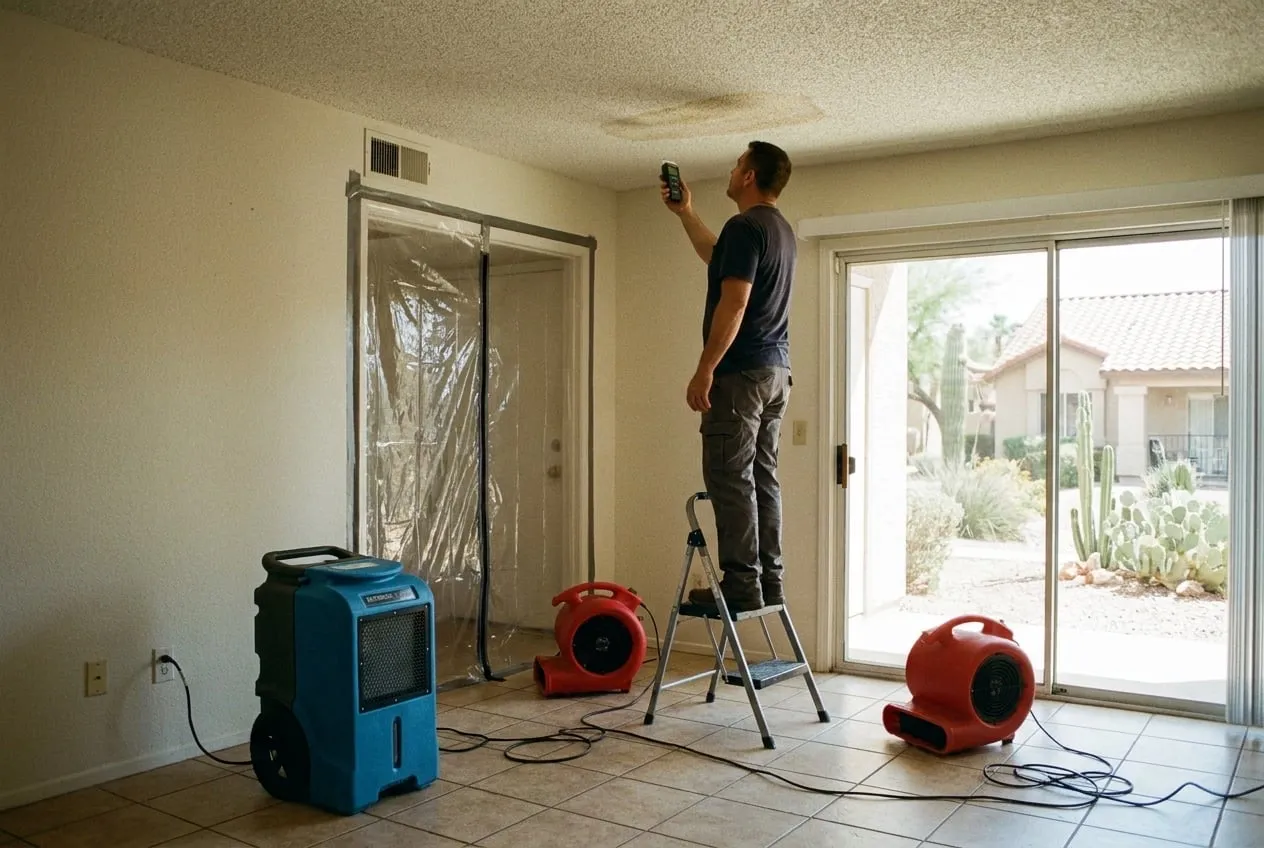
Stacked units. In 85085, which takes in Norterra and the north I-17 corridor, 27% of units sit in buildings of 10 or more units and 40% are rented. Units sit above units by design, so an upstairs supply failure can become a ceiling extraction below. The ceiling water damage guide follows that path.
Shared walls. Some townhome and patio-home communities share walls and sometimes plumbing chases. Water can show up first next door.
South of Bell, the North Phoenix page covers Moon Valley and the Cactus-to-Bell blocks. To the east, Desert Ridge has its own page. Around Deer Valley Airport, hangars, business parks, and light-industrial buildings fall under commercial water damage.
Who opens which door
Under Arizona's condominium statute, A.R.S. 33-1247, owners must give the association and other owners access through their unit when it is reasonably necessary for maintenance and repair, on reasonable notice. The statute gives no neighbor and no contractor a right to enter a locked unit.
So extraction starts in your unit, and access to the source unit runs through the association, the management company, or that unit's owner. Townhome and patio-home communities are often planned communities governed by their CC&Rs, which set the rules there.
Storm water and drain water
Monsoon cells along I-17 are short and violent. Water that crosses a threshold from outside is Category 3, whether it looks clean or not. The north Phoenix flood cleanup page covers how storm water reaches houses here.
Storm nights can also bring overnight outages. On Aug. 14, 2025, more than 1,000 SRP and APS customers combined lost power overnight. Keep a flashlight near the house valve.
Anything that came up a toilet, tub, or floor drain is also Category 3, and sewage cleanup covers it.
After the water is out
The full emergency flood cleanup page walks through what happens when the crew arrives. Here, the readings go to the baseboards, the carpet edge, the shared wall, and in a stacked building, the ceiling below.
Water Fighters Restoration does mitigation and rebuild with one team, so the moisture map that guides extraction also guides the repairs. Plumbing repair belongs to your plumber.
Water Fighters Restoration is IICRC Certified 70192944 · AZ ROC 324471 · ROC 324468 · EPA Lead-Safe Certified Firm · Licensed, Bonded & Insured.
Common Questions
Water is coming through the shared wall from the unit next door, and nobody answers there. Can extraction start on our side?
Yes, on your side. Extraction and drying can begin in your unit while the source is still running next door, though water will keep arriving until someone closes it.
Access to the neighbor's unit goes through the association or management company, on reasonable notice. In a condominium, A.R.S. 33-1247 sets that process; in many townhome and patio-home communities, the CC&Rs do. The statute gives no neighbor and no contractor, a restoration crew included, a right to enter a locked unit.
We mopped up a leak that was all on tile. Why do moisture readings still show wet at the baseboards?
Because the water did not stay on the tile. On a slab floor, it runs to the walls and under the baseboards, into the bottom edge of the drywall and the wood plate behind it.
Where the room meets carpet, the pad pulls water in and holds it under a surface that feels nearly dry. A mop clears what you can see, and the readings show where the rest went.
The storm lasted under an hour. How did that much water get inside?
Storm cells along I-17 can drop a lot of rain fast. On July 30, 2022, an NWS meteorologist said some areas north of Phoenix along I-17 got 1 to 2 inches of rain, mostly within about 30 minutes to an hour. Deer Valley Airport recorded wind above 60 mph.
Rain that heavy, with wind behind it, does not need long to find a door track or a low threshold. Whatever came in from outside is Category 3, and the monsoon flood guide explains why.
There's a white line on the tile and baseboards where the water stood. What is it, and does it show how far the water went?
It may be mineral residue, since tap water that dries can leave some behind. The City's 2025 Water Quality Report lists Phoenix tap water at 172 to 302 ppm total hardness, or 10 to 17.6 grains per gallon. Hardness is not regulated under drinking-water health standards.
The line can hint at where water stood on the surface. Water keeps moving under baseboards and into carpet pad past it, so moisture readings, not lines, set the extraction map. The Phoenix water damage handbook explains how those readings work.
The pipe that failed serves the whole condo building, not just our unit. Does the association handle extraction inside our unit?
It depends on your declaration. Under A.R.S. 33-1247, unless the declaration says otherwise, the association maintains the common elements and each owner maintains the unit.
Read the declaration, or ask the association how it reads it. Do not let the sorting-out delay extraction; water inside the unit keeps spreading while the documents are checked.