
Mold Remediation in Peoria
Published October 8, 2026 · Last reviewed October 8, 2026 · Water Fighters Restoration
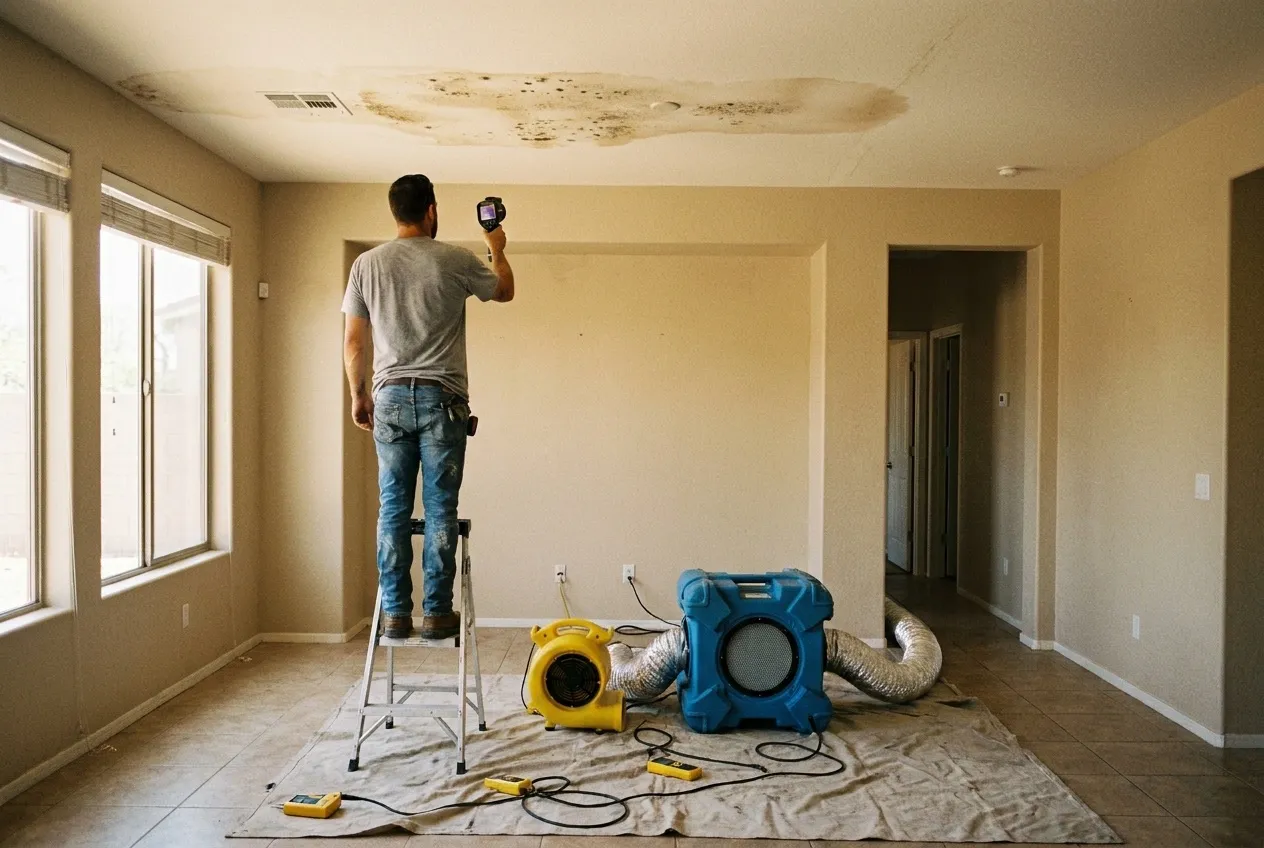
The stain on the family-room ceiling started as a tan ring. Now it has gray freckles in the middle, right under the upstairs bathroom. Or the linen closet on the wall you share with the neighbor smells like a towel left too long in the washer.
Either way, the mold is pointing at water. Mold work in Peoria starts with finding the moisture source. Clean the growth off a wall that is still getting wet, and the job starts over. Peoria is home base for Water Fighters Restoration, and the Peoria water damage page covers the city's neighborhoods and their eras.
How Peoria lives in its houses
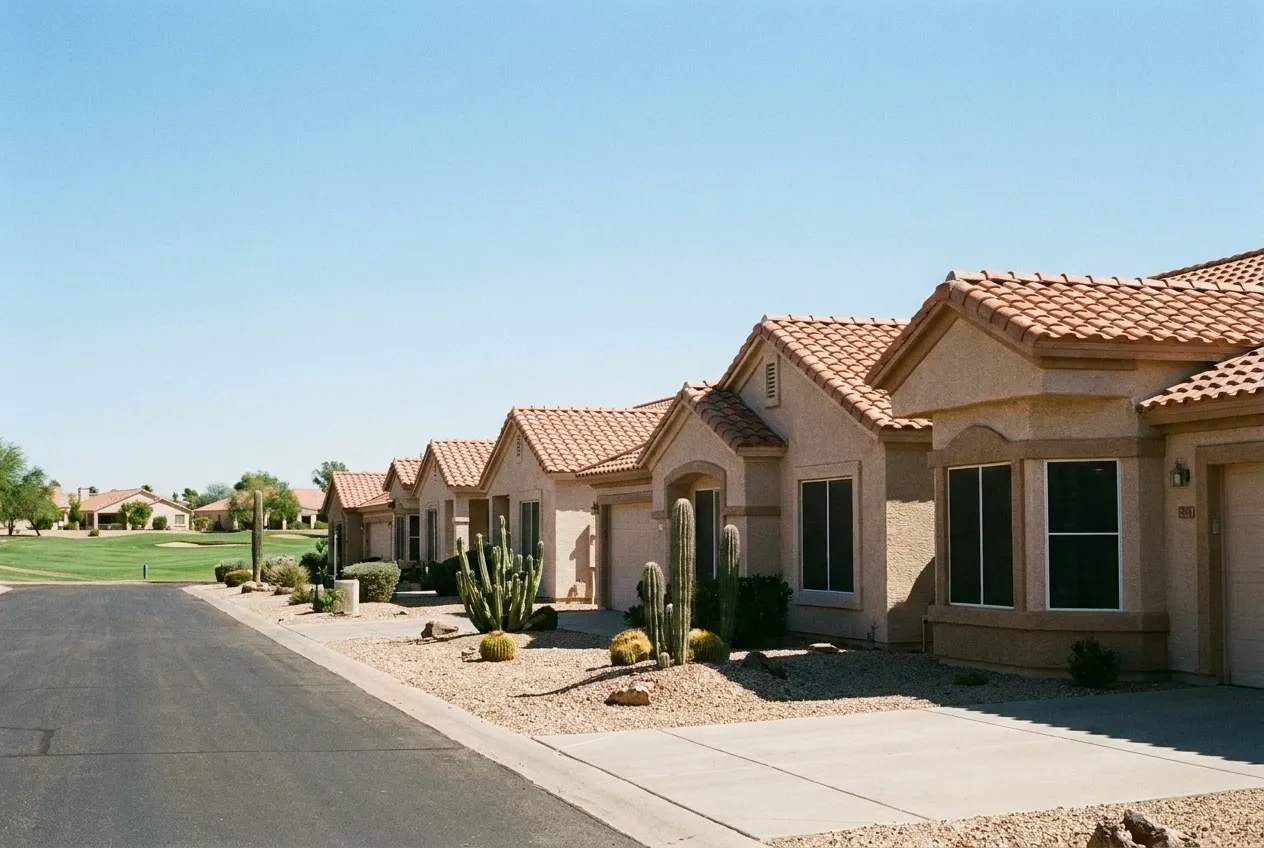
Peoria's housing splits close to evenly around the year 2000. About 43% of units were built from 1980 to 1999 and about 47% in 2000 or later, with only about 9.5% older than that. Median build years run from 1988 in 85345 and 1995 in 85381 to 1997 in 85382 and 2010 in 85383.
North Peoria's 85383 is mostly large detached houses. About 96% of its units are single-family detached, about half have four or more bedrooms, and about 42% went up from 2010 to 2019. 85382 is a 1990s ZIP, with about 44% of units from that decade. About 8% of its units are single-family attached homes, and about 5% sit in two- to four-unit buildings. It is also home to Westbrook Village, an active-adult community.
About 3 in 10 Peoria households are headed by someone 65 or older, and in 85382 the figure is about 36%. Sun City sits along the city's edge, but only about 11% of ZIP 85373's land is inside Peoria. That ZIP's numbers mostly describe Sun City and unincorporated land, and the Sun City page covers that side of the line.
Three places mold gets missed
Over a finished ceiling. Where an upstairs bathroom or laundry sits over a finished ceiling, a slow leak can wet the top of that drywall and the joist bay above it before anything shows from below.
Along a shared wall. Attached patio homes and villas share a wall, and sometimes an attic space, with the home next door. Moisture can build on either side of that wall, and the side you can see isn't always the side it started on.
In a house that sat closed. Census counts roughly 1,700 Peoria homes as vacant and held for seasonal or occasional use. In a closed house, nobody is there to see a stain or smell a leak. The issue there is discovery time: by the time someone opens the door, a slow leak may have been running a long while.
The job, start to finish
The inspection follows moisture readings from the growth back to the source and marks the edge of the wet material. Whether lab testing helps depends on the question being asked, and the mold inspection page covers when it does. Slow leaks that nobody sees leave their own signs, and the hidden water damage guide walks through them.
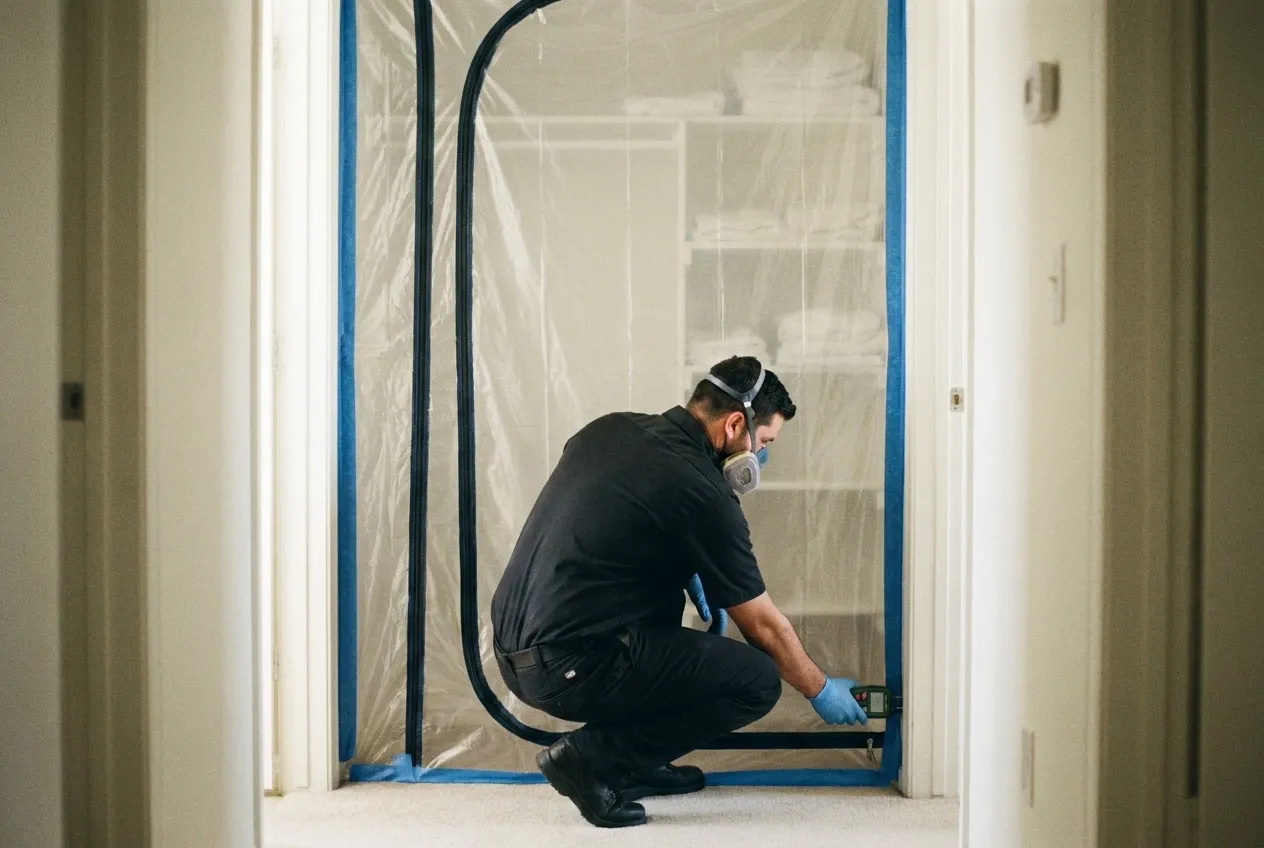
Removal runs under containment. The Phoenix mold guide explains containment and clearance step by step, and the full mold remediation page covers the service Valley-wide.
Then the same team rebuilds what came out: drywall, ceiling, baseboard, and flooring. The plumber handles any pipe repair. Estimates are free, the estimate you receive is the same one the insurer receives, and we bill the insurance company directly.
Water Fighters Restoration is IICRC Certified 70192944 · AZ ROC 324471 · ROC 324468 · EPA Lead-Safe Certified Firm · Licensed, Bonded & Insured.
Common Questions
Does Peoria's property maintenance code say anything about air conditioning?
Yes. Peoria's property maintenance code requires heating and cooling systems capable of keeping temperatures between 70°F and 90°F. That is a requirement about what the system can do, not a thermostat setting, and it is code text, not legal advice. Rental questions under state law are covered in the landlord-tenant guide. For mold, the practical point is simpler: an air conditioner pulls moisture out of the air as it cools.
There's a sewer smell at the bathroom sink. Could that be mold in the wall?
Start with the drain, the way the City does. Its water FAQ says the water standing in a sink, tub, or shower trap "serves as an excellent barrier against sewer gas." That water "may have evaporated due to infrequent use, or the house being vacant." The City's first step is to "pour a quart of water in each problematic drain." It also points to grime in the drain's tailpipe, where "mold and bacteria grow and produce unpleasant odors." If the smell persists, the City's answer ends with a plumber: "as a last resort, a plumbing professional can quickly diagnose and fix the problem." A musty smell that stays after all that, or a wall that reads wet, is a different job.
Mold showed up on the downstairs ceiling under our upstairs bathroom. Does the bathroom floor have it too?
It can. The water came down through the floor system, so the inspection follows it back up into the joist bay and the subfloor under the bathroom. Readings decide how much gets opened. The ceiling water damage guide explains why the wet area can run past the stain.
We refilled the traps, and the sewer smell came back. Who should hear about it?
The City, and a plumber. Peoria's Water Services page has an online "Report an Odor or Sewer Smell Form." The City says a sewer smell in a home or business "may be a sign of trouble with the city's wastewater or stormwater system." The drain lines inside the house are a plumber's call. If the wall or cabinet beside the drain reads wet, or the smell turns musty, that part is a moisture job, and it's ours.
We live in an attached patio home. How is mold remediation handled when we share a wall?
Containment and air filtration are set so the work air isn't pushed into the neighbor's home. If the source or the growth crosses the wall, access to the other side goes through that owner or the association. The moisture source has to be found on whichever side it's on, since drying one side of a shared wall doesn't stop water coming from the other.