
Water Damage Restoration in Litchfield Park
Published August 21, 2026 · Last reviewed August 21, 2026 · Water Fighters Restoration
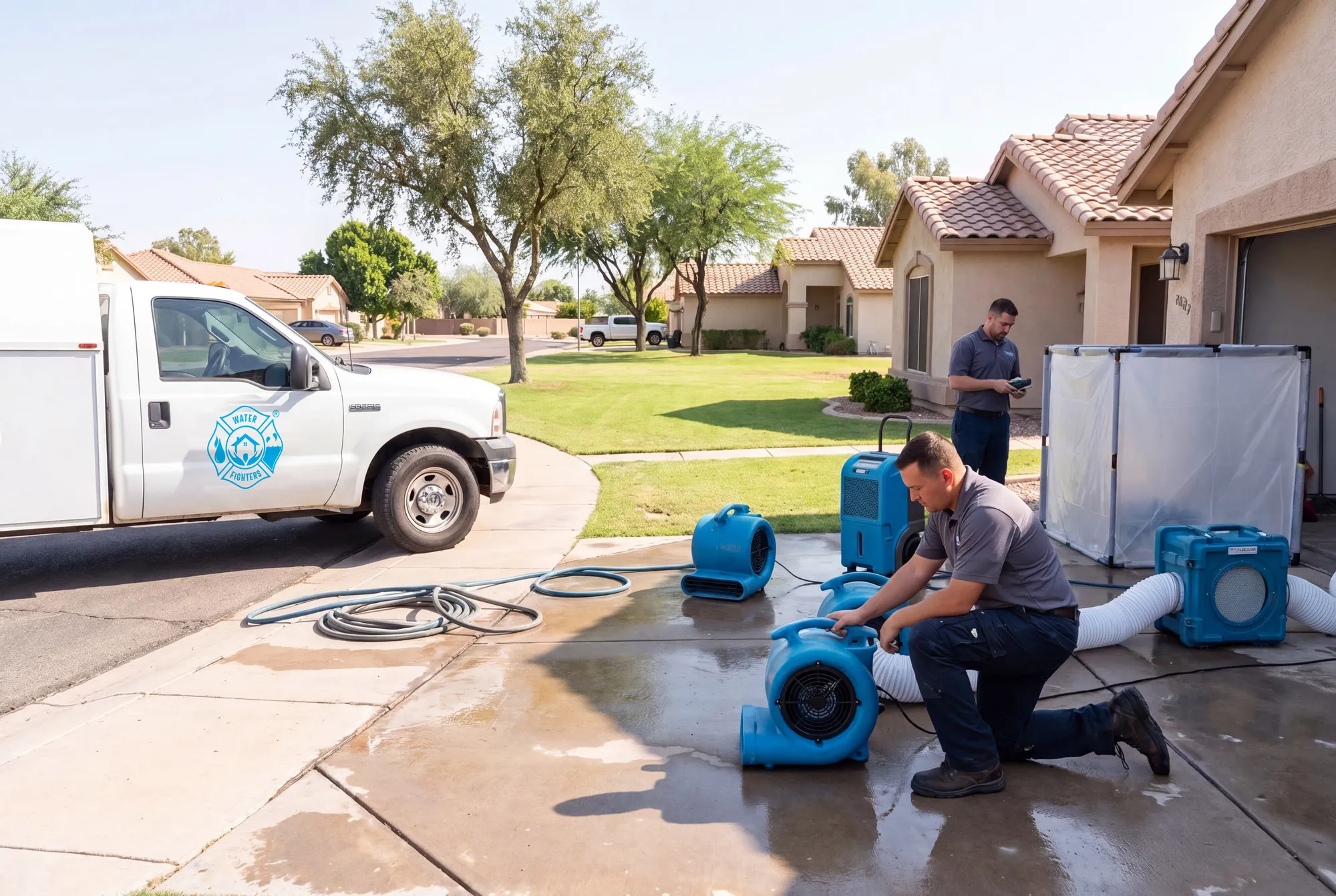
Litchfield Park does not look like the West Valley. It looks like somewhere with rain. Big trees, real lawns, a resort at the center of town, and streets laid out before most of Maricopa County existed as anything but farmland. That difference is not cosmetic, and it shows up in the kind of water damage we handle here.
The Town Goodyear Built
Paul Litchfield came to Arizona in 1916 looking for cotton to put in tires, and the company town that grew around that operation became this one. The Wigwam opened in 1929. The core of the town dates to that era and the decades right after, and homes from the forties, fifties, and sixties sit a few blocks from newer construction on the edges.
That range matters because plumbing eras are not decoration. A home from the town's early decades may still have galvanized supply lines, cast iron drains, or both, depending on what has been replaced along the way. Galvanized corrodes from the inside until the wall thickness gives out. It does that on a schedule measured in decades. A lot of the galvanized still in Litchfield Park is well past the point where failure is a question of when, not if. Cast iron drains fail differently and more quietly — the bottom of the pipe erodes first, so the leak is under the slab or inside a wall long before anything shows upstairs.
Newer homes on the town's edges have the opposite profile: modern materials, builder-grade components, and the first real replacement window arriving now. Two very different houses, two different conversations, sometimes on the same block.
What Old Plumbing Does Here
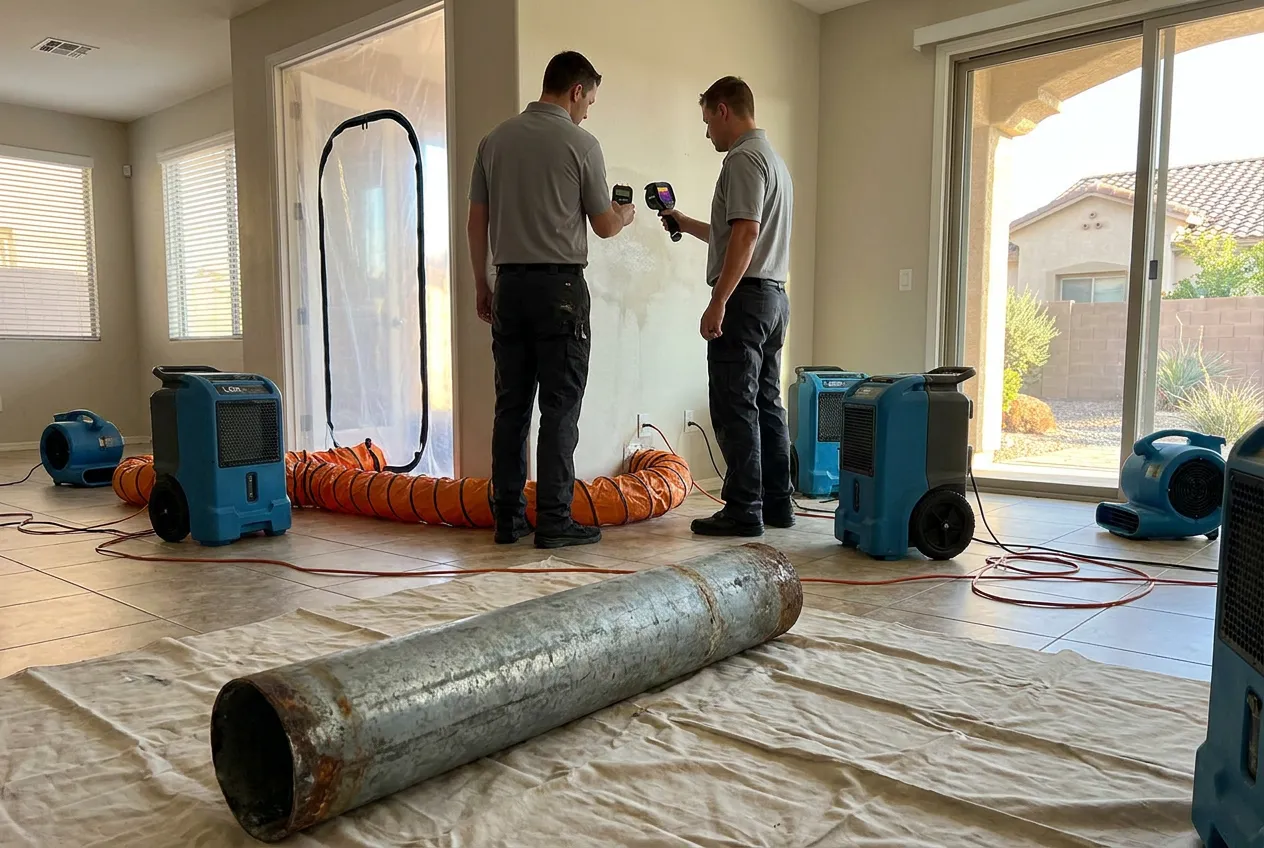
The failure people expect is a burst — a loud, obvious event with water moving fast. That happens. The failure that costs more is the other one: a pinhole in an old supply line inside a wall, or a cracked cast iron drain under a slab, running at a trickle for weeks or months.
Slow losses do more damage per gallon than fast ones. A burst gets attention immediately and gets extracted the same night. A pinhole soaks framing, wets insulation, and grows a mold colony in a wall cavity nobody has opened since the Eisenhower administration. By the time it announces itself — a stain, a smell, a floor that feels soft — the scope has quietly tripled.
A few tells are worth knowing in an older home. A water bill that climbed and stayed climbed. A section of wall or floor cooler than the rest. Paint that bubbles in one spot. A musty smell that has a location instead of filling the house. Any of those in a home with original plumbing is worth a meter check before it is worth a repaint. The handbook walks through what happens after that.
Grass, Trees, and Flood Irrigation
The green is the whole point of Litchfield Park, and it is maintained by a system most of the Valley abandoned: flood irrigation, delivered on a schedule, filling a lot until it soaks in. It works. It also means large volumes of water arrive at ground level near houses on purpose, several times a month in the growing season.
Two things follow. First, grading and thresholds carry more responsibility here than they do in a xeriscaped subdivision. A settled walkway or a door with a low sill can turn a routine irrigation turn into water inside the house. Second, when water does show up indoors, establishing whether it came from the irrigation, from a sprinkler line, or from a failure inside the wall is the first job, not a formality.
The trees are the other half. Mature canopy means mature roots, and roots go where the water is — which in an older neighborhood often means an aging clay or cast iron sewer lateral. Root intrusion is a sewer problem before it is a water problem. When a lateral backs up into a house, what arrives is Category 3 and gets handled that way, whatever it looks like.
Common Questions
Our house is from 1958 and still has some original plumbing. What fails first?
Galvanized supply lines and cast iron drains, and they fail differently. Galvanized closes up and then leaks; cast iron erodes along the bottom and leaks where you cannot see it. Both are past the age where waiting is a strategy.
Water came in during an irrigation turn. Is that covered by anything?
Your carrier decides that one. The practical distinction still matters: water rising at grade and coming in is treated differently from a sudden failure inside the plumbing. Document the day, the turn, and the entry point before anything gets cleaned up.
Do the big trees actually cause plumbing problems?
Roots follow moisture, and an aging sewer lateral leaks moisture. In neighborhoods with mature canopy and original laterals, root intrusion is a routine finding, not an unusual one.
The house smells musty in one hallway and nowhere else.
A smell with a location is a useful symptom. It usually means a wet cavity rather than general humidity, and in an older home the likely candidates are a supply pinhole in the wall or a drain leak below the floor.
We're on the newer edge of town, not in the old core. Different problems?
Yes. Newer construction here trades corrosion for components — angle stops, braided supply lines, water heaters reaching the age where replacement is cheaper than the cleanup.