
Mold Inspection in Phoenix: What Gets Checked and When Testing Helps
Published October 8, 2026 · Last reviewed October 8, 2026 · Water Fighters Restoration
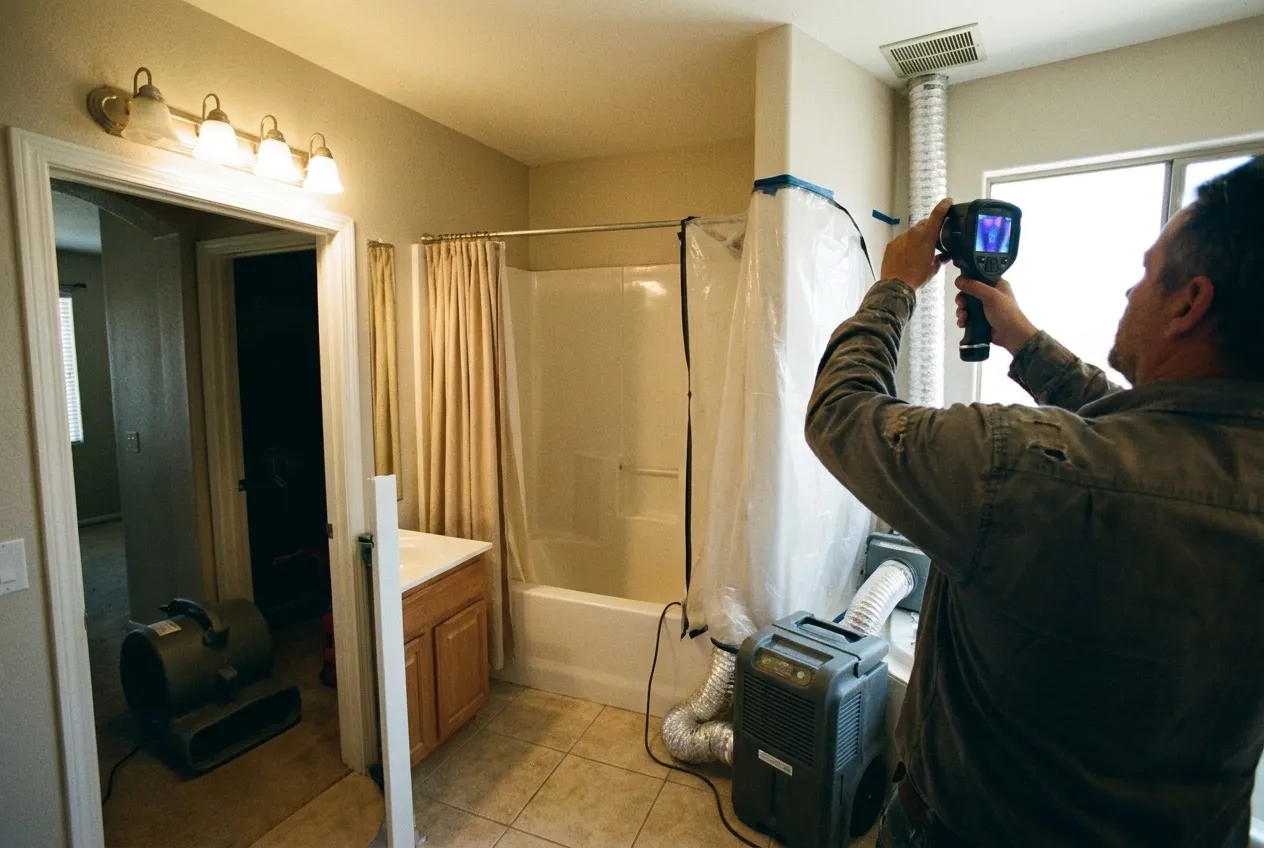
The hall bathroom smells like a towel left wet in a gym bag, and the smell is strongest under the exhaust fan. Nothing on the ceiling looks wrong, and the house sits in the desert. A test kit on a store shelf promises an answer.
A mold inspection answers a different question first: where is the water? Mold grows where moisture stays, so an inspection is a moisture investigation. A lab enters the picture only if a result would change what happens next.
What to do right now
- If water is still moving, close the fixture valve or the house valve where the line enters the home. Leave the curb meter box to your water provider. In Phoenix, the City's number is Phoenix Water's 24/7 line, 602-261-8000.
- Write down when the water showed up, where it ran, how long it sat, and how it was cleaned up.
- For active water, Water Fighters is Open 24 hours, 7 days, and on-site within an hour.
What a mold inspection is
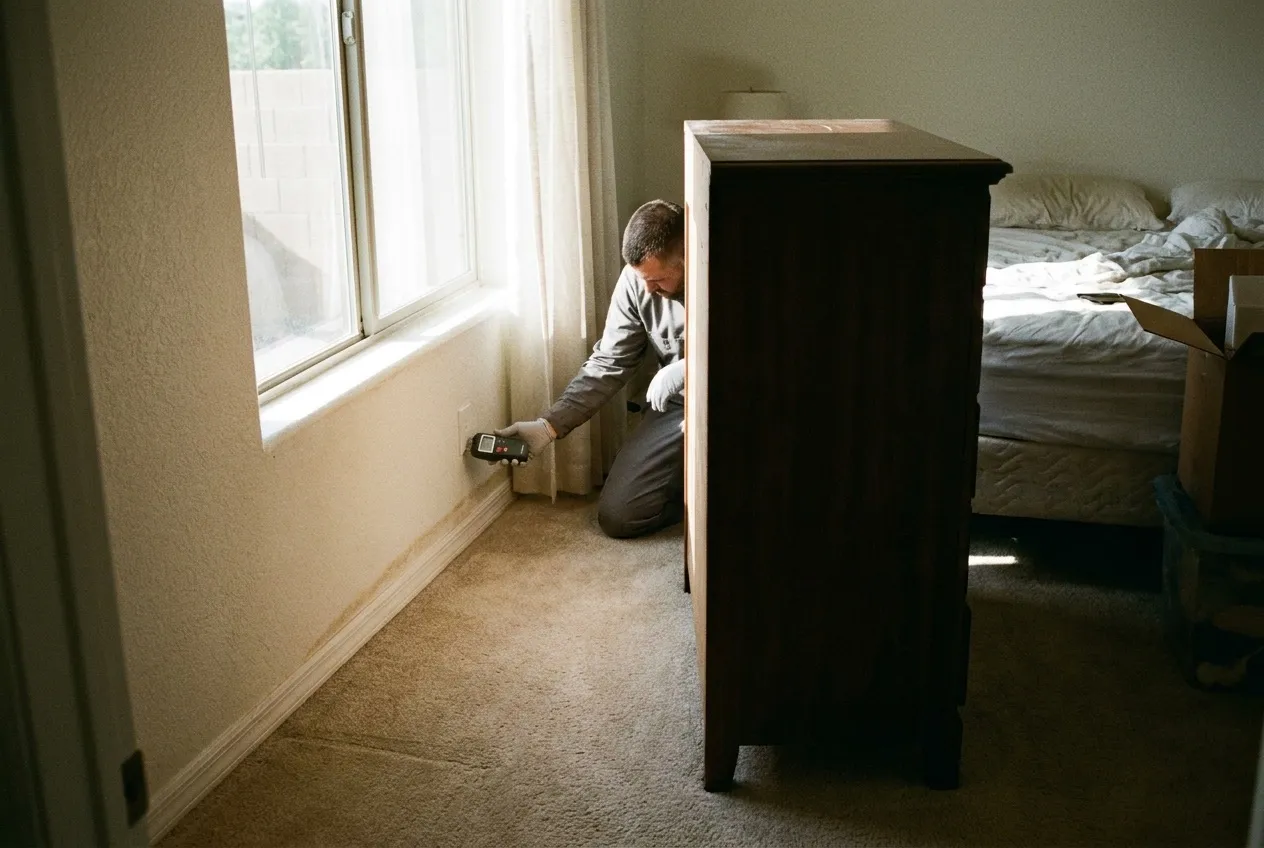
"Most mold is found by simply looking," EPA's mold course says, and "the most important equipment is your own eyes and nose, although a good flashlight may help." Instruments come next, and they find moisture, not mold. Moisture meters and humidity gauges point toward water, and a thermal camera shows temperature patterns. None of them sees growth.
Each agency has its own words on testing. EPA: "In most cases, if visible mold growth is present, sampling is unnecessary," and "routine sampling for mold is not recommended." CDC: "CDC does not recommend mold testing." An Arizona Department of Health Services info sheet from 2010, still posted, says ADHS "does not recommend testing as the first step to determine if you have a mold problem." There's no number to test against, either. EPA says "no EPA or other federal limits have been set for mold or mold spores."
The industry's remediation standard, ANSI/IICRC S520 (4th edition, 2024), lists "Inspection and Preliminary Determination" as its own component. Water Fighters is IICRC Certified 70192944.
What a mold inspection checks, in order
- The water history. EPA says past leaks "should be investigated to determine how much water was involved and how quickly it was removed."
- A look and a smell, room by room. "Moldy or musty odors should alert an investigator to the possible presence of mold."
- Moisture readings at the suspect area and past it, along with humidity.
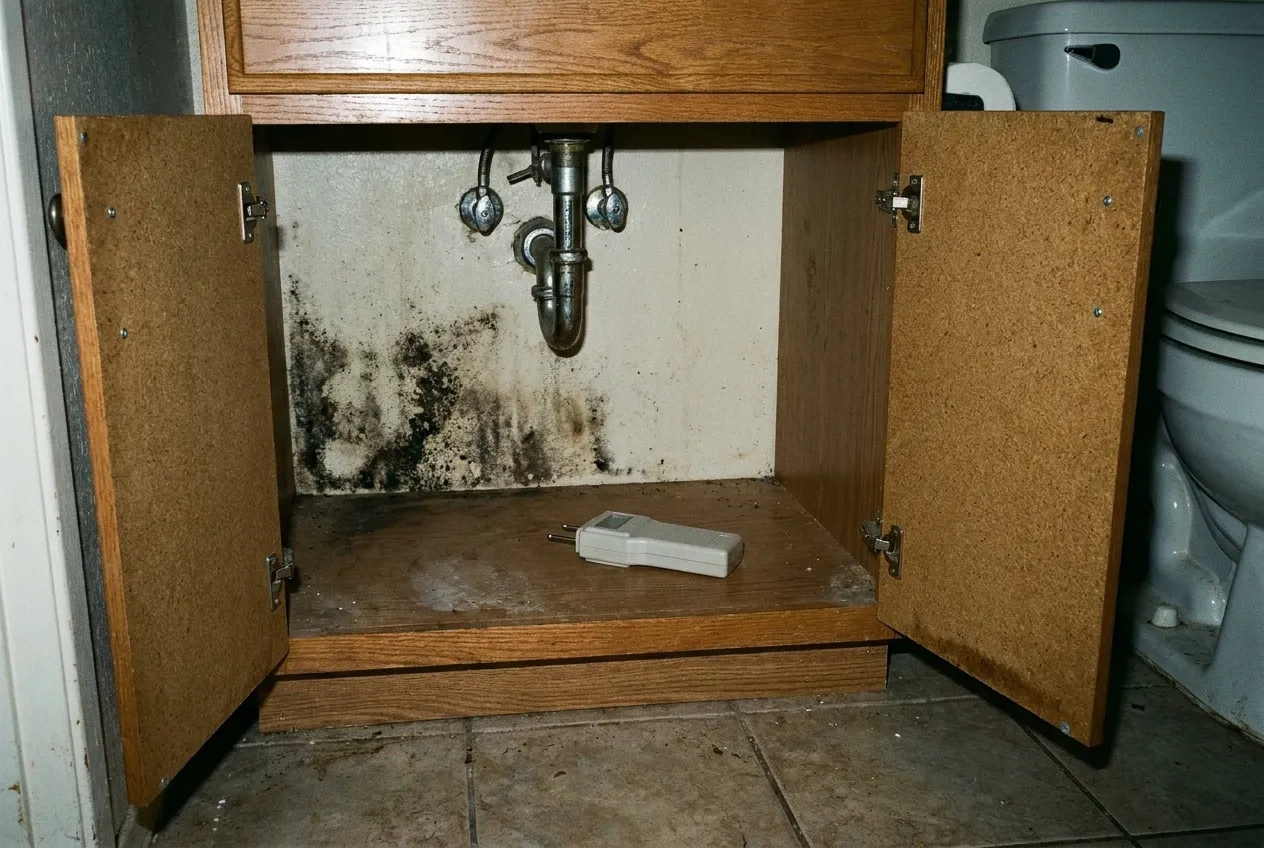
- Hidden spots EPA names: the back side of drywall, the underside of carpet pad, wall cavities around leaking or condensing pipes, and condensate drain pans inside air handlers.
- Look-alikes, ruled out.
- A sampling decision: would a result change the plan, and what question would it answer?
A ceiling stain near an attic air handler starts with the ceiling water damage guide, and drain pans have their own AC condensate page.
What looks like mold and isn't
"Not everything that looks like mold is mold," EPA's mold course says. Paint on the back of drywall can pass for growth, and so can carpet stains. "Alkaline crystals on soil or concrete walls may look like mold, but, unlike mold, they are usually water-soluble." EPA adds that white, soluble material on crawl-space soil "may be alkaline salts, not mold, indicating moisture has been a problem."
Phoenix has its own version. The City's 2025 Water Quality Report puts tap-water hardness at 172 to 302 ppm. White residue where a leak dried may be mineral rather than growth, and the hidden water damage guide covers efflorescence on block walls. When the eye can't settle it, EPA says most labs "need only a little of the suspected mold on a clear strip of sticky tape" to check under a microscope.
When sampling earns its place
EPA's rule is short: "Unless the results would or could make a change in your plans, you don't need to sample." EPA's commercial-buildings guide, which it says applies to other buildings too, names cases where sampling may be considered: litigation, an unclear source, and health concerns. Even then, sampling "should be done only after developing a sampling plan that includes a confirmable theory regarding suspected mold sources and routes of exposure."
The limits are built in. Air sampling "provides information only for the moment in time in which the sampling occurred, much like a snapshot." ADHS says an outdoor air sample "needs to be taken at the same time as the sample indoors, to provide a baseline measurement," and calls sampling "at best a general guide." The Phoenix mold guide covers clearance testing after removal, and the commercial mold page explains when an independent indoor environmental professional should run the protocol.
Arizona has no mold license, so the method matters
Arizona has no state license for mold inspectors or remediators, and the north Phoenix mold page covers the research behind that. The ADHS sheet adds that sampling in private homes "is not done by public health agencies."
With no state credential to check, the method has to stand in for one. That means EPA's sequence, the S520 standard, and an inspector who can say what question a sample would answer.
Insurance and the rebuild
Mold coverage depends on the policy and the cause. Sublimits, exclusions, and whether the mold followed a covered sudden water event all matter, and no contractor can promise coverage. In practice, the part of an inspection a carrier reads is the dated record: the moisture source, the readings and the photos. The insurance coverage guide covers mold sublimits. The estimate you get from Water Fighters is the same one your insurer gets, and Water Fighters bills insurance directly.
The right trade fixes the source first. Growth that's found goes to mold remediation under containment, and the wet structure is dried and rebuilt. Water Fighters does mitigation and rebuild as one licensed team, Valley-wide, from staffed locations in Phoenix (Deer Valley) and Peoria, the home base.
Common Questions
What should we not do before the mold inspection?
Don't disturb it. EPA says "Do not paint or caulk moldy surfaces," and not to run an HVAC system "if you know or suspect that it is contaminated with mold." Don't scrub or spray it, pull wallpaper, or open the wall. EPA warns that "removal of wallpaper can lead to a massive release of spores if there is mold growing on the underside of the paper." Opening and closing air handlers "can send high levels of dust and mold into the air."
Can a moisture meter tell whether mold is growing inside the wall?
No. EPA says investigators use meters "to find wet areas where mold may be growing," and that a meter "can help an investigator locate hidden areas of mold growth." Locating isn't confirming. Confirming means seeing the material, through a borescope ("an optical probe, inserted through a small hole drilled into a wall") or an opening made under professional controls. A sample is the other route, when the plan calls for one. A thermal camera has the same limit: it shows temperature patterns, not growth.
Will a store-bought mold test kit tell us anything useful?
Not much on its own. EPA says sampling "should be conducted by professionals who have specific experience in designing mold sampling protocols, sampling methods and interpreting results." Its list of pitfalls includes "an inadequate number of samples," samples that "become contaminated," and "Outdoor control samples may be omitted." ADHS adds that reliable sampling "requires equipment not available to the general public." Spores are in every indoor space, so a result that says "mold present" answers a question nobody asked.
We're buying a house. Should we order a mold test before closing?
Only if a result would change what you do about the house. That is EPA's test: you don't need to sample unless the results "would or could make a change in your plans." EPA's hiring advice fits any inspector: "make sure the professional has experience identifying and locating mold and water problems." The seller's disclosure form generally asks about past mold and water leaks.
The inspection found wet drywall but no mold. What happens next?
The moisture is the finding, and the order matters. ADHS says it is "critical to remove the source of moisture first," because "mold growth will return shortly if an affected area becomes re-wetted." The right trade fixes the source, whether that's a plumber, a roofer or an HVAC contractor. Then the wall is dried and checked with readings until it meets its dry standard, and the drying guide explains how that's measured. One team handles the drying and the rebuild.