
Water Damage Restoration in Apache Junction, AZ
Published September 1, 2026 · Last reviewed September 1, 2026 · Water Fighters Restoration
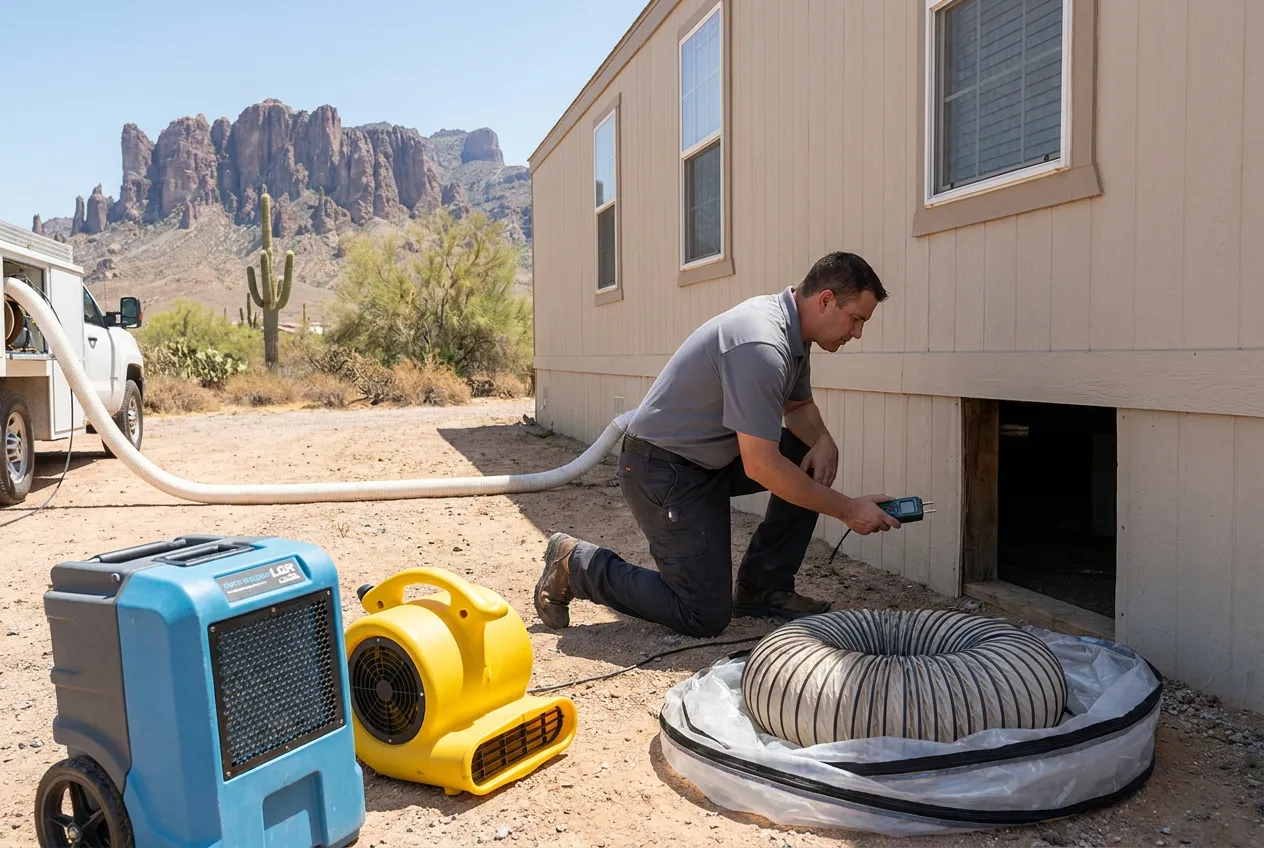
Apache Junction sits on the bajada below Superstition Mountain. Water moves southwest through town during storms. Inside many homes, it also moves downward into assemblies that standard slab-home inspections never reach.
Mobile and manufactured homes make up roughly 45% of local housing units. They are the city's single most common housing type. That changes extraction, access, drying, and the way damage appears.
A wet floor may be only the top layer of the loss. Below it can be particleboard subfloor, floor ducts, insulation, and a belly board holding water out of sight.
Water Fighters Restoration is Open 24 hours, 7 days. Crews stage as one licensed team, Valley-wide. The response promise is on-site within an hour.
Manufactured homes are different drying work
A site-built house and a manufactured home can have the same failed supply line. The water path after the break may be completely different.
Manufactured homes often place plumbing and ducts within or below the floor system. Water can pass through seams and openings, soak particleboard, enter insulation, and collect above the belly board. Skirting can hide the affected crawl space from normal view.
That is why a surface check is not enough. The inspection has to follow gravity through the floor assembly. Technicians may need access from below to determine where insulation is wet and whether the belly material is holding water.
Particleboard can swell, break down at its edges, and lose strength. Drying or removal depends on its condition, contamination, and measured response.
The nearby Mesa restoration page covers a related manufactured-home pattern. Apache Junction has a larger share of this housing, so the underfloor inspection is not a side note here.
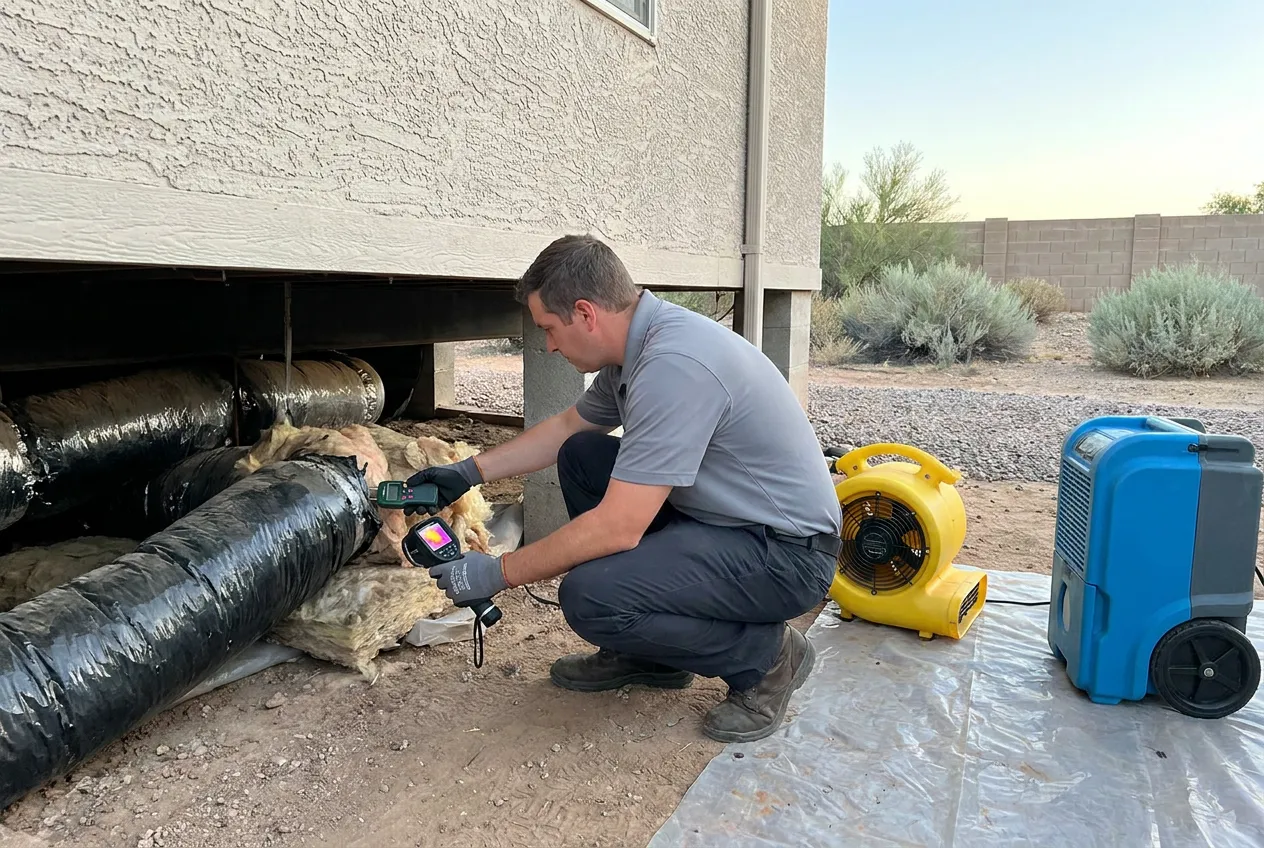
What an underfloor inspection is looking for
A complete manufactured-home water check answers several separate questions:
- Where did water pass through the finished floor?
- Is the particleboard swollen, soft, or separating?
- Did insulation settle against a wet belly board?
- Are floor ducts wet inside or outside?
- Did water reach soil, supports, skirting, or another room?
The answers determine the work. Extraction from a kitchen floor does not remove water held below the kitchen. Air movement in the room does not guarantee air reaches enclosed insulation.
A measured plan may include controlled access, removal of saturated insulation, cleaning where needed, and drying from both sides of the assembly. Hazardous or contaminated conditions are handled by professionals, not turned into an under-home project for the resident.
Winter occupancy creates summer-vacancy losses
Dozens of 55+ parks and RV resorts operate across Apache Junction. Sunrise RV Resort, Superstition Buttes, and Superstition Lookout are examples. These communities fill from November through April and become much quieter in summer.
A supply line can leak for days before someone sees it. The first sign may be a neighbor noticing water near the skirting. It may be a property contact opening the door to warm, stale air and a lifted floor seam.
Delayed discovery broadens the inspection. Technicians look beyond the first wet room because water may have continued through floor cavities and along under-home low points.
Remote owners need moisture maps, photographs, and a clear removal plan they can review from elsewhere.
Weekes Wash is an active storm route
Apache Junction sits around 1,700 feet in elevation below the Superstitions. Weekes Wash carries mountain runoff through town. It flooded homes as recently as July 2022.
A regional detention facility is funded and underway. It is not finished. Current response planning should not treat future flood control as protection that already exists.
Storm water may also sheet-flow southwest across roads and lots. Water entering a structure from outside is Category 3. It requires containment, controlled removal, cleaning, and drying based on contamination and material condition.
Flood control here is a Pinal County matter, not a Maricopa County system. Apache Junction is primarily in Pinal County, with a small Maricopa County sliver.
The storm-damage restoration page explains the service response. The monsoon flood guide explains why runoff can arrive far from where rain first fell.
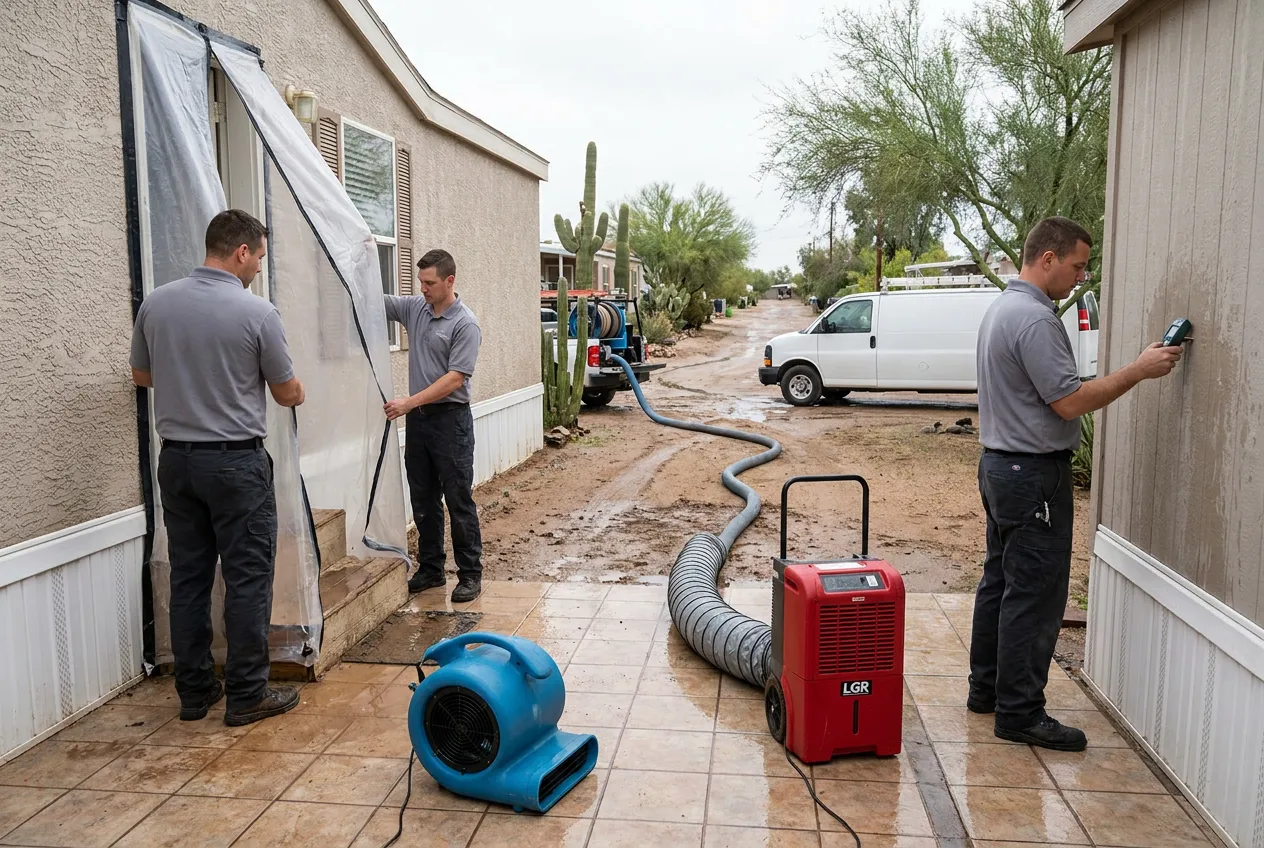
Septic backups are a local part of the picture
The city's sewer system serves roughly 9,600 customers against about 22,000 housing units. A large share of properties likely remain on septic, so backups are a local pattern.
A septic or drain backup is Category 3. That classification does not change because the water stays under a home. Contaminants can reach insulation, subfloor, soil, and floor ducts.
Professional work separates affected space, removes materials that cannot be safely restored, cleans remaining surfaces, and documents drying. The sewage cleanup service covers the process and the reasons fans are not the first step.
The 1970s through 1990s building era matters
Apache Junction incorporated on November 24, 1978. Its population grew from about 2,390 in 1970 to 38,499 in 2020.
Much of the site-built and manufactured stock dates from the 1970s through the 1990s. That places some homes within the roughly 1978 to 1995 polybutylene window.
It is a phase question, not a citywide label. Pipe material should be identified at the property. Replacement fittings and partial repipes can also leave more than one material in the same home.
Newer growth continues in Superstition Vistas on the south side, separate from the nearby Queen Creek housing pattern.
The response plan follows the assembly
Source control and extraction come first. Technicians then measure the room above and the assembly below, adding containment when contamination or removal requires it.
One team does mitigation and rebuild. That matters when flooring, subfloor, skirting, drywall, or interior finishes must be removed and replaced.
Common Questions
Why does a manufactured-home leak need an inspection below the floor?
Water can soak insulation, particleboard, ducts, and the belly board after the room surface looks dry. The inspection follows the water through the floor assembly instead of assuming extraction from above reached every wet layer.
Can a summer leak remain hidden in an Apache Junction park home?
Yes. Many 55+ parks and RV resorts become quieter after April, so a leak may continue before a neighbor or property contact notices it. Delayed losses usually require a wider moisture map and clearer remote documentation.
Is the Weekes Wash detention facility already protecting nearby homes?
No. The regional facility is funded and underway, but it is not finished. Current storm planning should still account for Weekes Wash and southwest-moving runoff described in the monsoon flood guide.
What if septic water reaches the belly board but not the room above?
It is still a Category 3 loss. Underfloor insulation, belly material, ducts, subfloor, and soil may require evaluation even when the finished room shows little or no visible water.
Does every older Apache Junction home have polybutylene pipe?
No. The material is plausible in portions of the 1978 to 1995 building window, but it is not a blanket citywide condition. Pipe material and any partial replacement work have to be confirmed at the home.