
Water Damage Restoration in Ahwatukee
Published August 21, 2026 · Last reviewed August 21, 2026 · Water Fighters Restoration
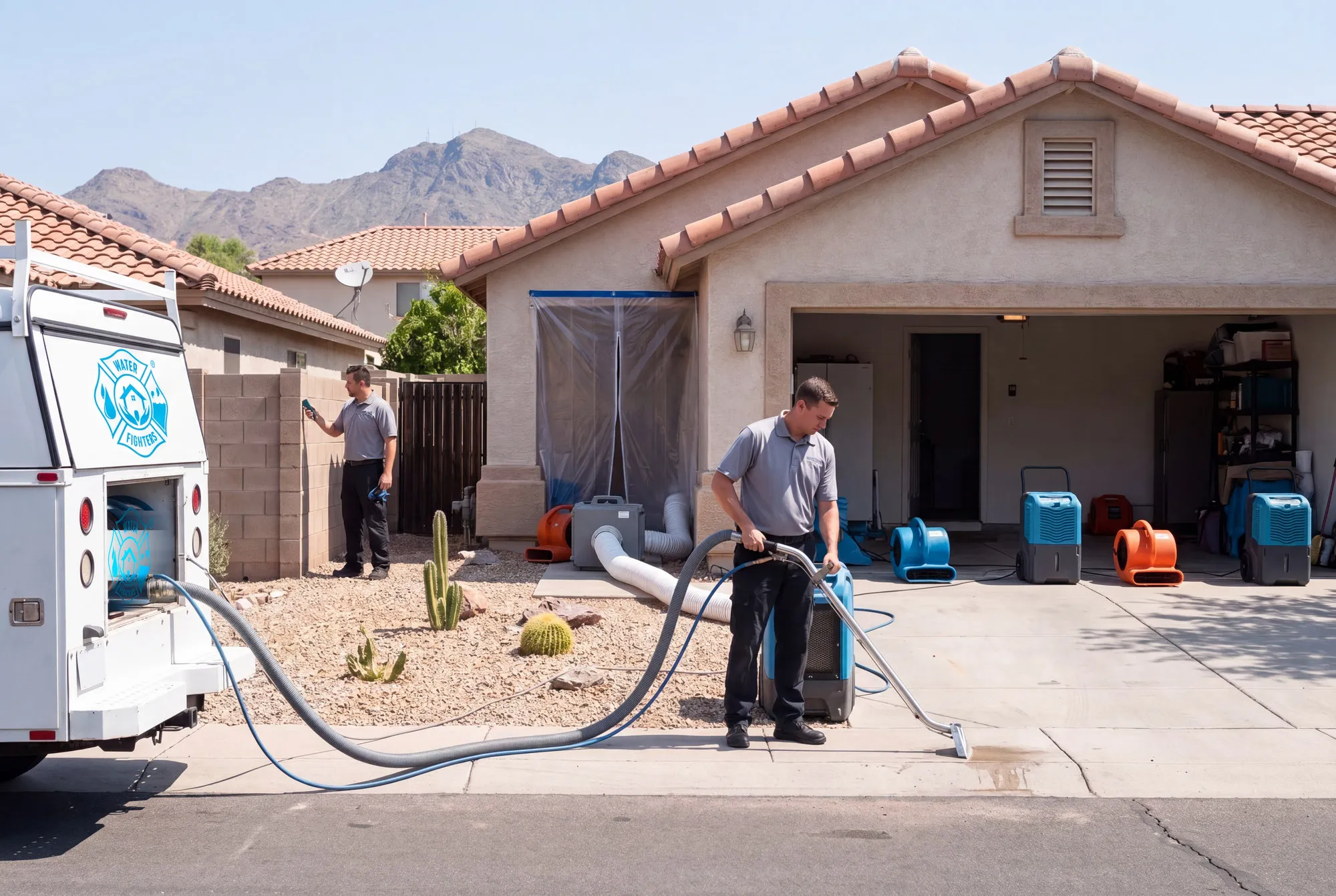
Ahwatukee is part of Phoenix that does not touch the rest of Phoenix. South Mountain sits between it and the city, and the entire community is reached through a short list of routes. People here joke about living in the world's largest cul-de-sac. For a company that measures its work in response time, that geography is the first thing to plan around.
The Mountain in the Middle
The practical version: getting to a house in Ahwatukee means the I-10 corridor, the 202, or one of the roads that skirt the mountain. When one of those is closed for construction or an accident, the alternatives are limited and everybody uses them at once. That is not an excuse, it is a dispatch input. Crews heading south get routed with the current condition of those corridors in mind rather than the shortest line on a map.
The same isolation shapes the housing. Ahwatukee was built as a planned community from the 1970s onward, filling in through the eighties, nineties, and into the 2000s along the foothills. It is largely a single generation of construction with distinct sub-eras, which means the components inside those houses tend to reach the end of their lives on a shared schedule rather than randomly. Water heaters, angle stops, braided supply lines, condensate systems — the boring parts that account for most of what we extract.
What the Slope Does
Water on a hill has somewhere to be. Ahwatukee sits on the south flank of South Mountain, and when a monsoon cell parks over the ridge, the runoff comes down through the community rather than around it. The master plans anticipated this — retention basins, engineered channels, streets that double as drainage during a real storm — and the system works most of the time.
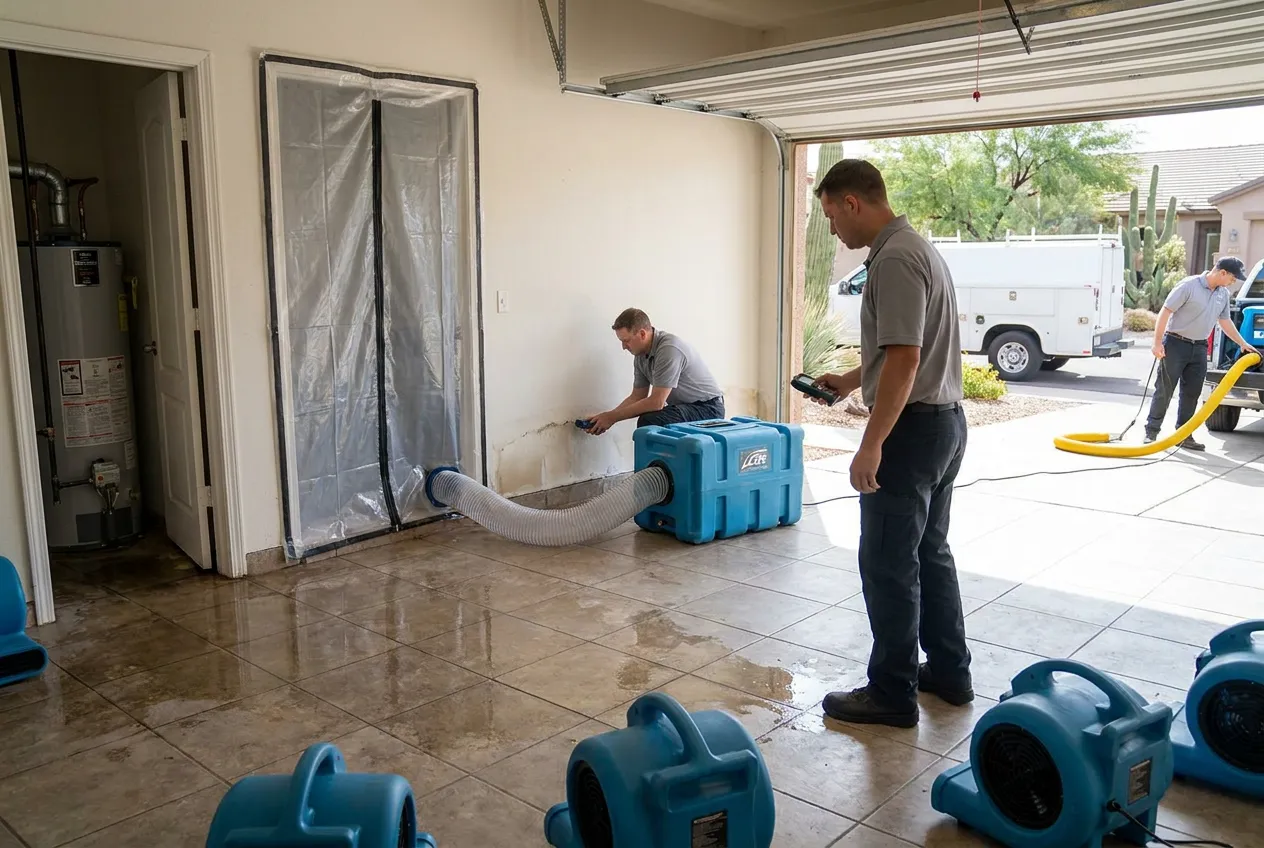
What it does not manage is the last stretch between the street and your slab. Homes on the uphill side of a lot take sheet flow head-on. Homes at the bottom of a grade collect what the street sheds. Side yards funnel. A garage threshold that has settled a quarter inch becomes the low point of the whole property. Almost every storm call we run in Ahwatukee is a lot-level story, not a failure of the community's drainage.
The foothill homes add slope-specific problems: retaining walls with drainage that has silted up over twenty years, patios that were graded correctly and are not any more, and the reality that landscaping on a hillside moves. Water that arrives from outside is contaminated the moment it crosses the threshold, and the monsoon guide covers what that means for what can be saved.
Summer brings the quieter version. Air handlers in Ahwatukee attics run for months without a break, condensate lines scale up, and a clogged line overflows into a hallway ceiling with no storm in sight. That failure has nothing to do with the mountain and everything to do with the calendar.
The HOA Layer
Ahwatukee runs on associations. Mountain Park Ranch, Lakewood, the Foothills, and the rest maintain standards that hold the community's look together, and restoration here happens inside that structure as a matter of routine.
That means a few concrete things. Exterior repairs visible from the street can require architectural review, and documentation prepared correctly the first time clears it without a second round. Gate and vendor access gets coordinated in advance rather than negotiated at midnight. In attached and shared-wall formats, a loss that starts in one unit and reaches another gets the two-clients-one-job protocol: both sides metered, the origin documented, and both carriers handed evidence rather than an argument to have with each other.
When the job moves from drying to putting things back, the standard is whatever the community expects, which is the argument for one team through the rebuild rather than a handoff to whoever is available.
Common Questions
Does being on the other side of South Mountain slow you down?
It changes the route, not the coverage. Dispatch accounts for the condition of the corridors in and out rather than assuming the shortest line, which matters most during rush hour and during storms.
Water came down the slope and into the garage. Is that the same as a burst pipe?
No, and the difference matters for both the cleanup and the claim. Water that arrives from outside is contaminated and is handled as Category 3. A supply line failure inside the house is clean water and a different scope entirely.
Our ceiling stained in August and there wasn't a storm.
That is usually the air handler. Condensate lines clog in the cooling season, the pan overflows, and it comes through the ceiling below. An annual flush is inexpensive and prevents most of them.
The association has to approve exterior repairs. Does that slow the work down?
Interior drying does not wait for anyone. Exterior work that needs review gets documentation built for that purpose, which is the difference between clearing on the first submission and losing two weeks.
Our retaining wall has been fine for twenty years and now the patio floods.
Drainage behind a retaining wall silts up over time, and grading moves. A wall that drained perfectly in 2005 can be functionally sealed now, which turns the patio into a basin.