
Water Damage Restoration in Fountain Hills
Published August 4, 2026 · Last reviewed September 1, 2026 · Water Fighters Restoration
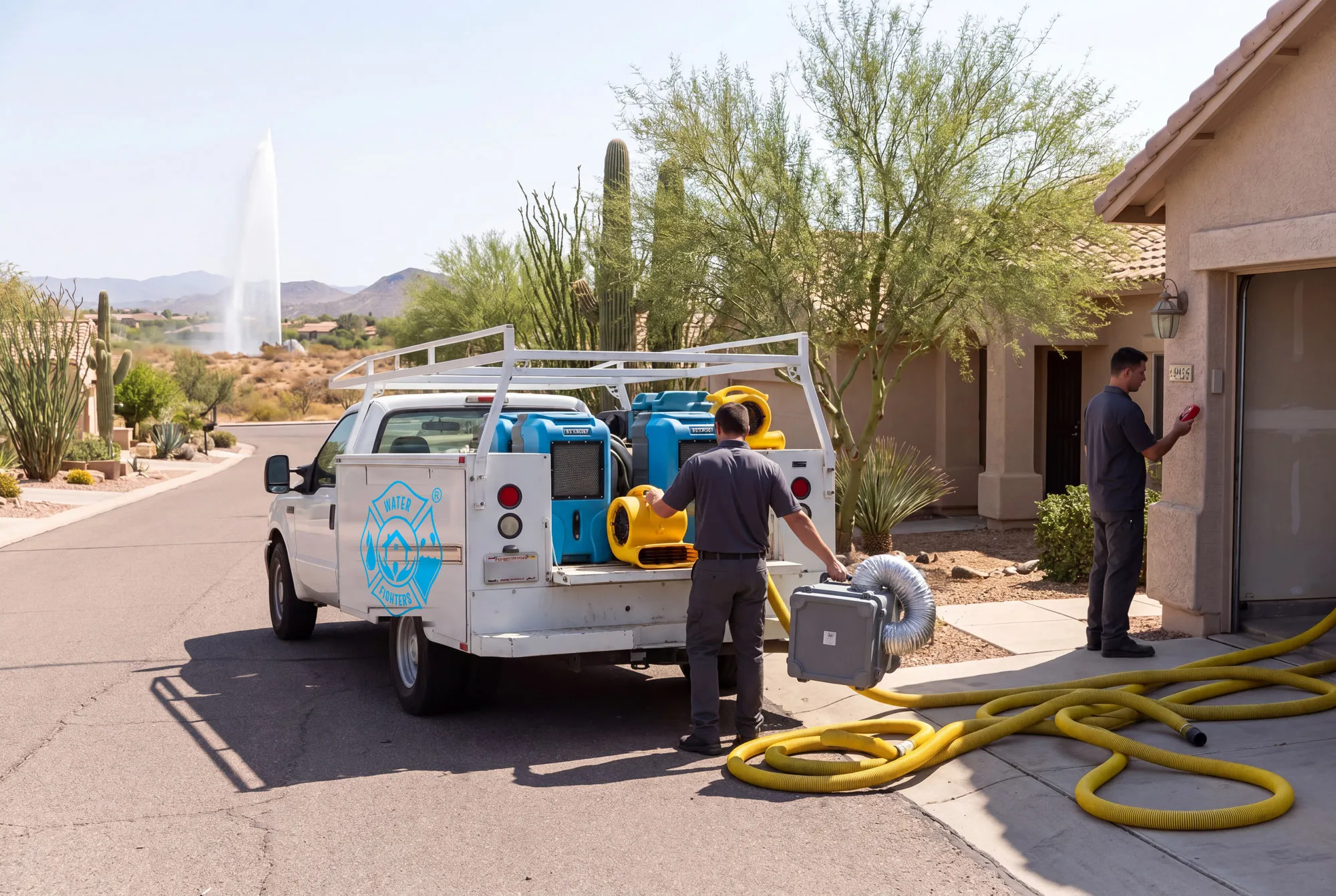
Most Valley suburbs are flat by design. Fountain Hills was laid out by McCulloch's planners across genuine hills in the early seventies, wrapped around the fountain that named the town — which means nearly every lot here has an uphill and a downhill, and water never forgets which is which.
Water still coming in or rising outside? Use Flood Cleanup in Fountain Hills for the first-hour protocol and local drainage read.
A Town With Topography
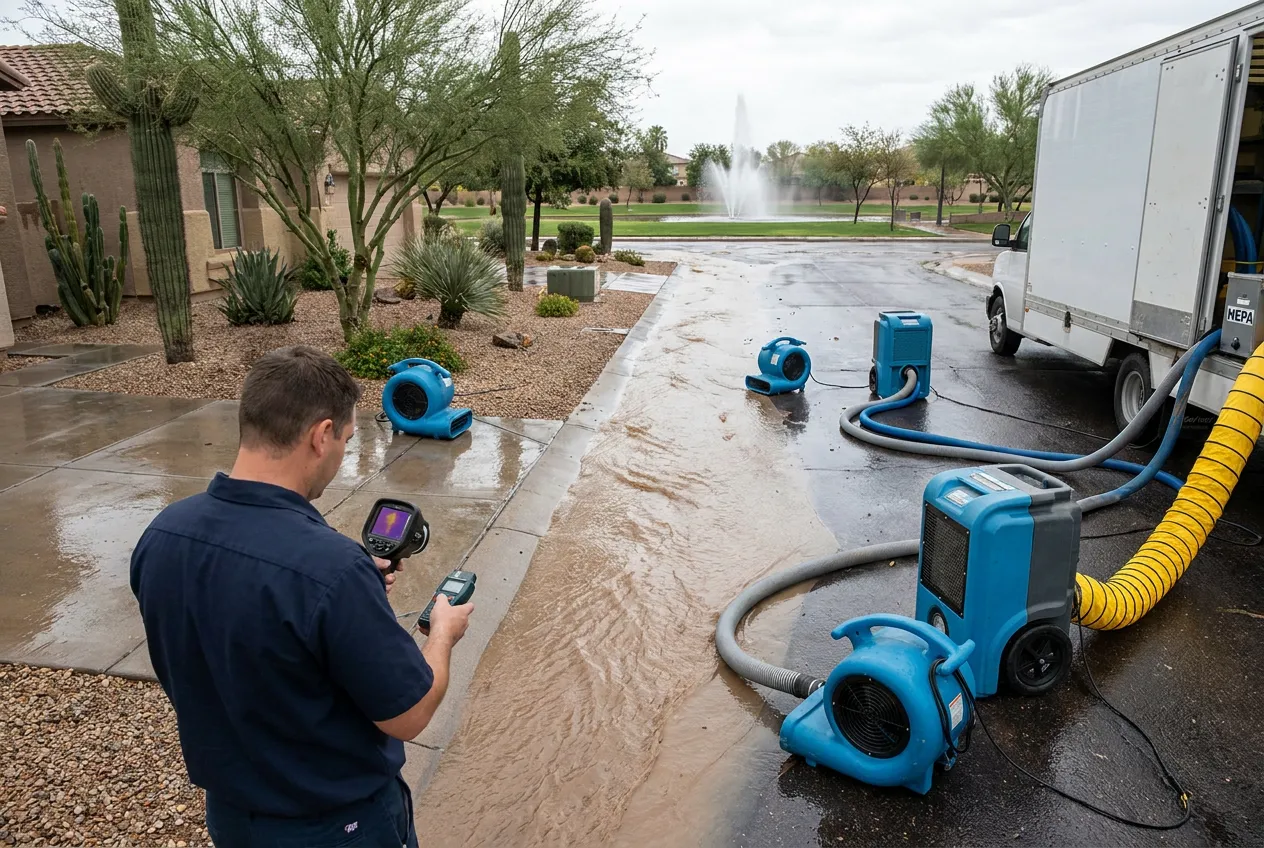
Slope is the town's signature and its water-damage variable. Monsoon cells working the McDowell edge send runoff downhill fast, following streets, natural washes, and whichever driveway crossing sits in the historical path — and hillside lots are each their own small drainage design, where a settled berm or a clogged swale quietly re-aims twenty years of runoff at a stem wall. Interior failures get the slope treatment too: a supply line letting go on a split-level's upper floor delivers its water downhill through the house with conviction. Storm water indoors is Category 3 from the first minute; the June walk of your lot's runoff path — from the uphill line to the lowest door — prevents more Fountain Hills losses than any product we could name. When it happens anyway, extraction on a fast clock is what keeps a threshold event from becoming a floor-system event.
Two Generations of Homes
Fountain Hills housing splits cleanly in two. The original seventies-and-eighties core carries its era honestly — first-generation copper deep into service life, aging valves and drains, and the polybutylene window's edge in the later original sections; the tells are the usual quiet ones, and original materials deserve the dry-in-place discipline we bring to every older home. The newer generation is custom and semi-custom hillside construction — larger homes, long utility runs, view-lot grading, and finish levels that make preservation the priority: specialty drying for wood and stone, surgical openings sized by the meter, and documentation detailed enough that the insurance scope reflects what's actually installed. Both generations end at the same place — the one-team rebuild matched to the home's standard, with one estimate your carrier reads directly.
The Seasonal Rhythm
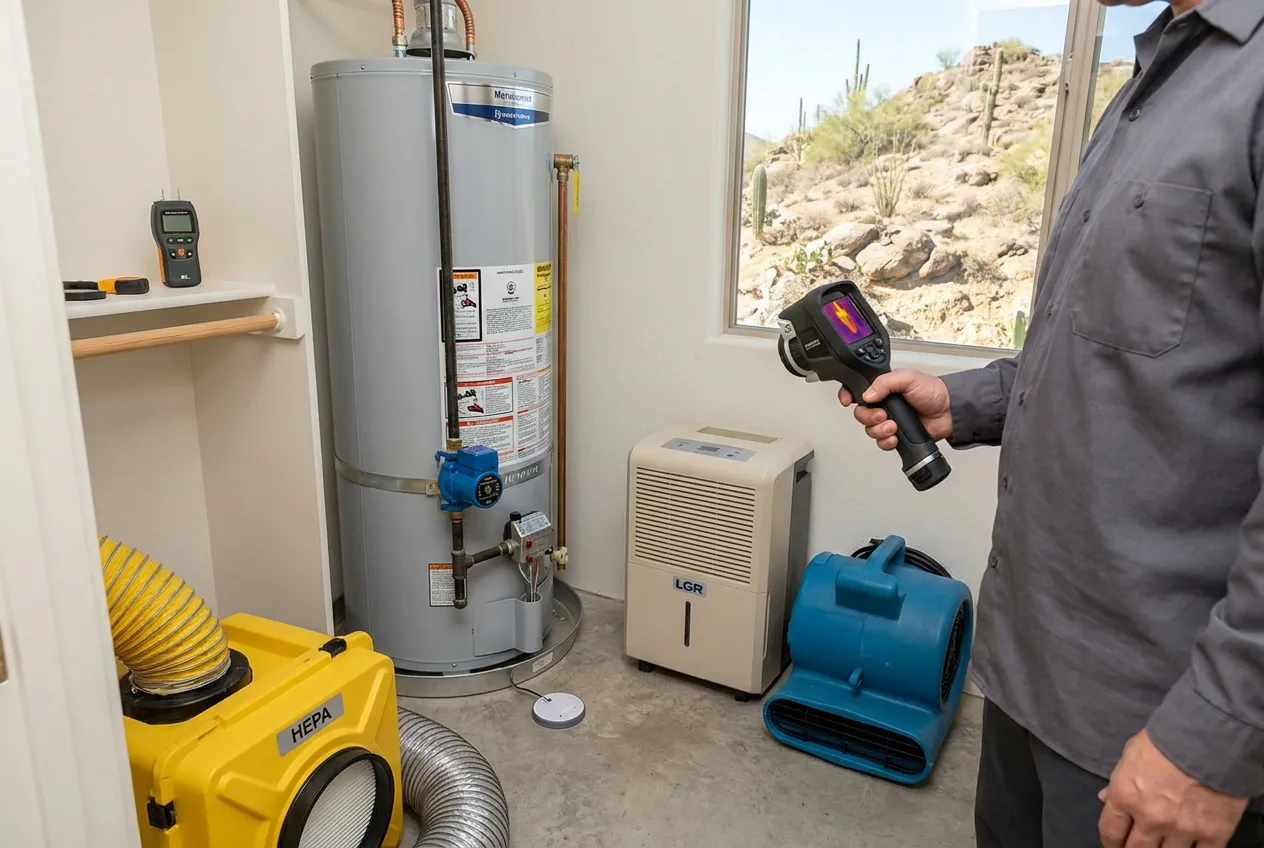
Fountain Hills runs a strong seasonal-resident current, and the vacancy playbook applies at full strength: main valve off when the house goes quiet, leak sensors at the heater and under sinks, someone walking the interior monthly, and a local contact authorized to act — because a spring failure discovered at fall return is a rebuild story, and on a hillside lot the water's been traveling in the meantime. For out-of-town owners we run the standard remote protocol: video-documented assessment, scopes readable from anywhere, coordination through your house watcher or property manager, and the cost mechanics broken out line by line so approval from a distance is an informed act, not a leap.
Common Questions
How fast can you reach Fountain Hills?
Within the hour, any hour — the town sits inside the standing Valley staging plan, and the northeast run is a routine one, not a stretch.
Our lot slopes toward the house from the street. How much should that worry us?
Enough to walk it every June. Grading that aims at a stem wall is fixable on a calm weekend and expensive during a storm; if runoff has ever reached the slab, a grading contractor conversation is worth more than any restoration ever will be.
A pipe failed upstairs in our split-level and water ran through two floors. Where do you even start?
Top down — source confirmed and stopped, then every level the water touched gets metered before anything gets opened. Multi-level losses hide moisture in floor systems between stories, and mapping first is why we open surgically instead of exploratively.
We're gone all summer. What's the honest minimum before we leave?
Main valve off and one person walking the interior monthly — those two alone prevent the catastrophic version. Sensors and an authorized local contact turn a bad week into a bad afternoon; the handbook's vacancy chapter has the full list.