
Water Damage Restoration in Rio Verde, AZ
Published September 2, 2026 · Last reviewed September 2, 2026 · Water Fighters Restoration
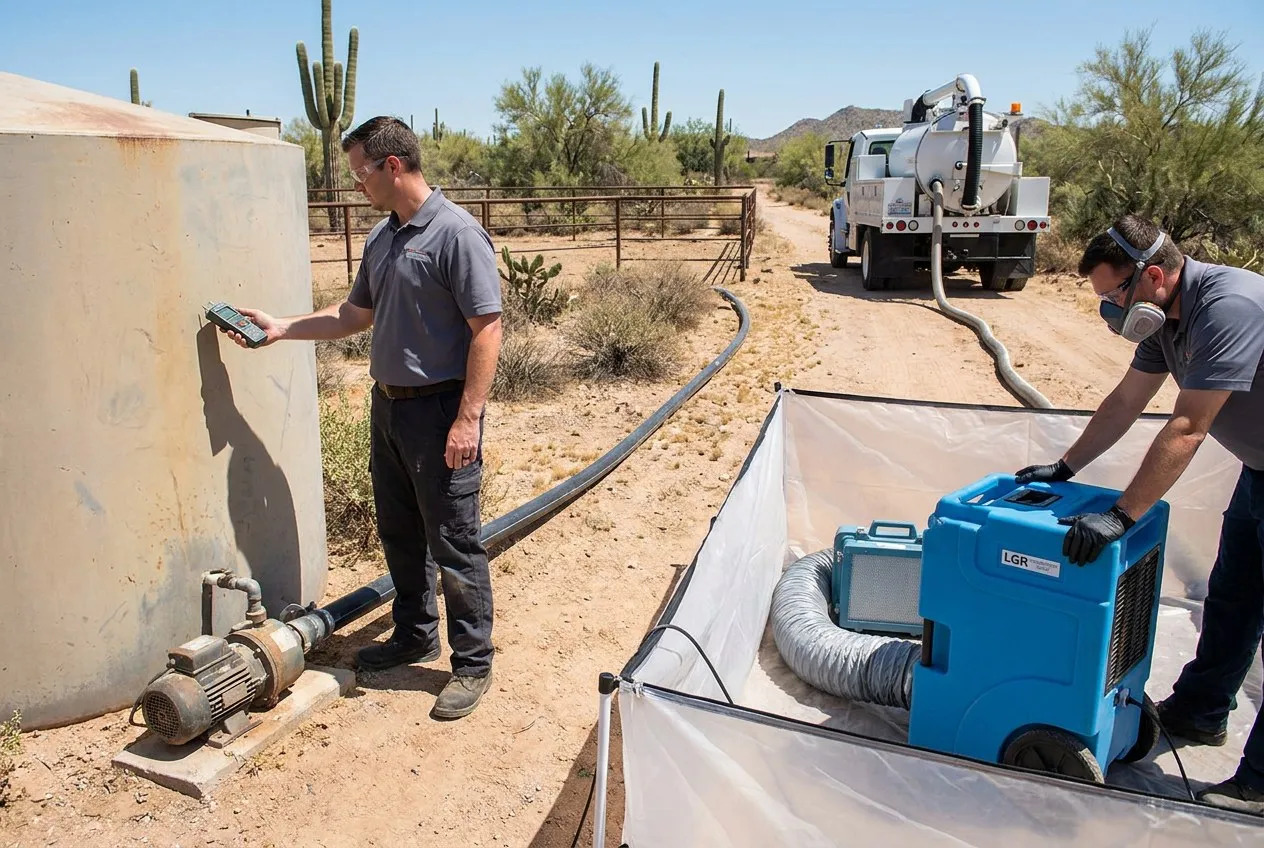
Rio Verde proper and Rio Verde Foothills share a name, a mailing area, and desert geography. They do not share a water or sewer system.
Rio Verde proper is an age-restricted, master-planned golf community with piped water and wastewater. The Foothills are an unincorporated county island of wells, hauled water, storage tanks, and septic systems.
That distinction controls almost every restoration question. A failed common utility line makes sense in Rio Verde proper. It does not exist in the Foothills.
The Fountain Hills restoration page covers the nearest established service-area neighbor. The Scottsdale restoration page covers the city name that appears on many Foothills mailing addresses, even though the Foothills are not Scottsdale.
Which Rio Verde water system applies
| Area | Water | Wastewater | Typical property systems |
|---|---|---|---|
| Rio Verde proper | Piped EPCOR service from local groundwater | Piped EPCOR sewer | Copper-era slab plumbing, some polybutylene-window housing, community utility connections |
| Rio Verde Foothills | Private wells or hauled water delivered to on-site tanks | Septic only | Storage tanks, booster pumps, pressure tanks, long private lines, barns and outbuildings |
Tonto Verde and Trilogy at Verde River are adjacent, distinct communities, not alternate names for Rio Verde proper.
Identify the community before describing a main, sewer, or shutoff.
Rio Verde proper is a piped utility island
Rio Verde proper developed from 1973 around two golf courses. Its 2020 population was 2,210, with a median age of 71.1. One household member must be 55 or older.
EPCOR acquired Rio Verde Utilities in 2019. Local groundwater serves about 2,220 water and 1,876 wastewater connections.
Housing is mainly 1970s through 1990s copper-era slab construction. Later phases may fall within the polybutylene window. Materials are confirmed at the home rather than assumed by community name.
Seasonal vacancy can lengthen discovery. An original water heater, pinhole leak, or failed toilet connection may run through several rooms before a neighbor or manager notices.
The water-heater flooding guide explains that delayed-discovery pattern.
The Foothills water cutoff is resolved, but water still arrives by truck
Rio Verde Foothills contains roughly 2,000 properties. Most use private wells. More than 500 homes once depended entirely on hauled water filled at Scottsdale's standpipe.
Scottsdale ended that access on January 1, 2023 under its drought plan. The deeper cause was the area's wildcat lot-split history. Parcels split fewer than six times avoided subdivision review and did not have to prove a 100-year assured water supply.
Scottsdale approved an interim EPCOR-water pass-through in February 2023. State legislation created a standpipe district that June. The pass-through ended December 31, 2025.
EPCOR opened its own Foothills filling station on January 1, 2026. The crisis is not ongoing. Water still reaches hauled-water homes by truck and enters an on-site storage tank. There are no water mains to those properties.
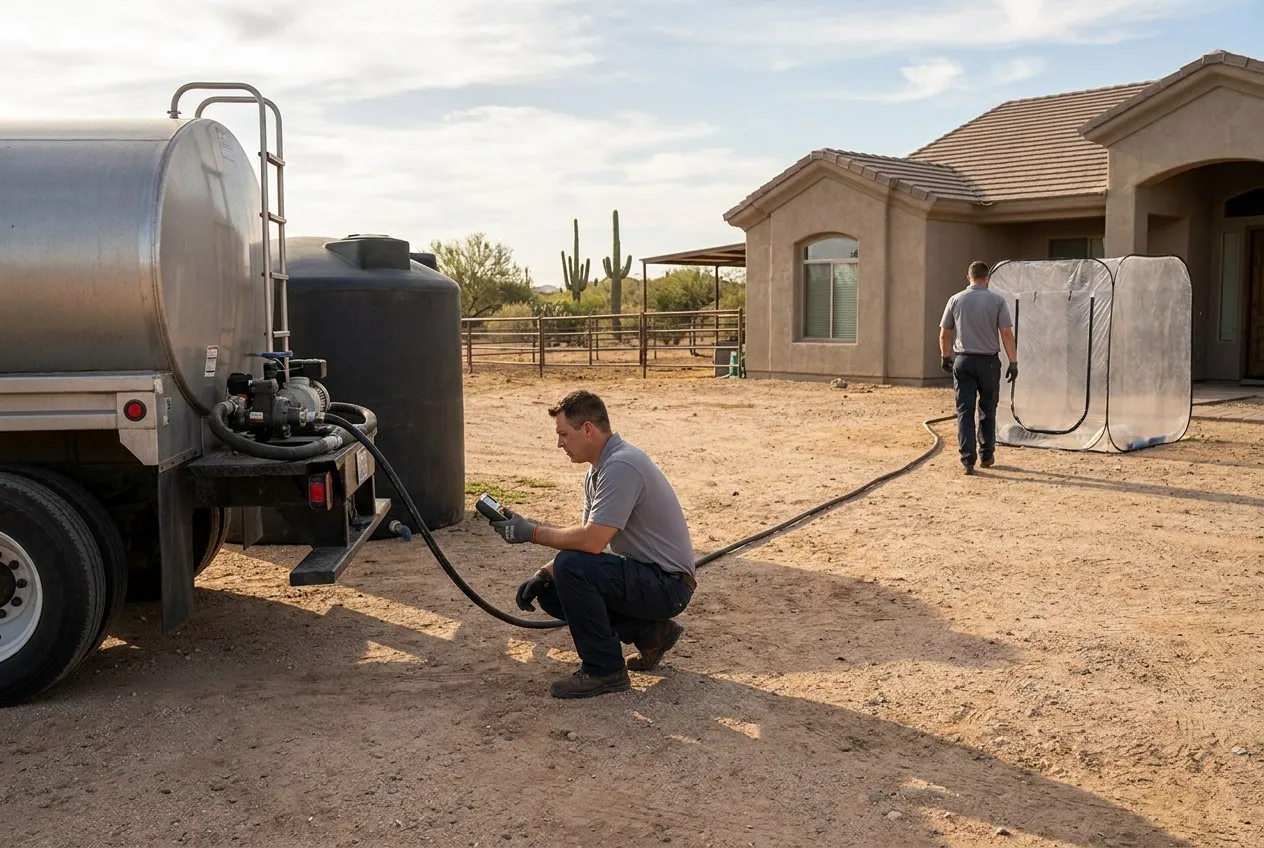
Water Fighters Restoration is Open 24 hours, 7 days. Crews stage as one licensed team, Valley-wide, with the promise on-site within an hour.
Private systems create failure points before the house
A Foothills system may include a well, pressure tank, storage tank, booster pump, filters, and a long supply run. Leaks can lower pressure or saturate soil before reaching the house.
Above-ground sections face constant heat and sunlight. Fittings, supports, and exposed tubing need direct inspection when pressure changes or wet soil appears.
Rio Verde Foothills uses septic systems. Anything from a septic tank, line, or drain backup is Category 3. The sewage cleanup page covers professional containment and drying.
Horse properties add barns, stock-water lines, and detached structures. The inspection follows the private system rather than stopping at the main house.
Access, power, and seasonal occupancy shape the dry-out
Rio Verde proper is roughly 30 to 45 minutes from Scottsdale bases. Foothills dirt roads may become rutted or restricted after storms.
Access does not change the moisture target. It changes equipment delivery, monitoring visits, temporary-power planning, and how supplies reach the site.
Drying equipment needs safe electrical service, not the home's water supply. When utility power is unstable, equipment operates only from an approved source. Temporary power is coordinated with qualified electrical and generator support when conditions allow.
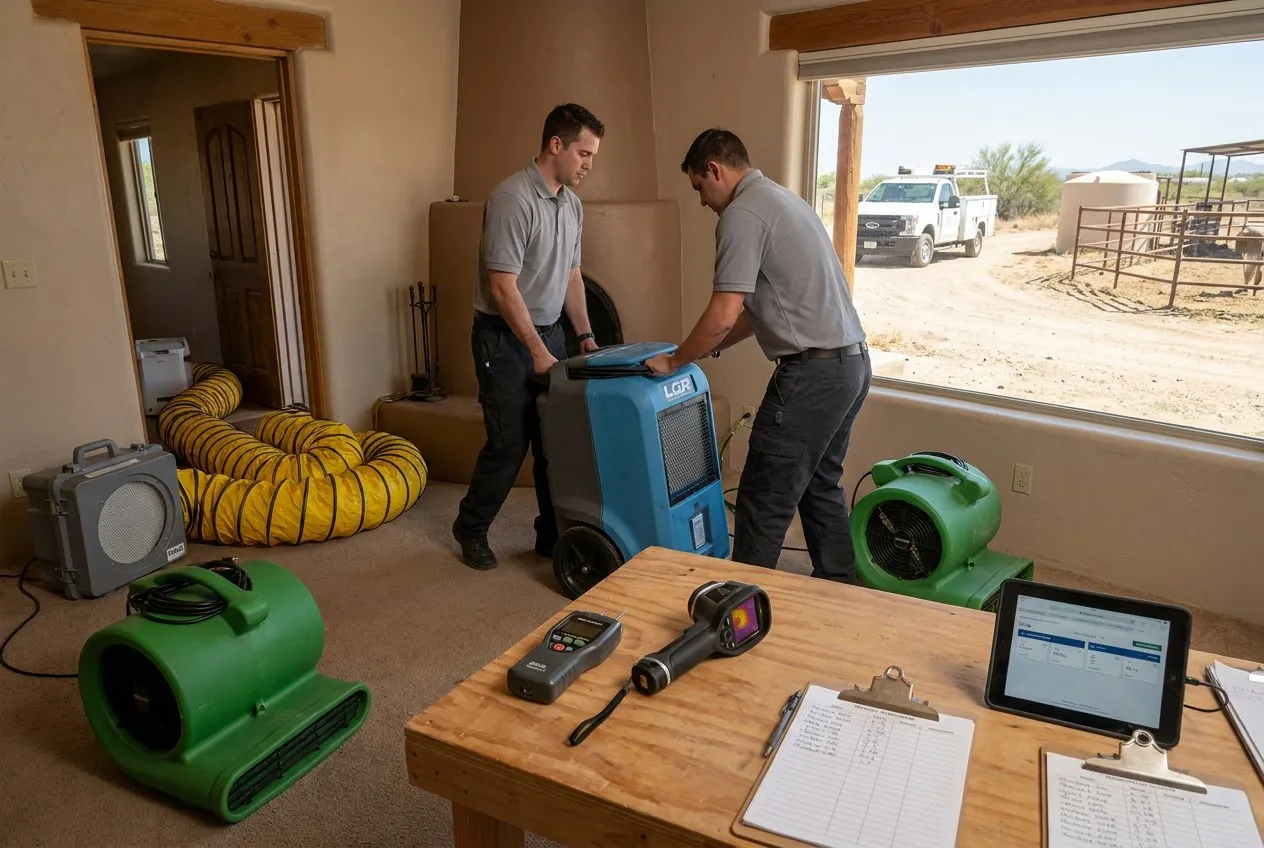
The insurance claim guide helps out-of-state owners organize photos, readings, emergency work, and repair scopes without assuming coverage.
The river and washes need precise language
The Verde River forms the eastern edge of Rio Verde proper, with development set back about seven-tenths of a mile. January 1993 was the river's benchmark twentieth-century flood. March 2023 releases from Bartlett Dam reached 37,000 cubic feet per second.
Those are documented high-flow events, not claims that neighborhood homes flooded. In the Foothills, local storm water moves through unnamed desert washes and across dirt roads toward the Verde.
Water that crosses the ground or a wash before entering a structure is Category 3. The source record should preserve flow direction, sediment, and the opening used by the water.
One team does mitigation and rebuild. That keeps remote approvals and private-system repairs aligned with structural drying and finish work.
Water Fighters Restoration is IICRC Certified 70192944 · AZ ROC 324471 · ROC 324468 · EPA Lead-Safe Certified Firm · Licensed, Bonded & Insured.
Common Questions
What happens when a Rio Verde Foothills storage tank or booster system fails toward the house?
The private line is traced from the tank through the pump and fittings toward the structure. Technicians document where water reached soil, slab, walls, or detached buildings before drying begins.
Does a restoration crew need the home's water supply to dry a hauled-water property?
No. Extraction, air movement, and dehumidification do not depend on household water. The operation can bring the limited work water needed for cleaning while the private supply remains offline.
Can rutted dirt roads change a multi-day dry-out?
Yes, because they can delay equipment delivery and monitoring access. The drying target stays the same, but routes and service visits may change. Record those access interruptions in the insurance claim file.
What keeps drying equipment running during storm power cuts?
Equipment runs only from a safe, approved electrical source. When utility service is unstable, temporary power uses qualified support and unsafe circuits remain off through the storm response.
How often is a sun-cooked above-ground line the cause of a Foothills leak?
No reliable local percentage exists for this area. Heat and sunlight can age exposed components, so technicians inspect them while confirming whether the actual release came from the line, fitting, tank, or pump.