
Wet Carpet After Water Damage in Phoenix
Published October 8, 2026 · Last reviewed October 8, 2026 · Water Fighters Restoration
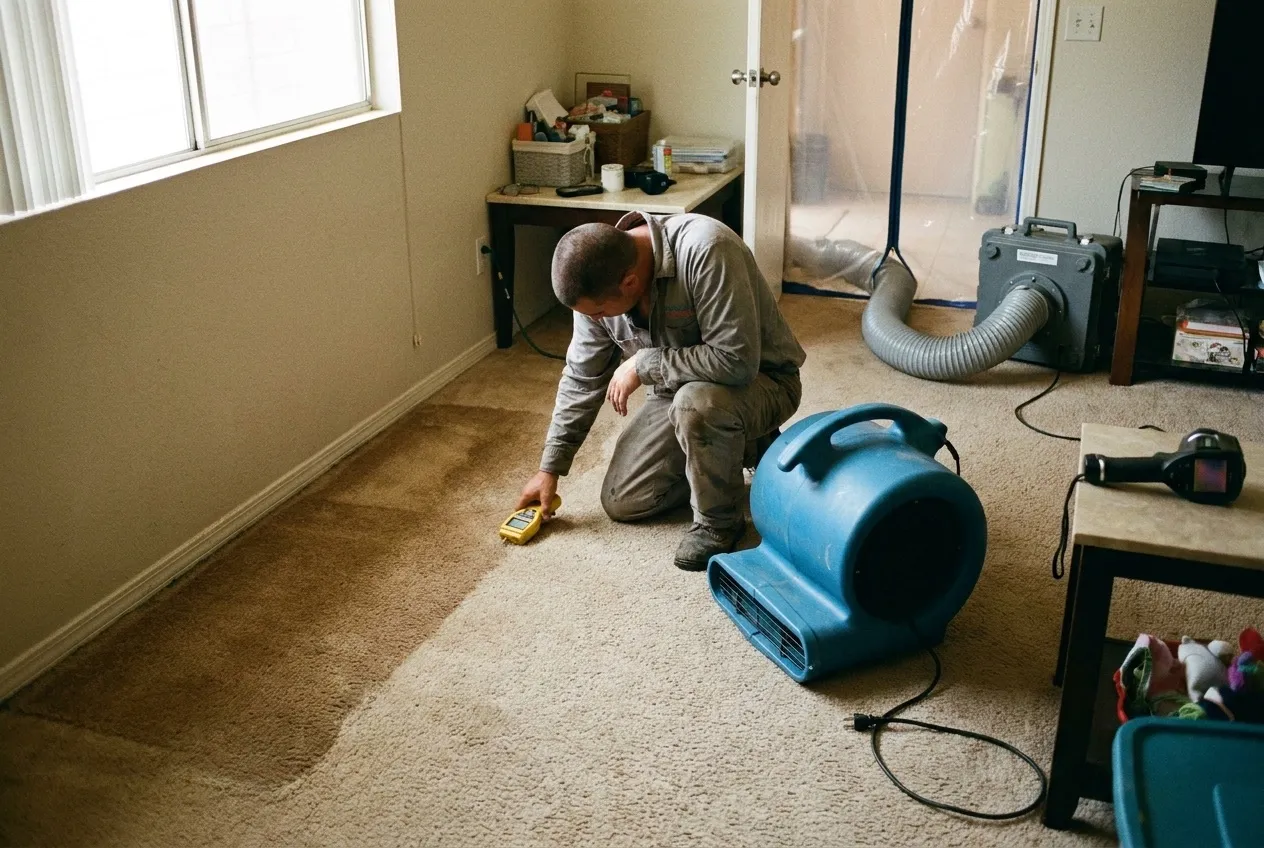
The supply line behind the bathroom wall leaked for a day before anyone noticed. Now the family room carpet along that wall is a shade darker than the rest, and it gives a cold squish under a bare foot three feet out from the baseboard. Wet carpet is really two materials with two separate verdicts. The carpet on top can sometimes be kept, and the pad under it usually can't. The call runs in a fixed order, and the order explains why one layer stays and the other gets bagged.
The five questions, in order
- What category was the water? Clean supply water leaves the carpet in play. Contaminated water takes the pad for certain, and Category 3 takes the carpet too.
- How long did it sit? Northern Arizona University's S500-based guideline says drying carpet may be effective only if it wasn't wet with Category 1 or 2 water for more than 48 hours.
- How much of the pad got wet? Readings set the boundary, and they can run well past the visible mark.
- What did the carpet do while it was wet? A weakened or separated backing can end a carpet the category would have allowed, and browning from below can stain it.
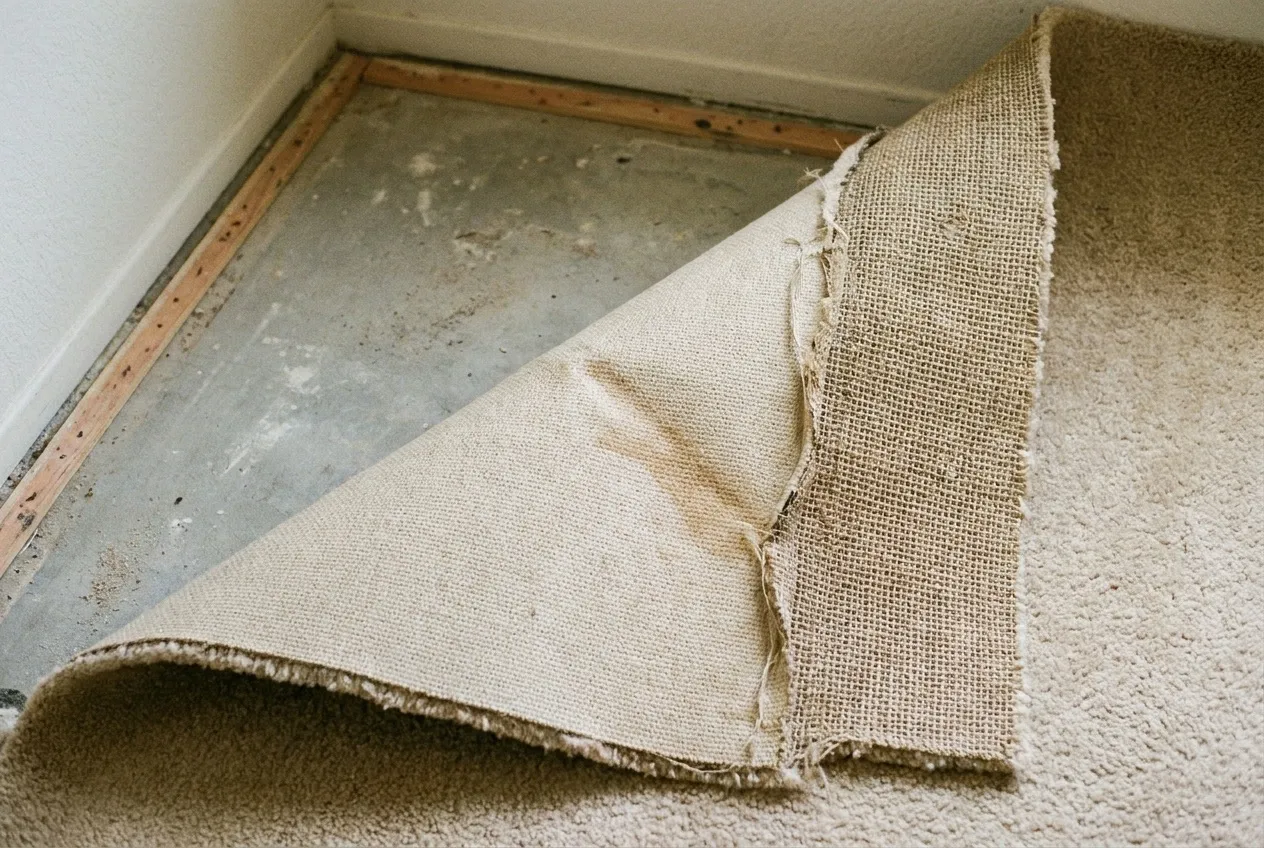
- What's underneath? In many Valley homes it's a concrete slab with wooden tack strip nailed into it, and both have to dry too.
What to do while it's still wet
Stop the water at the fixture valve, or close the house valve where the line enters the home. Leave the curb meter box to your water provider. If the water came from a clean supply line, lift shoes, boxes and papers off the wet carpet, and photograph the wet edge before it moves. Don't run fans across it yet. EPA's cleanup table says not to use fans before determining that the water is clean or sanitary. The same table lists carpet and backing among the materials to dry within 24 to 48 hours. Water Fighters Restoration is Open 24 hours, 7 days, and on-site within an hour.
Category comes first
Category 1 water from a supply line, caught fast, leaves the carpet a drying candidate, and the readings set how much pad comes out. Category 2, such as washing machine or dishwasher discharge, is where sources split. A CleanLink summary of the 2015 S500 says the padding must be replaced but the carpet can be saved. NC State Extension says pad saturated with gray water goes, with no exceptions. Read together, the pad comes out, and the carpet can sometimes be cleaned and kept.
Category 3 ends it. A New Zealand Qualifications Authority unit standard says it flatly: "Carpet affected by category 3 water damage is unsalvageable." The 2021 S500's Category 3 examples include sewage, wasteline backflows from beyond any trap, and rising water from rivers or streams. Outside water that crossed the yard or street is handled as Category 3 as well, which is more cautious than the S500 requires. For Category 2 or 3 water, the S500 says remediation should occur before restorative drying. The sewage cleanup page covers that work, and the categories guide explains the call.
Why the pad usually goes
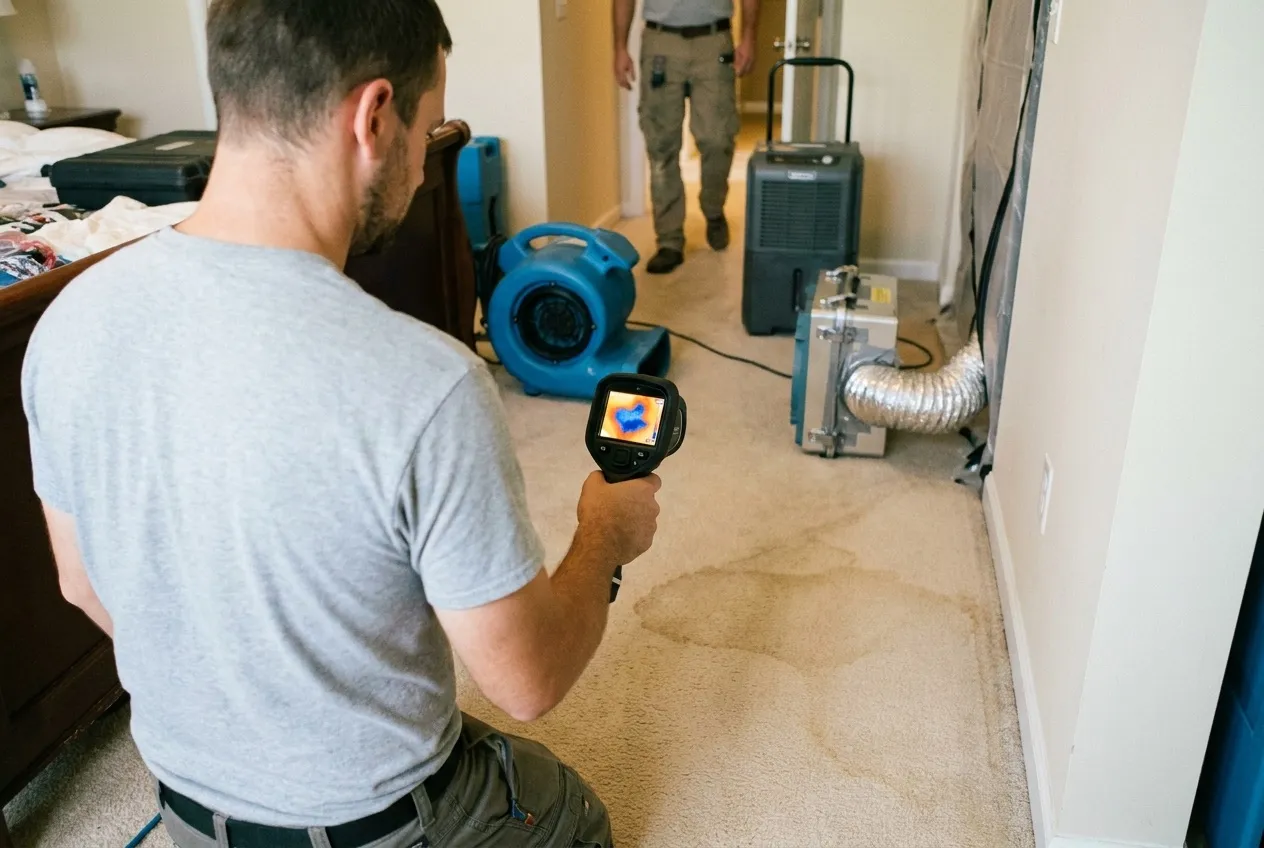
Pad is the more absorbent layer and usually the cheaper one, which is part of why removing it is the default even when the carpet stays. Vacuuming alone won't finish the job. EPA's mold course says wet vacuums alone will not dry carpets, and that the carpet padding also must be dried. How far the removal goes is measured, not guessed. A thermal camera shows where the floor reads cooler than it should, and a meter confirms what's actually wet.
What the carpet does while it's wet
The carpet has failure modes of its own. Its latex backing can weaken when wet, its primary and secondary backings can separate, and browning can come up from the cellulose in the carpet or its base. A weakened or separated backing can turn a carpet the category allowed into a replacement. The questions at the bottom of this page cover each one.
Floating, insurance and the rebuild
Salvageable carpet is often floated: pulled off the tack strip, the pad removed, and air driven beneath it until the readings are dry, then re-stretched. The extraction guide covers getting the water out first, and the drying-time guide explains why concrete runs on a longer clock than carpet.
For the insurance file, the category call, the readings and the photos of the pad are what explain why one layer stayed and the other went. Water Fighters bills the insurance company directly, and the estimate you receive is the same one your insurer receives. One team does mitigation and rebuild, so replacing carpet or pad stays tied to the same water damage restoration file. Water also travels before it shows, and the Sunnyslope page answers how a bathroom leak ends up in the hallway carpet.
Preventing the next one
Carpet never starts the leak. A supply line, a washer hose or a water heater near it does, and the washing machine and water heater guides cover those sources. Find your house valve now, where the line enters the home, so the next leak runs for less time.
Common Questions
The carpet is wet only along one wall. Does the pad come out of the whole room?
It comes out where the readings say it's wet, which may or may not be the whole room. The extent is measured with meters and a thermal camera, not guessed from the visible mark. NC State Extension says clean-water pad wet for less than 48 hours can be restored when only part of the room's pad is wet. Pad saturated with gray or black water goes, with no exceptions.
Is it OK to walk on carpet while it's drying?
Keep traffic off it as much as you can. NC State Extension notes that moisture can weaken the latex backing, and that walking on wet carpet can cause the backing to separate. A separated backing is one of the failures that can turn a salvageable carpet into a replacement.
Brown stains showed up on the carpet after it dried. What are they?
Often cellulosic browning. A New Zealand unit standard defines it as browning from chemical reactions between water and cellulose in the carpet or carpet base. That's why it can appear after drying with nothing spilled on top. It's a cleaning question if the water was clean, and a removal question if the water was Category 3.
Our carpet sits on a concrete slab. Does the slab have to dry too?
Yes. EPA's cleanup table says the subfloor under carpet "must also be cleaned and dried." Concrete is a low-evaporation material in the S500 class system, and significant absorption into it makes a Class 4 loss, where drying may take longer. The tack strip nailed into that slab can stay wet after the carpet face feels dry, which is why readings go down to the concrete.
The carpet ripples now that it's dry. Is it ruined?
Not always. Rippling can be slack, and properly installed residential carpet goes in with a power stretcher, so slack can be stretched back out. It can also be delamination, where the bond between the primary and secondary backing has broken down, and that usually ends the carpet. Telling the two apart takes a look at the backing, not a guess from across the room.